You’re currently paying nothing for Shopify Email. A Klaviyo rep or an agency just told you that you’re leaving revenue on the table. Maybe that’s true. Maybe it isn’t. Most articles on this topic are written by Klaviyo partner agencies that earn a commission on every Klaviyo setup — so the recommendation almost always points the same direction.
digitalsprung is a Shopify partner, not a Klaviyo partner. There’s no commission either way. That’s the starting point for this article: a calculation, not a sales pitch.
Klaviyo vs. Shopify Email: The Core Difference in One Sentence
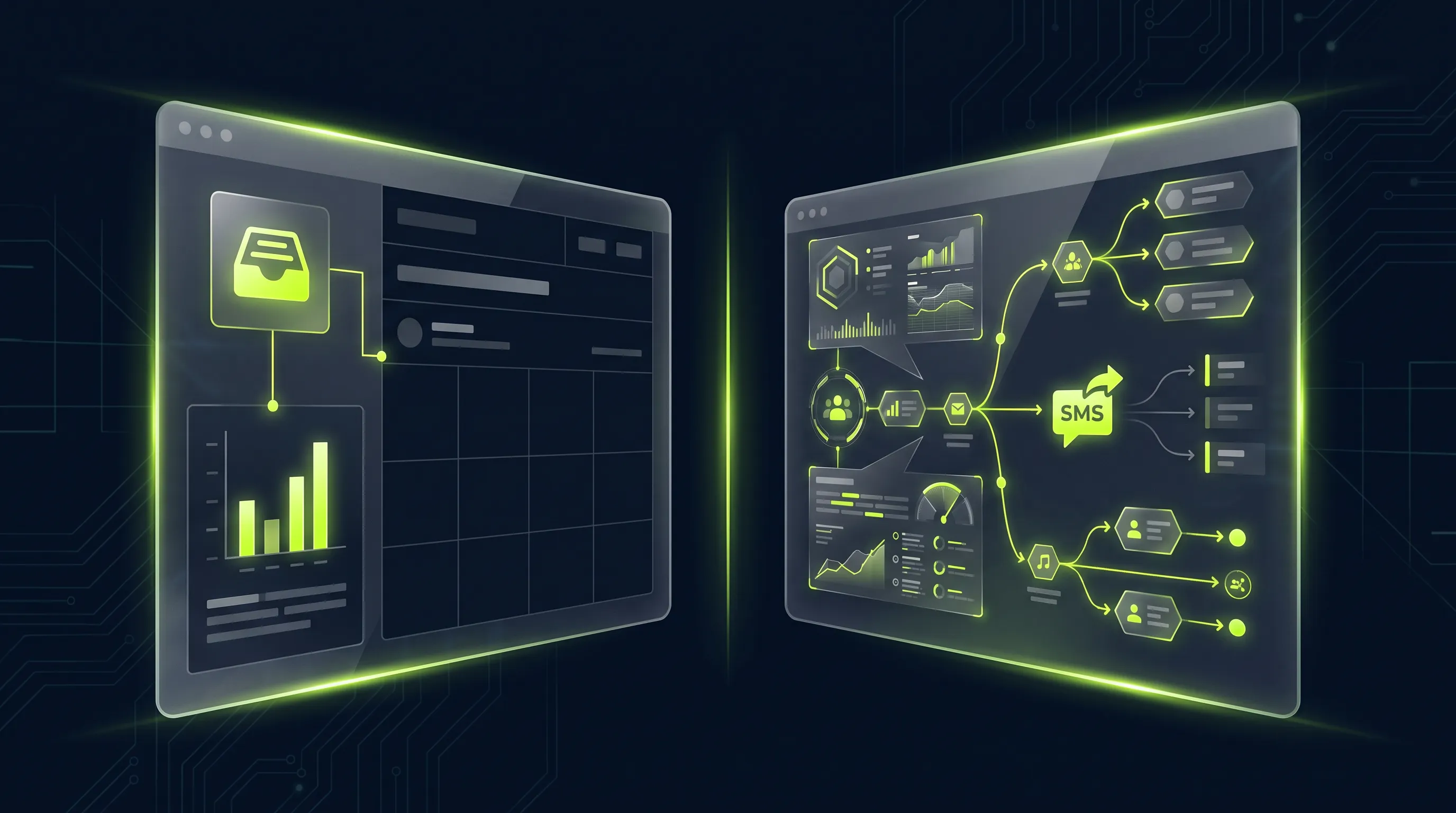
Shopify Email is Shopify’s free, native campaign and basic-automation tool for merchants who want to send emails with minimal effort. Klaviyo is a dedicated marketing automation platform with deep segmentation, complex multi-channel flows (email plus SMS), and predictive models — built for merchants who want to run email as an independent, data-driven revenue channel, not as a side feature of the store.
So the difference isn’t “better” versus “worse” in a quality sense. It’s a difference in ambition. If you treat email marketing as a box to check, Shopify Email usually serves you well. If you want to build email into your second-largest revenue channel after the store itself, Shopify Email eventually hits limits no pricing update will fix.
What Is Shopify Email?
Shopify Email is the native email marketing tool inside the Shopify admin, with no separate account or app install. It includes a drag-and-drop editor with Shopify product blocks, basic segmentation by order behavior, and pre-built automations for standard cases like welcome emails, cart abandonment, and order confirmations. The first 10,000 emails per month are free; after that, sending is billed on a tiered basis.
What Is Klaviyo?
Klaviyo is a standalone customer data platform with integrated email and SMS marketing that connects to your store via the official Shopify app, syncing order, product, and behavioral data in real time. It offers over 60 pre-built automation flows, granular segmentation on any data point, flow-level A/B testing, and AI-driven predictive models (e.g., for purchase likelihood or churn risk). Billing is based on the number of active profiles in the account, not on send volume.
Feature Comparison: Klaviyo vs. Shopify Email in Detail
| Criterion | Shopify Email | Klaviyo | Advantage |
|---|---|---|---|
| Pricing model | By send volume (emails/month) | By number of active profiles | Depends on engagement patterns |
| Segmentation | Basic (order behavior, tags) | Granular, any data point, nested conditions | Klaviyo |
| Automation flows | Pre-defined standard cases | 60+ flow templates, freely combinable, multi-step branching | Klaviyo |
| SMS marketing | Not integrated | Natively integrated, shared segments with email | Klaviyo |
| A/B testing | Not available | At campaign and flow level | Klaviyo |
| Predictive models (AI) | Not available | Purchase likelihood, churn risk, CLV prediction | Klaviyo |
| Reporting depth | Open/click rate, revenue per campaign | Per-flow revenue attribution, cohort analysis, custom reports | Klaviyo |
| Setup effort | Minimal, ready immediately | Moderate to high, requires initial segment and flow configuration | Shopify Email |
| Learning curve | Very low | Moderate, especially for complex segmentation | Shopify Email |
| Data connection to store | Native (same system) | Real-time sync via app, very granular | Roughly equal |
| Multi-store capability | Per store, separately | One account can pool multiple Shopify stores | Klaviyo |
| Free entry point | 10,000 emails/month, permanently free | Up to 250 profiles / 500 emails, then paid | Shopify Email |
What this table doesn’t show, but matters just as much: Klaviyo isn’t simply a “premium version” of Shopify Email. It’s a different category of tool. If you introduce Klaviyo without actually using its segmentation and flow logic, you’re paying for functionality you never call on. That’s the most common mistake I see in Klaviyo rollouts.
The 5 Most Important Automation Flows Compared
| Flow | Shopify Email | Klaviyo |
|---|---|---|
| Welcome series | Single email or simple 2-3 step series | Multi-step series with behavioral branching (e.g. based on click behavior) |
| Cart abandonment | One standard reminder, fixed delay | Multi-step series with dynamic product recommendations and optional SMS fallback |
| Browse abandonment (product view without purchase) | Not available | Fully supported, incl. segmentation by viewed category |
| Post-purchase / cross-sell | Simple follow-up email possible | Triggered by product category, purchase history, and time delay |
| Win-back (inactive customers) | Achievable manually via segments, no dedicated flow | Dedicated flow with reactivation incentives and exclusion logic |
The gap is clearest in browse abandonment: Shopify Email can react to an abandoned cart, but not to a product view with no cart action at all. For stores with high product-page dwell time and a low add-to-cart rate, that’s a structural blind spot only a platform like Klaviyo covers. For how win-back flows translate into retention economics, see the article on churn rate in e-commerce, which works through the EBITDA impact of a retention improvement.
What Does It Actually Cost? The Honest Math
The cost structures of the two systems work fundamentally differently, and that’s exactly where many comparison articles blur the picture.
Shopify Email bills by send volume: the first 10,000 emails per month are permanently free, then 1 USD per 1,000 emails, dropping to 0.65 USD per 1,000 above 300,001 emails, and 0.55 USD per 1,000 above 750,001 emails.¹
Klaviyo bills by active profiles in the account — regardless of how often you actually contact them. Since February 18, 2025, every profile marked active in the account counts, not just profiles contacted within the prior 90 days as before.² That’s an important shift: if you don’t regularly clean your list, you pay for inactive dead weight.
| Active Profiles / Subscribers | Shopify Email (approx.) | Klaviyo (approx.) | Difference |
|---|---|---|---|
| Up to 250 | Free | Free (Free plan) | No difference |
| 1,000 | Free up to ~10,000 emails | ~$30/month (~€28) | Klaviyo pricier, but flow depth available |
| 5,000 | Free up to ~10,000 emails, then tiered | ~$75-100/month (~€70-95) | Klaviyo moderately pricier |
| 10,000 | ~$30-50/month depending on frequency | ~$150/month (~€140) | Comparable order of magnitude |
| 50,000 | ~$150-250/month depending on frequency | ~$720/month (~€665) | Klaviyo significantly pricier |
| 250,000 | ~$700-1,100/month depending on frequency | ~$2,300/month (~€2,130) | Klaviyo significantly pricier |
What follows from this: looking purely at send costs, Klaviyo gets relatively more expensive as list size grows. But that’s the wrong comparison to make. The relevant question isn’t “what does sending cost,” but “what does the extra automation depth generate in revenue — and does that exceed the extra cost.” That needs a different calculation.
When Is Switching Actually Worth It? The Break-Even Formula
Almost every comparison article names a subscriber threshold for switching to Klaviyo — usually somewhere between 500 and 2,000 subscribers, with no traceable reasoning behind it. The problem: subscriber count alone says nothing about the economics. A store with 500 subscribers and €60,000 in monthly revenue is in a completely different position than one with 500 subscribers and €8,000 in monthly revenue.
The actually relevant calculation is simpler than the borrowed thresholds suggest: how much additional revenue uplift from better automation is needed for Klaviyo’s extra cost over Shopify Email to pay for itself?
Formula: Required Revenue Uplift (%) = Klaviyo Extra Cost per Month ÷ Monthly Revenue × 100
A worked example makes the effect clear: at 10,000 active profiles and roughly €140 in Klaviyo cost per month, a store with €40,000 in monthly revenue needs just 0.35 percent of additional revenue uplift from better automation to cover the extra cost. For a smaller store with €8,000 in monthly revenue, the required threshold sits at 1.75 percent — still low, but a different order of magnitude.
The practical takeaway: above a certain revenue level, the break-even threshold is so low that a single flow that actually works (browse abandonment, or a better-segmented cart abandonment sequence) typically covers the cost on its own. The real risk isn’t the cost — it’s whether the flows are actually set up properly and maintained after the switch. Klaviyo doesn’t get expensive because the tool is expensive. It gets expensive when it sits next to Shopify Email, unused.
GDPR, Data Transfers, and What European Merchants Actually Need to Check
Many comparison articles either skip the GDPR question entirely or handle it with blanket alarmism (“Klaviyo isn’t GDPR-compliant”). Both are inaccurate.
Is Klaviyo GDPR-Compliant?
Klaviyo is self-certified under the EU-U.S. Data Privacy Framework (DPF) and additionally relies on Standard Contractual Clauses (SCCs) in its Data Protection Addendum.³ The DPF is the successor to the Privacy Shield framework struck down by the CJEU in 2020, and since 2023 it governs legally permissible data transfers to the US for certified companies. For stores without sector-specific requirements, that makes Klaviyo generally usable in a GDPR-compliant way — provided the data processing agreement is properly executed and your own privacy policy is updated accordingly.
What remains: the DPF itself is under ongoing legal scrutiny, similar to Privacy Shield before it was struck down. For merchants in heavily regulated sectors (healthcare, financial services) or with an internal compliance policy against any US data transfer, this remains a relevant risk factor regardless of Klaviyo’s certification.
Shopify Email and Data Processing
Shopify Email processes customer data within Shopify’s existing infrastructure, which has used EU data centers in Frankfurt and Dublin since 2023. No additional third-party data flow is created, because no separate system is connected. If you want to keep data flows to a minimum, Shopify Email structurally has less to review — not because Klaviyo is less secure, but because every additional tool brings additional review obligations.
Double Opt-In: Required or Not?
A common misconception: double opt-in isn’t named word-for-word as a legal requirement under German law. What actually applies is stricter in practice: under Germany’s Unfair Competition Act (§ 7 UWG), email advertising without prior explicit consent is prohibited, and the burden of proving that consent lies with the sender. Germany’s Federal Court of Justice has repeatedly confirmed that double opt-in is the most reliable proof of valid consent.⁴ Without that proof, cease-and-desist letters and fines are a real risk — regardless of whether you use Shopify Email or Klaviyo. Both tools support double opt-in technically; setting it up correctly remains the merchant’s responsibility, not the tool’s.
When Is Shopify Email Genuinely Enough?
This is the question answered least honestly, because it doesn’t create an upsell argument.
Shopify Email is enough if email marketing is a communication channel for you, not your second revenue channel. Concretely: if you mainly send newsletters about new products and promotions, a working cart-abandonment reminder is sufficient, and you don’t have the capacity to actively maintain segments and flows, Shopify Email isn’t leaving meaningful revenue on the table. Switching to Klaviyo in that case mostly delivers one thing: higher cost for unused depth.
Even for very small lists under roughly 1,000 profiles, the Klaviyo premium is rarely justified by additional revenue as long as the basics — welcome series, cart abandonment — aren’t even properly set up yet. In that case, the first investment isn’t the tool, but the time it takes to actually configure the existing standard flows in Shopify Email.
Switching becomes relevant once one of these applies: you want SMS as a second channel alongside email, your product catalog supports genuine behavioral segmentation (e.g., by category interest), or you already have several thousand active profiles where granular segmentation measurably increases relevance per email.
Migration Checklist: From Shopify Email to Klaviyo
Technically connecting Klaviyo to Shopify through the official app is straightforward and usually takes a few hours. The real pitfalls lie elsewhere, especially for European merchants:
- Secure your double opt-in proof. Before migrating, export each subscriber’s consent timestamp and opt-in source from Shopify. Without this record, you lose the ability to prove valid consent in a dispute, regardless of which tool you’re using.
- Limit the parallel-run period. During the transition, both systems often run simultaneously. Fully disable Shopify Email’s standard flows (cart abandonment, welcome series) once the corresponding Klaviyo flows go live — otherwise customers receive duplicate, contradictory messages.
- Plan segmentation before the import. Don’t import your entire contact list unsegmented. Use the import to separate contacts by purchase history, activity, and consent status from day one — cleaning it up afterward is significantly more work.
- Check consent requirements for tracking. Klaviyo’s on-site behavioral tracking script (product views, browse abandonment) falls under cookie/tracking consent requirements in most European jurisdictions (in Germany, § 25 TTDSG). That needs to be correctly reflected in your cookie consent tool before the tracking code goes live.
- Clean up inactive profiles before importing. Since Klaviyo bills by active profiles, every uncleaned dead contact costs money directly. Running a cleanup pass before migration lowers ongoing costs immediately.
- Configure sender authentication correctly. SPF, DKIM, and DMARC records need to be set for the new sending infrastructure, or you risk deliverability problems right after the switch.
Common Mistakes When Switching to Klaviyo
The most common mistake isn’t technical, it’s structural: Klaviyo gets introduced, but the flows never get touched again after initial setup. A cart-abandonment flow that’s configured once and never optimized again delivers barely more than the Shopify Email default over the long run, at a significantly higher cost.
The second common mistake: segmentation stays too broad (“all customers,” “all newsletter subscribers”), which means Klaviyo’s actual advantage — granular relevance — never gets used. If you keep sending the same message to everyone after migrating, you’ve really just increased costs, not changed strategy.
The third mistake concerns expectations: Klaviyo doesn’t automatically improve email performance. It makes better segmentation and automation possible — someone on the team still has to use it. For how this automation depth plays out on customer lifetime value over time, see the article on customer lifetime value for Shopify stores, which works through the calculation in detail.
Frequently Asked Questions About Klaviyo vs. Shopify Email
What’s the difference between Klaviyo and Shopify Email?
Shopify Email is the free, native campaign tool inside the Shopify admin with basic automation. Klaviyo is a standalone marketing automation platform with granular segmentation, 60+ flow templates, integrated SMS marketing, and AI-driven predictive models. Shopify Email bills by send volume, Klaviyo by number of active profiles.
What does Klaviyo cost at 10,000 contacts?
At roughly 10,000 active profiles, Klaviyo’s tier runs about $150 per month (as of Q3 2026, per klaviyo.com/pricing). For comparison, Shopify Email is free up to 10,000 emails per month, then billed at $1 per additional 1,000 emails.
Is Klaviyo GDPR-compliant?
Klaviyo is self-certified under the EU-U.S. Data Privacy Framework and additionally uses Standard Contractual Clauses in its data processing agreement. For most European merchants, that makes Klaviyo usable in a GDPR-compliant way. For merchants with a hard compliance policy against any US data transfer, the DPF remains a risk factor, since comparable frameworks have been struck down by courts before.
How many subscribers do you need for Klaviyo to pay off?
There’s no universally correct subscriber count. What matters is the ratio between Klaviyo’s extra cost and monthly revenue: for most stores above roughly €20,000 to €30,000 in monthly revenue, the required additional revenue uplift from better automation is so small (often under 1 percent) that switching pays for itself through a single well-functioning flow.
Can I run Klaviyo and Shopify Email in parallel?
Technically yes, but only recommended for a short transition window during migration. In ongoing operation, Shopify Email’s standard automations (cart abandonment, welcome series) should be disabled once the corresponding Klaviyo flows are active, to avoid sending customers duplicate or contradictory messages.
Is double opt-in required for Shopify Email and Klaviyo?
Double opt-in isn’t named word-for-word as a legal requirement under German law, but under § 7 UWG the sender must be able to prove explicit consent for email advertising. Germany’s Federal Court of Justice has repeatedly confirmed double opt-in as the most reliable proof. Both tools support double opt-in technically — setting it up correctly remains the merchant’s responsibility.
Does Klaviyo make sense for a small store with under 1,000 subscribers?
Usually not right away. For very small lists, the Klaviyo premium is rarely justified by additional revenue, especially if the standard automations in Shopify Email aren’t even fully configured yet. It’s worth setting up the free Shopify Email flows properly first, before considering a switch.
Conclusion: Klaviyo or Shopify Email, the Honest Recommendation
There’s no universal answer, but there is a reliable calculation. Shopify Email is the right choice as long as email is a communication channel for you alongside the store, not your second-largest revenue driver. Klaviyo pays off once your monthly revenue is large enough that the required uplift percentage from the break-even formula becomes small, and once you actually have the capacity to maintain segments and flows rather than setting them up once and forgetting about them.
What this decision isn’t: a matter of prestige, or a recommendation that applies uniformly to every store. If you introduce Klaviyo without using its automation depth, you’re paying for a tool you’re effectively running as a more expensive Shopify Email. If you stay on Shopify Email while browse-abandonment and SMS channels would measurably generate revenue, you’re giving up a lever that pays for itself quickly in most cases.
If you want to work through this decision concretely for your own store, with real numbers instead of borrowed thresholds: I have these conversations independently of both vendors, with no commission riding on either direction.
References
- Shopify. (2023). Volume pricing for Shopify Email. changelog.shopify.com/posts/volume-pricing-for-shopify-email
- Klaviyo. (2026). Klaviyo Pricing. klaviyo.com/pricing — Shift to active-profile billing effective February 18, 2025.
- Klaviyo. (2026). Klaviyo and GDPR: What You Need to Know. klaviyo.com/gdpr — Data Privacy Framework certification and Standard Contractual Clauses.
- e-recht24. (2026). Ist das Double-Opt-in-Verfahren Pflicht? e-recht24.de/datenschutz/13333-double-opt-in-verfahren.html — Legal basis under § 7 UWG and German Federal Court of Justice rulings.