The global B2B e-commerce market crossed $30 trillion in 2025. Forecasts put it at $44.5 trillion by 2029. At the same time, studies consistently show that 80% of mid-market digitalization projects fail to deliver the promised value.
That gap has a root cause: most companies choose their platform based on feature lists. They compare capabilities that every enterprise solution promises. What they don’t compare is the underlying architecture — and that’s exactly what determines whether a system holds up in three years or needs to be replaced.
This article isn’t a product catalog. It’s a structured decision framework for CTOs, IT directors, and business leaders who need to make a platform choice that has to hold for seven to ten years.
What Makes a Real Strategic Comparison
Most B2B shop system comparison articles are, at their core, marketing material — either directly from vendors or from agencies with a preferred platform. They display features in tables, check boxes, and conclude that every platform works for everyone as long as you buy the enterprise edition.
This comparison takes a different approach. It asks three questions that rarely get asked:
- What business model is this platform architecturally built for? Not: what can it do with customization — but what can it do without?
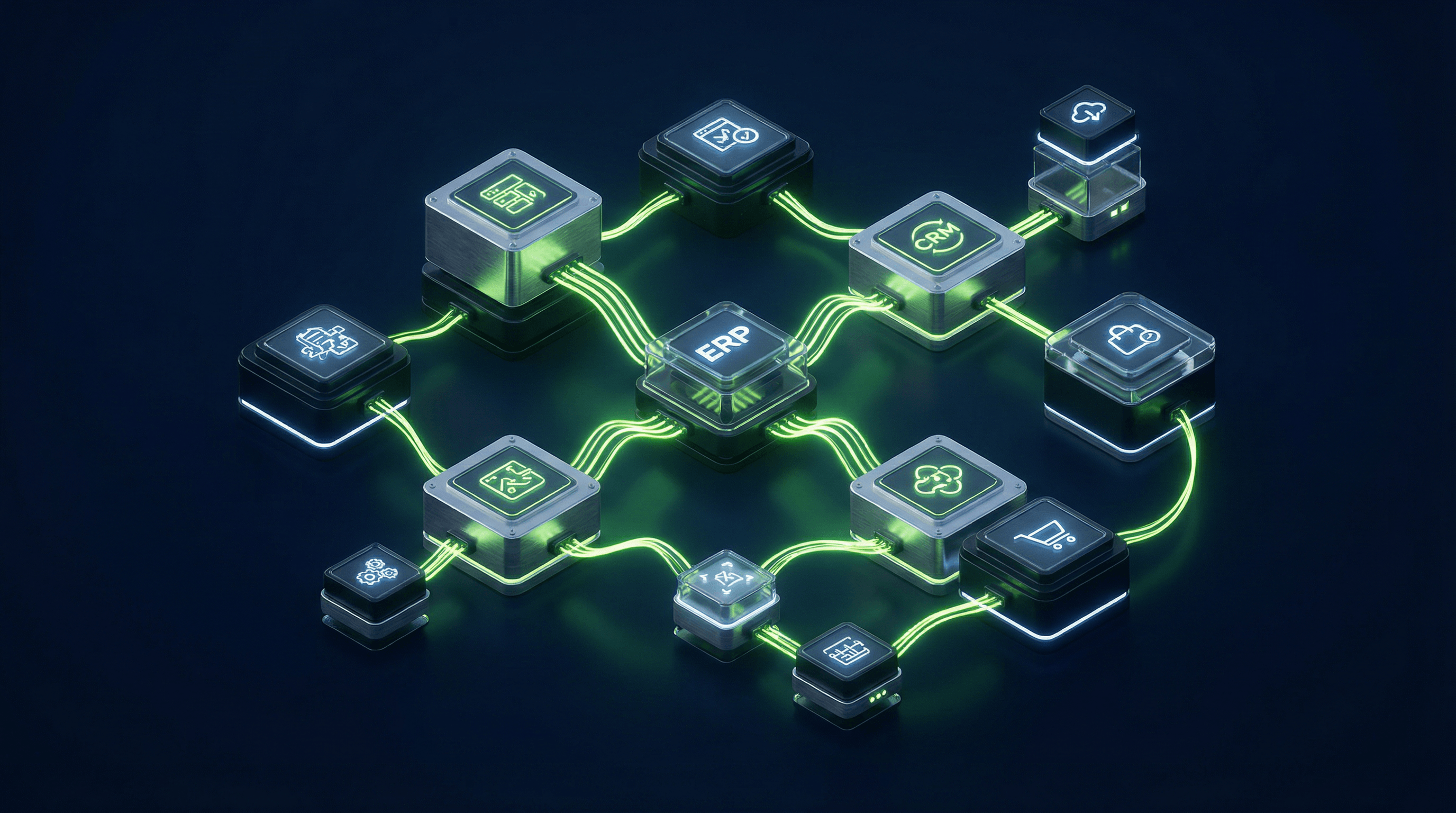
- Where does the integration ceiling hit? B2B commerce runs on ERP, PIM, and CRM. According to ECC Cologne, 42% of all B2B companies face serious difficulties connecting these systems to their storefront.
- Will this platform still be relevant in three years? Agentic Commerce — autonomous AI-driven procurement — will, per Forrester projections, account for 20% of all B2B transactions by 2027. Companies that choose a platform today that isn’t machine-readable will be structurally locked out.
The Three Architecture Types in B2B E-Commerce
Before evaluating individual platforms, one foundational distinction matters. Every system on the market falls into one of three architecture types — and that type determines long-term viability more than any single feature.
Type 1: Monolithic
Frontend and backend are tightly coupled. Changes to checkout affect product management. Updates require full regression testing. This type offers the shortest time-to-market at launch and the highest follow-on costs as complexity grows.
Typical examples: Shopware 5 (legacy), older Magento 1 installations, most custom-built legacy systems.
Type 2: SaaS with B2B Extensions
A managed platform that’s continuously maintained. Updates run automatically. Scaling is built in. The trade-off: less control over infrastructure, vendor dependency, and B2B functionality that was often bolted on rather than built in from day one.
Typical examples: Shopify Plus, BigCommerce B2B Edition.
Type 3: API-First, Composable, or Headless
Frontend and backend are fully decoupled. Individual functions — pricing logic, checkout, product data management — can be replaced independently. Maximum flexibility at maximum complexity. Not the right fit for every company, but the only model that scales long-term without replatforming.
Typical examples: commercetools, Spryker, Shopware 6 (API-first mode), OroCommerce (modular).
The Platforms — An Honest Assessment
Shopware 6
Shopware is the most widely used platform for B2B companies with a growth focus in the DACH region (Germany, Austria, Switzerland). With a 14.9% market share in Germany and an API-first architecture since version 6, Shopware has evolved from a pure SMB tool into a credible enterprise option. Since 2023, Shopware holds the highest market share among all platforms for companies with over €60M in annual revenue in Germany.
Architecture: API-first, optionally headless. The B2B Suite is available from the Enterprise Edition and covers company hierarchies, individual price lists, approval workflows, and quote processes natively.
Pricing: Rise from €600/month, Evolve from €2,400/month, Beyond from €6,500/month.
Strengths:
- Strongest ecosystem in the DACH market (agencies, extensions, community)
- Solid headless capabilities without a full architecture overhaul
- Active roadmap with a clear B2B focus (Agentic Commerce Alliance, AI integration since 2025)
- Flexible deployment: SaaS and self-hosted both supported
Best fit for: Mid-market companies in the DACH region with complex B2B requirements that don’t run SAP and need a scalable platform for 5–8 years. Also a good fit for companies that want to gradually move toward Composable Commerce without committing to a full architectural break upfront.
Honest caveat: The B2B Suite requires the Enterprise Edition — which means you pay for it. Additionally, scalability at very high transaction volumes (well above €100M GMV) is less battle-tested than SAP or commercetools.
Shopify Plus
Shopify Plus is the enterprise offering from the world’s most widely deployed e-commerce platform. It’s built for high-growth companies that prioritize speed and low operational complexity over maximum configurability.
Architecture: SaaS, optionally headless via Hydrogen/Oxygen. Native B2B functionality was added in 2022–2023 (Shopify B2B), but still doesn’t cover all enterprise requirements out of the box.
Strengths:
- Fastest time-to-market of any platform in this comparison
- Excellent performance and infrastructure (CDN, checkout optimization)
- Active ecosystem with thousands of apps
- Lowest operational complexity
Best fit for: Companies running B2B e-commerce with standardized processes — meaning no highly individualized pricing logic, complex approval chains, or deeply integrated ERP connections. Ideal for businesses that need to go live fast and value speed over flexibility.
Honest caveat: Shopify Plus is a B2C platform with B2B extensions, not the other way around. Customer-specific price catalogs, complex user roles, and custom procurement workflows often require third-party apps that collectively add $500–$2,000+ per month. The per-buyer licensing on certain B2B features is an additional cost factor that competitors like Shopware don’t charge. Anyone looking to handle genuine B2B complexity should run a thorough total cost analysis first.
Adobe Commerce (formerly Magento)
Adobe Commerce is historically the reference platform for complex B2B e-commerce implementations. Gartner places it in the Magic Quadrant as a Leader; Forrester classifies it as a Strong Performer. The open-source Magento foundation is layered with a paid enterprise version that includes native B2B functionality.
Architecture: PaaS (Adobe Commerce Cloud) or on-premises. Monolithic core with an API layer, but not a true API-first system.
Strengths:
- Comprehensive native B2B features out of the box
- Strong marketplace ecosystem with tens of thousands of extensions
- Multi-store and multilingual support for international requirements
- Proven platform with a large developer community
Best fit for: Companies with complex B2B scenarios that aren’t running SAP and need deep customization. Particularly strong in manufacturing, automotive supply chains, and wholesale distribution.
Honest caveat: Adobe Commerce has a well-documented upgrade problem. The Magento 1 to Magento 2 migration cost the industry dearly — and anyone choosing Adobe Commerce today needs to factor that risk in. The platform also requires an experienced development agency for ongoing operation and evolution, which significantly inflates total cost. For complex projects, time-to-market is considerably longer than SaaS alternatives.
SAP Commerce Cloud
SAP Commerce Cloud is the go-to choice for large enterprises already running within the SAP ecosystem. Seamless integration with SAP S/4HANA, SAP CRM, and other SAP modules is its primary competitive advantage — and usually the main reason companies choose it.
Architecture: Enterprise SaaS on SAP Business Technology Platform. Microservices-capable, but with substantial implementation overhead.
Strengths:
- Deepest SAP integration on the market (real-time data synchronization)
- Robust scalability for very high transaction volumes
- Strong fit for complex B2B procurement and supplier models
- Enterprise-grade security and compliance
Best fit for: Companies at roughly $250M+ in annual revenue running SAP as their core ERP and benefiting from a unified SAP landscape. Not a viable option for companies without a SAP backbone — the implementation overhead is disproportionate.
Honest caveat: Gartner rates SAP Commerce Cloud as a Leader. Forrester, however, rates the B2B solution more critically — noting that SAP didn’t participate in the full evaluation process. The contract and pricing process is widely considered complex and opaque. Initial investment is substantial. For companies without a SAP backbone, this platform simply doesn’t make sense.
Salesforce B2B Commerce
Salesforce B2B Commerce is the logical extension of the Salesforce CRM ecosystem into e-commerce. For companies already running Salesforce as their primary CRM, it delivers deep, native integration that requires no middleware.
Architecture: SaaS, natively on Salesforce Platform. Multi-tenant architecture with strong scalability.
Strengths:
- Seamless Salesforce CRM integration (no data loss, no middleware)
- Einstein AI for personalization and purchase recommendations
- Strong B2B workflows: contract pricing, purchase approvals, recurring orders
- International scalability with a multilingual management console
Best fit for: Companies running Salesforce as their CRM core that want to align their e-commerce operations around a CRM-centric model. Choosing Salesforce B2B Commerce is usually a choice for the Salesforce ecosystem as a whole.
Honest caveat: Salesforce B2B Commerce is among the most expensive options on the market — with per-buyer licensing fees that scale significantly with a broad B2B customer base. Setup and configuration require specialized implementation partners. Companies not already deeply embedded in the Salesforce ecosystem get little value that justifies the cost.
OroCommerce
OroCommerce is the only platform in this comparison built exclusively for B2B from the ground up. While all other systems were either developed from B2C platforms or retrofitted for B2B, OroCommerce addresses B2B complexity as a first principle.
Architecture: Open source, modular. Strong API capabilities with integrated CRM and CPQ (Configure-Price-Quote) included out of the box.
Strengths:
- Deepest native B2B functionality: company hierarchies, CPQ, individual pricing matrices, role-based permission systems
- Excellent ERP and CRM integration capabilities
- Open source: full control over code and data structure
- No B2C overhead — no unnecessary feature bloat you’ll never use
Best fit for: Companies with highly complex B2B requirements that need native CPQ functionality, detailed company hierarchies, and custom procurement workflows without compromise. Particularly strong in industrial, manufacturing, and wholesale distribution with long sales cycles.
Honest caveat: OroCommerce has lower name recognition than the major platforms — the ecosystem of agencies and developers is smaller. Specialized expertise is required for implementation.
commercetools
commercetools is the reference platform for Composable Commerce at enterprise scale. In the kernpunkt Analyst Score 2025 — based on Gartner, IDC, and Forrester ratings — commercetools took the top position for the first time. The company was founded in 2006 in Munich and is now active globally.
Architecture: API-first, microservices, headless. MACH architecture (Microservices, API-first, Cloud-native, Headless). No frontend components included — commercetools is pure commerce logic.
Strengths:
- Maximum flexibility: every component is independently replaceable
- Most future-proof architecture on the market
- Excellent scalability for very high transaction volumes and global markets
- No technical debt from monolithic structures
Best fit for: Companies pursuing a long-term platform strategy with maximum flexibility — and the technical team or implementation partner to operate a composable architecture. The platform assumes that the frontend, checkout, and additional commerce components are built separately.
Honest caveat: commercetools is not an out-of-the-box system. Buying it without an experienced development team means paying for flexibility you can’t use. Initial implementation effort is substantial and scales with the number of components you build around the platform and the depth of your integration requirements. The return materializes over the medium to long term through reduced follow-on costs and accelerated innovation cycles.
Spryker
Spryker was founded in Germany in 2014 and targets companies with the highest level of complexity: international enterprises, multi-channel operators, companies running multiple business models on a single platform.
Architecture: Modular, API-first. Similar to commercetools but with a stronger out-of-the-box B2B module set. Every business case gets its own module.
Best fit for: Very large organizations with extreme technical complexity and a strong internal team capable of running a modular platform architecture long-term.
Honest caveat: Spryker is the most demanding system in this comparison. Time-to-market is long, implementation costs are high. For mid-market companies, it’s almost never the right fit — the costs rarely justify the benefit.
The Decision Matrix
| Platform | Target Audience | Architecture Type | Key Strength | Key Weakness | Relative Implementation Effort |
|---|---|---|---|---|---|
| Shopware 6 | SMB to Enterprise, DACH | API-first / SaaS | DACH ecosystem, B2B Suite, flexibility | Scalability at very high GMV less battle-tested | Low to moderate |
| Shopify Plus | High-growth businesses | SaaS (B2C foundation) | Time-to-market, operational simplicity | B2B complexity only via third-party apps | Low |
| Adobe Commerce | Mid-market to Enterprise | PaaS / On-premises | Customization depth, native B2B features | Upgrade risk, high agency dependency | High |
| SAP Commerce Cloud | Large enterprise with SAP ERP | Enterprise SaaS | SAP integration, scalability | Pointless without SAP ecosystem | Very high |
| Salesforce B2B Commerce | Enterprise with Salesforce CRM | SaaS | CRM integration, AI personalization | Per-buyer licensing, high total cost | High |
| OroCommerce | B2B specialists, industrial | Open source, modular | Deepest native B2B logic, CPQ | Smaller ecosystem | Moderate to high |
| commercetools | Enterprise, long-term strategy | MACH, API-first | Maximum flexibility, future-proof | No out-of-the-box frontend | High |
| Spryker | Large enterprises, extreme complexity | Modular, API-first | Highest complexity coverage | Very high cost and time-to-market | Very high |
Four Decision Criteria Beyond the Feature List
When evaluating a B2B shop system, ask these four questions — not what features the platform has, but:
1. Integration Depth, Not Integration Capability
Nearly every platform claims to integrate with ERP, PIM, and CRM. That’s technically accurate — and largely meaningless. The real question is: How deep is the native integration, and what does additional middleware cost?
A company with customer-specific prices sourced from the ERP, individual inventory levels per sales region, and automated approval workflows doesn’t need an integration interface — it needs real-time synchronization. Every hour of latency in price data transfer is an operational risk.
Ask during evaluation: Which company with a comparable ERP landscape has this platform running in production — and how long did the integration take?
2. The Platform’s Scaling Model
Scalability in B2B is primarily process scalability, not traffic scalability. The questions that matter:
- How does the platform behave with bulk orders containing 10,000 line items?
- How does it handle mass catalog uploads by procurement teams?
- How does it manage approval waves during budget release cycles?
Cloud-based systems (SaaS) auto-scale during traffic spikes. Whether they also scale seamlessly during process spikes — large order volumes, concurrent approval workflows, simultaneous catalog updates — is a different question that should be tested in a proof of concept.
3. The Time-to-Market vs. Flexibility Trade-off
No platform simultaneously offers the fastest implementation and the highest flexibility. Choosing Shopify Plus buys speed. Choosing commercetools buys long-term flexibility. Choosing Shopware buys a solid middle ground for the DACH market.
This trade-off isn’t a flaw — it’s a legitimate strategic choice. The problem is when it isn’t made consciously. Companies that demand maximum flexibility and also want to go live in three months will fail regardless of which platform they pick.
4. Agentic Commerce Readiness
This is the criterion that appears in almost no comparison article — and that will become the defining differentiator over the next three years.
Agentic Commerce describes the use of autonomous AI agents in the procurement process. A procurement manager defines parameters: minimum stock levels, maximum budget, preferred vendors. The AI agent monitors inventory, crawls approved B2B storefronts, compares prices and delivery times, and triggers the order — fully automated or with a single confirmation click.
Forrester projects that 20% of all B2B transactions will be agent-driven by 2027–2028. Shopware co-founded the Agentic Commerce Alliance in 2025 and is actively building out standardized protocols (MCP, A2A) for AI-driven purchasing.
What does this mean for platform selection? Systems without full API coverage, without real-time structured product data, and without documented machine interfaces will simply be bypassed by AI procurement agents. Not because they’re bad — but because they don’t fit the protocol.
A platform that isn’t API-first in 2026 isn’t Agentic-ready in 2028.
The Five Most Expensive Platform Selection Mistakes
These patterns repeat across the industry with remarkable regularity:
1. The platform is chosen for today’s state, not the five-year target. Companies doing $10M today and targeting $50M in three years need a different architecture than they need right now. Choosing the wrong platform for your current state means buying an early replatforming in three to four years — and all the costs that come with it.
2. Integration costs are underestimated. Per Forrester, nearly half of all evaluated e-commerce projects exceeded their planned budget — often significantly. The most common reason: integration costs between the storefront, ERP, PIM, and CRM are set too low in the initial estimate or left out entirely.
3. IT and management aren’t aligned. CTOs plan the technical infrastructure. Sales leadership wants the customer-facing experience. Procurement wants process automation. Without a shared, documented requirements definition, you end up with three different systems — on one platform.
4. The platform is chosen based on the best demo. Demos are optimized to impress. What demos don’t show: how the system behaves with 50,000 SKUs, 200 concurrent orders, and a parallel ERP sync. Always test against a reference installation with comparable data load.
5. Replatforming is treated as a one-time event. Companies that replace one static solution with another static solution will restart the same process in two to three years. Sustainable platform strategy means choosing an architecture that scales with growing complexity — not one that’s cheap today.
How to Structure Your Decision
No platform is universally right. The decision depends on four variables that need to be assessed individually for every company:
- Company size and growth trajectory — How large are you today, and where do you want to be in five years?
- System landscape — Which ERP, CRM, and PIM systems are already in place, and how deeply do they need to be integrated?
- B2B complexity — How customized are pricing logic, approval workflows, and customer catalogs?
- Internal resources — Do you have an internal development team, or are you fully dependent on external partners?
Anyone who knows these four variables and answers them honestly can use the decision matrix above as a filter — and will typically land on two to three candidates worth evaluating seriously.
The Bottom Line: Decide the Architecture, Not the Feature List
Making a platform choice based on a single article would be a mistake. This article provides the structured framework — not the finished decision. Your individual system landscape, your specific B2B logic, and your concrete growth goals require analysis that goes beyond standard comparisons.
The sensible next step: use the platform matrix as an initial filter, narrow down to two or three candidates for a real proof of concept — and run an honest five-year TCO calculation before budget gets approved. Companies that follow this sequence rarely make the wrong call.
Frequently Asked Questions About B2B Shop Systems
Which B2B shop system is best for mid-market companies?
There’s no universally best system — the answer depends on your existing tech stack, growth trajectory, and the complexity of your B2B processes. For companies in the DACH region, Shopware 6 is typically the strongest starting point: it has the densest ecosystem of agencies and extensions in Germany, Austria, and Switzerland, it’s API-first by design, and the B2B Suite covers most requirements natively. Companies with complex CPQ processes should additionally evaluate OroCommerce.
What does a B2B shop system actually cost?
Implementation costs vary widely by platform and project complexity, ranging from a simple setup on a SaaS platform like Shopify Plus to a highly complex enterprise project like Spryker or SAP Commerce Cloud. More important than the upfront cost is the five-year total cost, meaning licensing, hosting, agency fees, integrations, updates, and ongoing development combined. A useful benchmark: TCO (Total Cost of Ownership) should stay below 1% of annual GMV. If that number keeps rising, either the platform or the implementation is the problem. The most reliable way to estimate the actual cost for your project is a structured initial consultation based on your system landscape and requirements.
What's the difference between Shopware and SAP Commerce Cloud?
Shopware was built for SMB to enterprise in the DACH market and is the right fit for companies that need a flexible, API-first platform without a SAP ecosystem. Implementation effort sits in the mid range, available as SaaS or self-hosted. SAP Commerce Cloud only makes sense for large enterprises already running SAP ERP, the strength lies in native real-time synchronization with SAP S/4HANA. Without a SAP backbone, the implementation overhead is disproportionate, and it’s by far the highest in this comparison.
What is Composable Commerce and is it right for my company?
Composable Commerce describes an architecture where all commerce functions — pricing logic, checkout, product data management, search — are built as independent modules loosely coupled via APIs. The opposite is a monolithic platform where all functions are tightly intertwined. Composable Commerce makes sense when you need long-term flexibility and want to swap individual components independently. For most mid-market companies, a fully composable approach (e.g., commercetools) is overkill — an API-first system like Shopware 6 provides a solid middle ground.
What is Agentic Commerce and why does it affect platform selection today?
Agentic Commerce describes the use of autonomous AI agents in procurement: the agent monitors inventory levels, compares prices across approved vendors, and triggers orders automatically — without any manual checkout process. Forrester projects that by 2027–2028, 20% of all B2B transactions will be agent-driven. For platform selection, this means: systems without complete API coverage, without real-time structured product data, and without documented machine interfaces will simply be bypassed by AI procurement agents. A platform that isn’t API-first in 2026 isn’t Agentic-ready in 2028.
How long does it take to implement a B2B shop system?
Time-to-market varies significantly by platform and project complexity. Shopify Plus with a standardized B2B setup: 2–4 months. Shopware 6 with B2B Suite and ERP integration: 4–8 months. Adobe Commerce with extensive customization: 6–12 months. SAP Commerce Cloud or commercetools: 9–18 months. These timelines assume professional project management and clearly defined requirements. Incomplete requirements or organizational misalignment between IT and management regularly double these numbers.
When is the right time to replatform?
Replatforming makes sense when the current platform hits structural limits — not when individual features are missing. Concrete signals: ERP integration increasingly requires complex workarounds, new pricing models or customer groups can’t be implemented without multi-month IT projects, TCO as a percentage of GMV keeps climbing, or the platform is no longer actively maintained. What replatforming doesn’t fix: organizational dysfunction, unclear requirements, or insufficient internal resources. Those problems follow the platform.
Do I absolutely need an external agency for a B2B shop system?
It depends on the platform and internal expertise. Shopify Plus can be operated by an experienced in-house e-commerce manager. Shopware 6 typically requires a certified agency for the initial implementation but can be maintained and extended internally afterward. Adobe Commerce, SAP Commerce Cloud, and commercetools require either dedicated external partners or a strong internal development team on an ongoing basis. The platform choice is therefore always also a decision about long-term resource commitment — internal and external.