
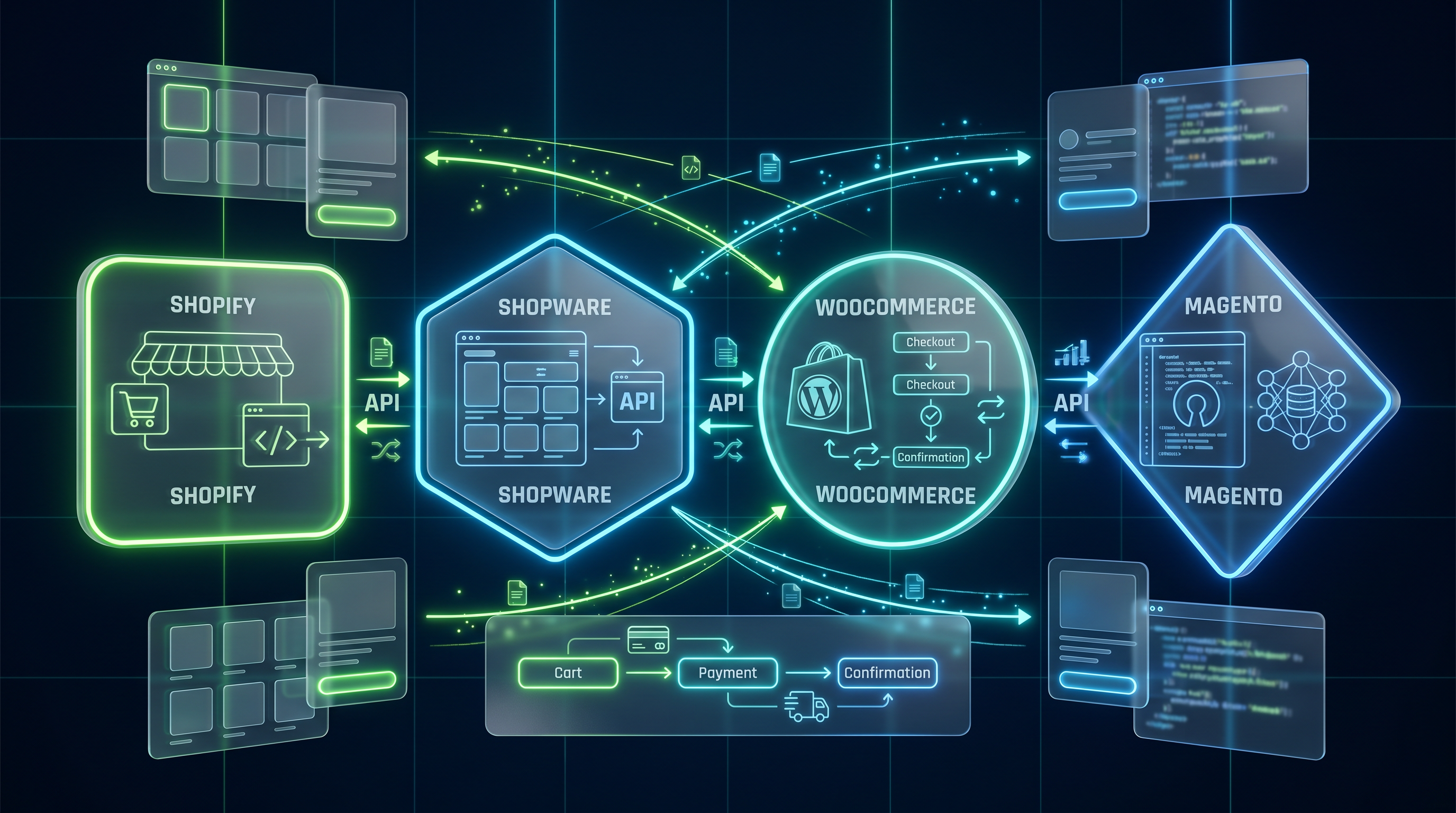
You’ve sat through three agency pitches. Each recommends something different: one swears by Shopware, the next has Shopify all over their portfolio, the third has been building on WooCommerce for years. They all sound convincing. They all have a conflict of interest.
That’s the core problem with ecommerce platform comparisons. There’s no objective answer from someone who isn’t selling one of these systems. This article is an attempt to change that.
I’m comparing Shopify, Shopware, WooCommerce and Magento as an independent consultant with no partnership with any of these vendors. No Shopify partner badge. No Shopware certification. Just operational experience from projects across the DACH region, with merchants who got this decision both right and wrong — and lived with the consequences either way.
A note on methodology: these assessments are based on my own projects across the DACH region, publicly available vendor pricing, and market data such as the EHI Retail Institute’s “E-Commerce-Markt Deutschland” study. I update this article whenever prices, market share or product features change materially. No affiliate links, no partner commissions, no sponsored placements.
What is an ecommerce platform, and why does the choice matter so much?
An ecommerce platform is the technical foundation your entire online operation runs on. It handles product presentation, checkout, payment processing, inventory management, customer communication, and connections to external systems like ERPs, CRMs and marketplaces.
What makes this decision so consequential: switching platforms in a mid-sized business requires a substantial budget that scales with catalog size, integration depth, and customization needs, ties up resources for six to eighteen months, and disrupts operations. Choosing the wrong online shop system today means paying that price in three to five years.
The second consequence most merchants underestimate: your ecommerce platform determines which ERP systems you can connect to, whether your product data is structured enough for AI applications, and whether your team can work independently every morning without waiting on a developer. This isn’t an IT decision. It’s an operations strategy decision.
The foundational choice: SaaS, open source or headless?
Before you compare any specific platforms, there’s a prior architecture question to answer. It defines which ecommerce platforms are even worth considering.
SaaS (Software-as-a-Service)
You rent the platform. Hosting, security updates, infrastructure: all included, all the vendor’s responsibility. You pay monthly and focus on your business, not your servers.
Shopify, BigCommerce and Wix fall into this category. SaaS suits D2C brands, growing B2C shops and businesses without an in-house development team — anyone who wants to launch fast without infrastructure debt.
The limit: you don’t have full control over code and infrastructure. Certain customizations aren’t possible, or only achievable through apps. Most shops can live with that. Some can’t.
Open source / self-hosted
You install the software yourself, on your own infrastructure or a hosting provider. Full control over code, data, customizations.
WooCommerce, Magento Open Source and Shopware (Community Edition) are self-hosted systems. They suit businesses with an in-house development team, complex custom requirements, or regulatory requirements around data location.
The catch: hosting, maintenance, security updates and scaling are your responsibility. That costs time and money that doesn’t appear in the license cost. Most merchants significantly underestimate this in their first budget estimate.
Headless commerce
Frontend and backend are separated. The commerce backend delivers data via APIs, and a custom-built frontend (typically React/Next.js) constructs the customer experience from that.
Shopify Headless (Hydrogen), Shopware Headless and Spryker belong here. Headless makes sense for businesses with highly specific UX requirements, omnichannel strategies across multiple touchpoints, and strong development teams.
The 8 criteria for choosing your ecommerce platform
These belong on the table before you take any vendor demo. They define which online shop systems are worth your time.
1. Hosting model and data requirements
Do you want or need to keep data on your own servers? Are there regulatory requirements around data location? Do you have a team that can operate hosting and infrastructure?
If all three answers are no, SaaS is the right direction. If data sovereignty is a hard requirement, open source on local hosting makes more sense.
2. Technical maturity of your team
A shop system that requires a developer for every daily process is a cost trap for businesses without strong IT. Shopify is deliberately built so merchant teams can work without developers. WooCommerce and Shopware require more technical understanding for configuration, updates and plugin management.
3. B2B or B2C — or both?
This is the parameter most often misjudged. Shopify is optimized for B2C and D2C. B2B features like individual customer price lists, approval workflows, quote generation and credit limits are only properly available on the Plus plan.
Shopware has B2B features embedded deeper in the platform architecture. If you’re purely B2C today but planning meaningful B2B volume in the next 24 months, factor that in now — not when you’re already mid-migration.
4. Multichannel and marketplace connections
Running only your own store today, or planning to add Amazon, eBay or other marketplaces? Every platform requires inventory synchronization, product data mapping and order processing.
Shopify has a broad app ecosystem for multichannel. A properly integrated Shopify ERP makes multichannel synchronization far more robust than any app-only solution.
5. SEO requirements and content strategy
Which ecommerce platform is best for SEO is a question that gets answered badly more often than not. The honest answer: SEO results depend far more on content strategy, site structure and backlink profile than on the platform. All four systems are configurable for strong SEO.
The meaningful differences: Shopify’s CDN delivers consistently fast load times. Shopware offers more flexibility in URL structure. How easily content editors can work without a developer is the underrated SEO factor.
6. ERP and systems integration
Which ERP, CRM, PIM needs to connect? Shopify has direct connections to Microsoft Dynamics, Oracle NetSuite and other enterprise systems through the Global ERP Program. In the DACH market, JTL and Xentral are the standard integrations.
Shopware offers deeper custom integration options through its open-source architecture, but needs more development effort. ERP integration isn’t a side note. It determines operational efficiency, data consistency and the ability to reliably track the ecommerce metrics that matter — inventory turnover, contribution margins, cash conversion cycle.
7. Total cost of ownership over 36 months
The cheapest platform is rarely the cheapest in operation. Always calculate:
TCO (36 months) =
  License / plan costs × 36
  + Hosting (if self-hosted)
  + Implementation costs (one-time)
  + Plugin / app costs × 36
  + Ongoing development costs
  - Saved manual labor costs
WooCommerce is free. But hosting, maintenance, security updates, plugin licenses and developer hours add up to a multiple of Shopify’s plan costs for comparable functionality. That isn’t an exception — it’s the rule.
8. Agent-readiness: structured data for AI shopping agents
Since January 2026, this isn’t a hypothetical anymore. Shopify and Google introduced the Universal Commerce Protocol (UCP), an open standard that lets AI agents — ChatGPT, Microsoft Copilot, Google AI Mode — handle cart, checkout and payment on a shopper’s behalf. Over 20 companies already support the standard, including Mastercard, Visa and Zalando.
For your platform, that’s an eighth criterion carrying equal weight: is your product data structured well enough for an agent to reliably verify price, availability and attributes? Shopify already built a native data layer for this with Shopify Catalog; Shopware followed with version 6.7. WooCommerce and Magento currently depend on third-party extensions. More detail in the agentic commerce section below.
The 4 leading ecommerce platforms compared
| Platform | Type | Starting/mo. | Operations | B2B | SEO | Multichannel | Best for |
|---|---|---|---|---|---|---|---|
| Shopify | SaaS | From €36 | Very low | ★★★☆☆ (Plus: ★★★★☆) | ★★★★☆ | ★★★★★ | D2C, B2C, growing brands |
| Shopware | Open source / SaaS | Community free | High | ★★★★★ | ★★★★★ | ★★★★☆ | B2B, complex DACH shops, mid-market |
| WooCommerce | Open source (WordPress) | Plugin free | Medium–High | ★★★☆☆ | ★★★★☆ | ★★★☆☆ | Early-stage, WordPress-native shops |
| Magento / Adobe Commerce | Open source / Enterprise | Open source free | Very high | ★★★★★ | ★★★★★ | ★★★★★ | Enterprise, complex catalogs, global |
Shopify: the SaaS standard for D2C and B2C
Shopify runs over 4.8 million active stores worldwide and has gained significant market share in the DACH region over the last three years, particularly with D2C brands and growing B2C merchants.
Shopify’s strength isn’t one specific feature — it’s the whole system. The platform is built so merchant teams can operate without daily developer support. Checkout, apps, themes, discount logic, reporting: all inside the admin without writing code. The app ecosystem covers almost every use case. The Shopify CDN delivers fast load times without you worrying about server infrastructure.
The limits are real: Shopify controls your infrastructure. Deep customizations that cross the platform’s boundaries are difficult or impossible. B2B features like approval workflows and customer-specific catalog structures only become robust at Plus level. Transaction fees for merchants not using Shopify Payments are a cost most merchants don’t notice until year two.
Shopify suits D2C brands, B2C merchants and businesses without a strong in-house IT team. How successful merchants actually scale on Shopify is covered in depth in the Shopify scaling guide.
Shopware: the German platform for complex requirements
Shopware is, according to the EHI Retail Institute’s “E-Commerce-Markt Deutschland” study, the most widely used shop system among Germany’s 1,000 highest-grossing B2C online stores — for the fourth year running. It’s one of the few relevant ecommerce platforms built in Germany — and that matters: DATEV compatibility, German payment methods and GDPR requirements are core to the product, not bolted on afterward.
Compared to Shopify, Shopware has concrete advantages: B2B features are embedded deep in the platform architecture, not restricted to a separate product tier. The storefront architecture is more flexible for complex content structures. The open-source foundation allows full custom adaptation. And hosting on German servers is an option, not an afterthought.
The trade-off is genuine: Shopware needs more technical know-how for operation and maintenance. Updates, security patches, plugin compatibility — your responsibility. Without a specialist agency or in-house development team, Shopware is the wrong choice even when the license appears free. This gap shows up clearly in TCO calculations, and more clearly than most planning spreadsheets show.
Shopware suits B2B merchants with complex pricing structures, brands with high expectations for product presentation, businesses with their own development team, and DACH merchants with strict data requirements.
WooCommerce: the WordPress solution for flexibility and low entry cost
WooCommerce is the most widely installed shop system globally — because it’s a free WordPress plugin accessible to anyone already running WordPress.
The case for WooCommerce: maximum customization through open source, no vendor lock-in, a large community and plugin ecosystem, low entry costs for tech-savvy teams. If you want to tightly integrate your store with a content-heavy WordPress setup, nothing connects more cleanly.
The case against: it isn’t a standalone shop system, it’s a plugin. As volume grows, so does infrastructure complexity. Hosting issues, scaling bottlenecks, security updates and plugin conflicts tend to appear exactly when your operations depend most on everything running smoothly. WooCommerce shops run professionally at high order volumes frequently approach or exceed Shopify’s TCO.
WooCommerce suits budget-conscious starters with WordPress experience, content-driven stores, and technical teams who want maximum control without platform fees.
Magento / Adobe Commerce: the enterprise platform
Adobe acquired Magento in 2018 and developed it into Adobe Commerce. It’s the platform for complex enterprise requirements: thousands of SKUs with multi-tier attribute structures, complex B2B purchasing workflows, global multi-language and multi-currency support, and multi-store configuration from a single installation.
What Magento can do that the others can’t, in this combination: scalable architecture for very large catalogs, a native B2B Commerce Suite, extensive flexibility in catalog structure.
What Magento costs surprises many people: implementation projects require a large, complexity-driven budget from the outset. Ongoing development effort is a permanent requirement. For shops under $5–10M annual revenue, Magento is the wrong choice in most cases, too complex, too expensive, too slow to iterate.
Magento suits enterprise merchants with high volume, complex catalogs and a dedicated development team.
Shopify vs. Shopware: the direct comparison
This is the question asked most often in the DACH market. The honest answer: there’s no universally better platform. There’s the platform that fits your specific situation.
| Criterion | Shopify | Shopware |
|---|---|---|
| Operating model | SaaS (cloud) | Open source / SaaS |
| Ease of use | Very high, no dev needed | Medium, dev recommended |
| B2B features | Robust from Plus | Native across all plans |
| Data control | With Shopify | Fully yours |
| DACH compliance | Configurable | Core product |
| App ecosystem | 8,000+ apps | 2,900+ plugins |
| Shopify Global ERP | Yes | No |
| Typical 3-year TCO | Lower for D2C | Lower with own IT team |
| SEO | Strong CDN, fast | More flexible URL structure |
| Better for | D2C, B2C, fast growth | B2B, DACH complexity, control |
Shopify is the better choice when your focus is D2C or B2C, you want to launch fast without technical projects, your team needs to work without developers daily, you’re planning international expansion, or your revenue is under $500k with no complex B2B requirements on the horizon.
Shopware is the better choice when B2B — individual price lists, approval workflows, quote processes — is central to your model, you have an in-house development team or a reliable agency relationship, data sovereignty on local servers is a hard requirement, or you need deep custom adaptations that cross Shopify’s platform boundaries.
The question that needs an answer before any decision: what does your B2B mix look like in 24 months? A store that’s 100% B2C today but building 40% B2B volume tomorrow may regret an early Shopify decision. A store that’s 80% B2B and chooses Shopify pays the price in workarounds and forced Plus upgrades.
What do ecommerce platforms actually cost? Official plans compared
These are official plan and license costs only. What hosting, implementation and agency work adds depends too heavily on your specific situation to quote as a flat rate.
| Platform | Starter plan | Mid plan | Enterprise | Transaction fee | Note |
|---|---|---|---|---|---|
| Shopify | Basic: €36/mo. | Shopify: €105/mo. | Plus: from €2,300/mo. | 0.5–2% without Shopify Payments | Hosting + updates included |
| Shopware | Community: free | Rise: from ~€600/mo. | Beyond: on request | None | Hosting separate if self-hosted |
| WooCommerce | Plugin: free | Plugins: variable | Hosting + dev: variable | None (payment provider fees) | WordPress hosting ~€20–200/mo. |
| Adobe Commerce | Open source: free | Pro: on request | Enterprise: on request | None | Implementation from six figures |
The meaningful comparison isn’t the list price. What does a DACH merchant with $1.5M annual revenue actually pay over 36 months?
Shopify (Shopify plan) runs about €3,780 in plan costs plus app costs. With Shopify Payments, no transaction fees. Hosting is included. Shopware Community is free as a software license, but hosting, maintenance, security updates and plugin licenses come on top. A professionally operated Shopware shop with agency support costs noticeably more per year than the license suggests. As a rough figure from our own projects: at this revenue level, a professionally run Shopware store’s 3-year TCO often lands between €60,000 and €90,000 once hosting, agency maintenance and plugin licenses are included — frequently more than double Shopify’s plan costs alone. That’s not a universal number; your actual figure depends on catalog size, integration depth and agency rates, but it shows the order of magnitude.
The cheaper platform is the one that fits your infrastructure. Without an in-house IT team, a SaaS system is almost always cheaper in TCO than a self-hosted solution — even when the license costs nothing.
By growth stage: which ecommerce platform when?
The most common mistake isn’t choosing the wrong platform. It’s choosing a platform that fits today but needs to be migrated in 18 months. Or the opposite: implementing an enterprise system for a store that’s still finding its market, and sinking two years into complex technical debt before the business has traction.
For stores in the build stage under $100k GMV: Shopify Basic or WooCommerce. No complex shop system at this stage. Launch, learn, validate the market. Your technology isn’t the bottleneck — your offer is.
In the growth range of $100k–$500k GMV, Shopify is the strongest choice for most D2C and B2C merchants. Fast iteration, low maintenance overhead, a broad app ecosystem. Shopware becomes relevant when B2B volume is a significant share. WooCommerce handles this range when a strong development team is behind it.
From $500k to $5M GMV is where most platform migrations happen — and where they’re most expensive. Shopify handles this volume comfortably. Shopware is the alternative for complex B2B structures and deep DACH-specific requirements. At this stage ERP integration becomes a real operational requirement, not a future project. And this is where your platform’s data structure starts determining whether AI-powered applications can actually work for you.
Above $5M GMV, Shopify Plus, Shopware Beyond or Adobe Commerce all become relevant. Here the platform choice is tightly coupled with IT strategy. Headless architectures become regularly sensible at this scale. ERP integration is mandatory. And this decision should be made with independent advice, not from a vendor’s demo call.
Migration: when does a platform switch make sense?
Switching ecommerce platforms isn’t a decision you make at a strategy meeting between agenda items.
A switch makes sense when your current system is demonstrably slowing your growth strategy — new channels can’t be integrated, B2B isn’t supportable. When technical debt has accumulated to the point that development costs are disproportionate. When your team spends hours daily working around platform constraints. When ERP integration can’t be solved cleanly with the current system.
A switch does not make sense because the design looks dated. That’s a redesign project, not a platform migration. Or because an agency pitched you on a new system — check the conflict of interest first. Or because a competitor is on a different platform.
What a switch actually costs: product and customer data migration, SEO preservation via 301 redirects and URL mapping, custom theme development, connector reconfiguration, team training, and typically six to twelve months of reduced operational velocity. Budget 1.5x your first estimate. That’s not a safety margin — it’s the historical average.
For B2B-specific decisions, particularly when Shopware or Shopify is being evaluated for a hybrid model, the B2B shop system comparison goes deeper on those trade-offs.
AI readiness in 2026: which platform is future-proof?
This sounds like a future topic. It’s a 2026 present topic.
AI-powered product recommendations, dynamic pricing and personalized suggestions only work precisely when the underlying product data is structured. A product without clean attribute structure — material, fit, season, compatibility — is largely invisible to AI systems. That data doesn’t come from your storefront. It comes from your ERP, if it’s configured properly.
Shopify has Shopify Magic and Sidekick as native AI features directly in the admin. Generate product descriptions, suggest audience segments, analyze support patterns. Usable today, not just roadmapped. Shopware offers better foundations for custom AI integrations through its API-first architecture, but fewer out-of-the-box features. If you want to build your own AI pipelines, Shopware gives you more freedom. If you want something working this week, Shopify has more.
The decisive point for all four platforms: AI readiness depends more on the quality of your product data and ERP data structure than on the platform itself. A poorly maintained Shopify store is just as invisible to AI as a poorly maintained Shopware store. More on that in the AI in ecommerce 2026 guide.
Checkout is a directly measurable revenue lever in the same conversation. Which platform ships the strongest native checkout and where AI-assisted optimization is already possible today is covered in the checkout optimization guide.
Agentic commerce 2026: are Shopify, Shopware and the rest ready for AI shopping agents?
On January 11, 2026, at the NRF Big Show in New York, Shopify and Google jointly introduced the Universal Commerce Protocol (UCP): an open standard that lets AI agents handle cart, checkout and payment across platforms and payment processors. More than 20 companies already support it, including Mastercard, Visa and Zalando. Four major AI shopping surfaces connect through UCP: ChatGPT, Microsoft Copilot, Google AI Mode and the Gemini app.
For your platform, that means: a customer asks their AI assistant for a product, the assistant compares, decides and buys, without the customer ever visiting your website. This isn’t a future scenario anymore. Shopify reported an eightfold year-over-year increase in AI-generated traffic to its stores in Q1 2026, and orders from AI-powered search grew almost 13x. By mid-2026, Shopify says 14% of frequent US online shoppers had already used an AI agent to make a purchase. These numbers come from Shopify itself and should be read with the appropriate caution, but the direction is unmistakable.
How ready are the four platforms in this comparison?
| Platform | UCP support | Structured data layer | Connected AI surfaces |
|---|---|---|---|
| Shopify | Native, co-developed the standard | Shopify Catalog | ChatGPT, Copilot, Google AI Mode, Gemini |
| Shopware | Yes, from version 6.7 | API-first, in progress | Via partner integrations |
| WooCommerce | No native protocol | Not available | Third-party plugins only |
| Magento / Adobe Commerce | No native protocol | Not available | Adobe Commerce extensions only |
Shopify has a structural head start here because it co-developed the standard. Shopware is catching up with its own agentic commerce response in version 6.7, keeping it the relevant option for B2B merchants who still want to participate in this shift. WooCommerce and Magento currently have no native protocol. That doesn’t rule them out, but it does mean relying on third-party extensions whose quality and update pace you don’t control.
The real prerequisite isn’t the platform, though — it’s your product data. An AI agent only buys what it can reliably verify: price, availability, variants, attributes. That’s the same data-quality point as the AI readiness section above, just with a concrete, measurable consequence: without the structure, your store loses revenue to competitors who have it, without a customer ever consciously “comparing.”
Frequently asked questions about ecommerce platform comparison
Which is the best ecommerce platform for 2026?
There’s no single best ecommerce platform. For D2C and B2C merchants who want to grow fast without heavy technical overhead, Shopify is the strongest choice. For B2B merchants with complex requirements, an in-house IT team and strict data sovereignty needs, Shopware is better suited. WooCommerce makes sense for budget-conscious starters with WordPress experience. Magento for genuine enterprise requirements.
What is the difference between Shopify and Shopware?
Shopify is a SaaS platform where hosting and infrastructure are included and no technical team is needed for daily operations. Shopware is primarily open source, self-hosted, and offers deeper B2B features and full data control. Shopify has a lower TCO for most D2C merchants. Shopware is better suited for complex B2B scenarios and DACH-specific requirements.
Can I migrate from WooCommerce to Shopify?
Yes, and it’s one of the most common migrations in the DACH market. It involves product and customer data migration, URL redirect mapping for SEO, custom theme development and connector reconfiguration. Budget six to twelve weeks for a professionally executed migration and take SEO preservation seriously from day one.
What does a professional online store cost to build?
It depends heavily on the platform and your complexity. A straightforward Shopify store with a standard theme can go live in weeks with a modest budget. A professionally configured Shopware store with ERP integration and a custom theme requires a considerably larger budget and timeline. Enterprise projects on Magento require the largest budget of all, scaling with catalog size and customization depth. A free initial audit is the fastest way to get a number that actually applies to your situation.
Is WooCommerce or Shopify better?
For most merchants without a strong in-house development team, Shopify is better: lower operational overhead, better scalability, lower TCO in the mid-volume range. WooCommerce is better when WordPress is already heavily used, maximum control is required, and a development team is available for ongoing operation and maintenance.
Which ecommerce platform is best for SEO?
All four platforms are configurable for strong SEO. Shopify offers CDN-optimized load times and structured data. Shopware offers more flexibility in URL structure. The biggest SEO lever isn’t the platform — it’s content strategy, internal linking and backlink profile. No platform compensates for weak content.
When do I need an enterprise platform like Magento?
A rough rule of thumb: Magento / Adobe Commerce becomes sensible above $5–10M annual revenue with very complex catalog requirements — thousands of SKUs with deep attribute trees, multi-store, global multi-language. Below that, Shopify Plus or Shopware Beyond are the better choice in most cases, with significantly lower operational overhead.
How long does implementing a new ecommerce platform take?
Shopify with a standard theme and app setup: 4–12 weeks. Shopify with a custom theme and ERP integration: 3–6 months. Shopware at medium complexity: 4–8 months. Shopware or Magento enterprise with ERP and custom build: 6–18 months. The most common cause of delays is unclear requirements and poor source data quality.
Do I need an agency for Shopify?
For a straightforward Shopify store: no. Merchants without a technical background can go live with a standard theme and app setup within days. For ERP integration, custom theme development and complex multichannel setup, a specialist Shopify agency is worthwhile. For Shopware and Magento, an experienced agency is necessary in almost all cases.
Which ecommerce platform is best for B2B?
Shopware has the deepest native B2B functionality: individual customer price lists, approval workflows, quote processes, credit limits — available from the Community Edition, not locked behind an expensive enterprise plan. Shopify B2B is robust from the Plus plan, but the entry point is expensive. For purely B2B-oriented stores with complex purchasing processes, Shopware is the stronger choice. The B2B shop system comparison goes deeper on this.
What is agentic commerce, and do DACH merchants need to act on it now?
Agentic commerce refers to purchases where an AI agent — inside ChatGPT, Microsoft Copilot or Google AI Mode — searches, compares and buys on a shopper’s behalf through the Universal Commerce Protocol (UCP). For most DACH merchants, this isn’t a first-order revenue driver yet in 2026, but the prerequisite for it — clean, structured product data — is worth building now. Waiting means catching up later under time pressure.
What about JTL-Shop, Gambio or PlentyONE — why aren't they in this comparison?
This comparison deliberately focuses on the four most globally relevant architecture types: SaaS (Shopify), open source with deep B2B (Shopware), WordPress plugin (WooCommerce), and enterprise (Magento). JTL-Shop, Gambio and PlentyONE are genuinely used alternatives in the DACH region, often paired with a JTL or Xentral ERP. For merchants already running JTL as their ERP, JTL-Shop is a serious option, but it covers a narrower use case than the four platforms compared here.
Which platform fits your business?
Answer three questions and get a recommendation matched to your situation:
What is your current or planned annual revenue?
What is your primary business model?
What matters most to you when choosing a platform?
My verdict: the decision that actually matters
After running many ecommerce platform projects across the DACH region, my honest read is this: most bad decisions don’t happen because one system is objectively worse. They happen because the platform choice starts from the wrong question.
The wrong question: which ecommerce platform is the best?
The right question: which online shop system fits my processes in 24 months, my team, my budget and my ERP infrastructure?
Shopify is the most rational choice for the majority of DACH D2C and B2C merchants today. Shopware is the stronger alternative for B2B-driven models with a DACH focus and an in-house IT team. WooCommerce has its place for technically capable starters. Magento for genuine enterprise requirements.
What I’d advise against: making the decision based on agency pitches without an independent view. Every agency has a system in their portfolio they’re best positioned to sell. That’s not a criticism. It’s a structural conflict of interest you should know about going in.
Ecommerce platform consulting for your store
You now know the differences between the major ecommerce platforms better than most decision-makers who’ve already made a choice. What’s missing: an independent sparring partner who knows your specific situation and gives a clear recommendation.
I offer a focused ecommerce platform consulting session: 60 minutes, structured analysis of your requirements, business model and IT landscape, a concrete recommendation with reasoning and a realistic cost estimate. No partner commissions. No agency interests. Just the recommendation I’d give if you were a friend asking me the question.