
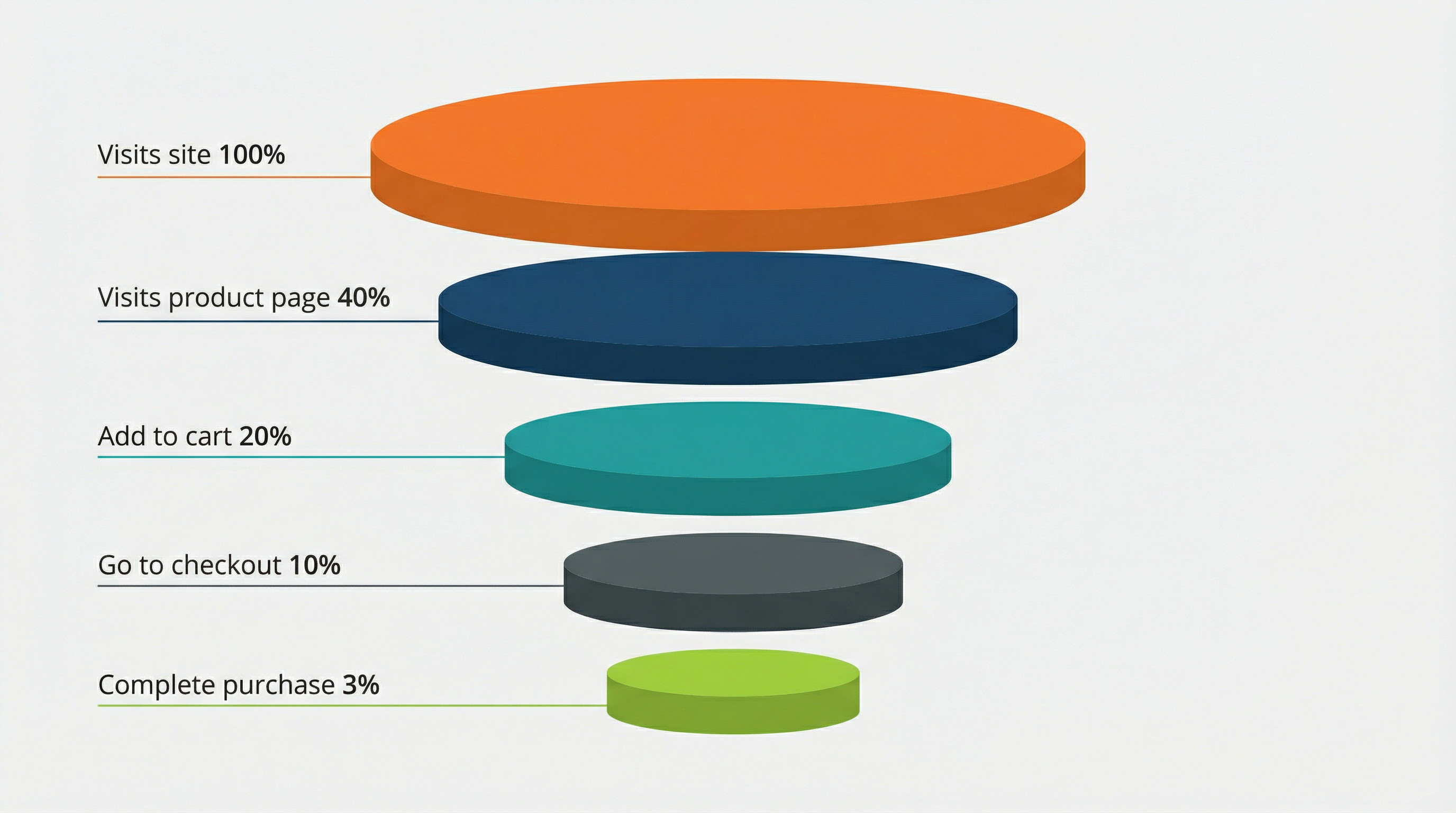
Picture this: Out of every 100 shoppers who add something to their cart, only 28 actually buy. The other 72 walk away — cart full, wallet closed. That’s not an edge case. That’s the baseline in e-commerce.
Here’s the thing: about half of those abandonments are fixable. The most common reasons — surprise fees, forced account creation, missing payment options — aren’t laws of physics. They’re design choices.
This guide walks you through a systematic approach to reducing cart abandonment: from prevention through checkout optimization to recovery via email sequences, exit-intent strategies, retargeting, and messaging channels. Everything backed by benchmarks, practical tips, and a calculator that shows how much revenue you’re leaving behind.
42.5% of all cart abandonments are simply a natural consequence of how people browse online stores — largely unavoidable. The remaining 57.5% are preventable, and that’s where your opportunity lives.
Why Shoppers Abandon Their Carts — What the Data Says
Before you start optimizing, you need to understand why people bail. The research is extensive, and the ranking might surprise you.
| Rank | Reason for Abandonment | Share |
|---|---|---|
| 1 | Extra costs (shipping, taxes, fees) | 47% |
| 2 | Just browsing / not ready to buy | 43% |
| 3 | Required to create an account | 25% |
| 4 | Delivery too slow | 24% |
| 5 | Checkout too long or complicated | 18% |
| 6 | Didn't trust the site with credit card info | 17% |
| 7 | Couldn't see total cost upfront | 16% |
| 8 | Preferred payment method unavailable | 13% |
| 9 | Unsatisfactory return policy | 12% |
| 10 | Website errors or crashes | 11% |
Two things stand out. First, cost is the number-one killer — not the price itself, but the surprise. When a customer gets to the final step and sees a $7 shipping charge they didn’t expect, it feels like a bait-and-switch. Second, 43% of abandonments are just window shopping — there’s not much you can do about that. But the other 57%? That’s your playing field.
Abandonment Rates by Industry
Not every vertical is hit equally. Higher-priced, research-heavy products naturally see more abandoned carts.
| Industry | Abandonment Rate |
|---|---|
| Luxury & Jewelry | 83% |
| Beauty & Personal Care | 81% |
| Home & Furniture | 80% |
| Fashion & Apparel | 79% |
| E-commerce Average | 72% |
| Electronics | 70% |
| Food & Grocery | 64% |
| Pet Supplies | 55% |
Prevention: Checkout Optimization — Stop Abandonments Before They Start
The most effective way to reduce cart abandonment is to prevent it in the first place. These fixes map directly to the top reasons people leave.
Show All Costs Upfront
The number-one reason for abandonment is unexpected costs. The fix is straightforward: surface every cost as early as possible.
What this looks like in practice:
- Display shipping costs on the product page or cart — not the final checkout step
- Be transparent about taxes and fees from the start
- For international stores: flag customs and import duties early
- Promote free shipping thresholds prominently (“Only $12 away from free shipping”)
Offer Guest Checkout
25% of abandonments happen because people are forced to create an account. A guest checkout option solves this instantly.
Best practices:
- Make guest checkout the default option, not a hidden link
- Offer account creation after the purchase (“Want to save your order for next time?”)
- Provide social login as a quick alternative (Google, Apple)
- If you need registration: ask for email and password only — everything else is optional
Payment Method Variety
13% of shoppers abandon because their preferred payment method isn’t available. In the US market, this means covering the basics and beyond.
Must-haves for US stores:
- Credit/debit cards (Visa, Mastercard, Amex)
- PayPal
- Apple Pay / Google Pay (especially on mobile)
- Buy Now, Pay Later (Klarna, Afterpay, Affirm)
- Shop Pay (for Shopify stores)
For international expansion:
- iDEAL (Netherlands)
- Bancontact (Belgium)
- SEPA Direct Debit (EU)
Build Trust at Checkout

17% of shoppers abandon because they don’t trust the site with their payment information.
High-impact trust signals:
- Security badges (Norton, McAfee, BBB) visible in the checkout area
- SSL indicator next to the payment form
- Customer reviews and star ratings in the footer or sidebar
- Clear return policy linked prominently (not buried in the terms)
- Visible contact information (phone number, live chat)
Optimize the Mobile Checkout
With an 80% mobile abandonment rate, the mobile checkout is the single biggest lever for most stores.
Critical fixes:
- Large, easy-to-tap buttons (minimum 48px height)
- Enable autofill for address fields
- Numeric keyboard for ZIP codes and credit card numbers
- Progress indicator: where am I in the checkout?
- Single-page checkout instead of multi-step
- Express checkout buttons (Apple Pay, Google Pay, PayPal Express) above the regular form
Recovery: Email Sequences — Your Strongest Lever After Abandonment
When a shopper walks away from their cart, email is your first and most powerful recovery channel. The performance data speaks for itself.
| Metric | Average | Top 10% |
|---|---|---|
| Open Rate | 50.5% | 65.3% |
| Click Rate | 6.3% | 13.3% |
| Conversion Rate | 3.3% | 7.7% |
| Click-to-Conversion | 42% | – |
For context: a typical newsletter gets 15-20% open rates and under 2% conversion. Abandoned cart emails perform 3x better — because the recipient has already shown purchase intent.
The Optimal Email Sequence: Timing Is Everything
A single email is fine. A well-timed sequence is significantly better.
Email 1 — The Reminder (1 hour after abandonment):
- Keep it simple and non-pushy: “Did you forget something?”
- Show the product image and name from their cart
- Direct button back to the cart
- No discount — the first email tests whether a nudge is enough
Email 2 — Build Confidence (24 hours after):
- Add social proof: product reviews and ratings
- Address common objections (return policy, shipping speed)
- Optional: offer customer service contact
- Still no discount
Email 3 — The Incentive (72 hours after):
- Now offer something: free shipping, 10% off, a small gift
- Create urgency: “Your cart expires in 48 hours”
- Clear CTA: “Complete your order for $XX” (show the total)
Subject Lines That Get Opened
Your subject line determines whether the email gets read or ignored.
What works:
- Personalized: “Hey Sarah, your cart is waiting”
- Product-specific: “Your [Product Name] — still available”
- Curiosity: “Did you forget something?”
- Scarcity (only if true): “Only 3 left in stock”
What doesn’t work:
- ALL CAPS and excessive punctuation
- Generic lines: “Come back to our store!”
- Fake urgency: “LAST CHANCE!!!”
- Overly promotional: “HUGE DISCOUNT INSIDE!!!”
Segment by Cart Value
Not every abandoned cart is worth the same effort. Segment your sequence by cart value for maximum ROI.
| Segment | Cart Value | Strategy |
|---|---|---|
| Low | Under $30 | Simple reminder, no discount (margins too thin) |
| Medium | $30-100 | Standard sequence with free shipping as incentive |
| High | $100-300 | More personal touch, offer customer service |
| Premium | Over $300 | Personal phone call or text, custom offer |
Recovery: Exit-Intent, Retargeting & Messaging
Email is the MVP, but it’s not the only player. A multi-channel strategy captures additional buyers who don’t respond to email.
Exit-Intent Popups: The Last Moment Before They Leave
Exit-intent technology detects when a visitor is about to leave the page and shows an overlay at exactly that moment.
Performance:
- Average conversion rate for exit-intent popups on cart pages: 17%
- Adding a countdown timer bumps it to 14.4% (vs. 9.9% without)
- Top-performing exit-intent popups hit up to 30% conversion
What works as an offer:
- Free shipping (strongest trigger, since shipping costs are the #1 abandonment reason)
- Percentage discount (5-15%, depending on margins)
- Time-limited coupon (“10% off for the next 30 minutes”)
- Cart save via email (“Send my cart to my inbox”)
Retargeting Ads: Find Cart Abandoners Across the Web
Retargeting ads reach shoppers who left your store on other websites and social platforms.
The numbers:
- Retargeted visitors are 43% more likely to convert than first-time visitors
- Cart abandonment rates drop by 26% when retargeting is in place
- Retargeting cuts cost-per-acquisition by 44% compared to standard campaigns
- ROI: Well-segmented retargeting campaigns deliver over 1,300% ROI
Platform strategy:
| Platform | Reach | Strength | Best For |
|---|---|---|---|
| Google Display Network | 90% of internet users | Broad reach, affordable CPMs | Awareness, reminders |
| Meta (Facebook/Instagram) | 51% of internet users | Precise targeting, visual formats | Product-specific ads |
| Google Shopping | High-intent shoppers | Strong purchase intent | Price-competitive products |
Best practices for retargeting:
- Timing: Launch ads within the first 24-48 hours — relevance drops quickly after that
- Dynamic product ads: Show the exact items from the abandoned cart
- Frequency capping: Cap at 5-7 impressions per user — beyond that, you’re just annoying people
- Burn pixel: Remove buyers from the retargeting audience immediately after purchase
SMS and Text Messages: For High-Value Carts
SMS and messaging apps are the newer recovery channels — and the performance data is compelling.
| Channel | Open Rate | Click Rate | Conversion Rate | Cost per Contact |
|---|---|---|---|---|
| 50% | 6% | 3-8% | $0.01-0.05 | |
| SMS | 98% | 19-30% | 15-20% | $0.05-0.15 |
| Retargeting Ads | – | 0.5-1.5% | Up to 26% reduction | $15-30 per cart |
| Exit-Intent Popup | – | – | 17% (cart abandonment) | Tool cost only |
When to use SMS:
- Cart values over $100 (the higher cost per message needs to justify itself)
- As an escalation after email (not instead of it)
- Only with explicit opt-in (required under TCPA and most privacy laws)
- Within the first 1-4 hours after abandonment (the SMS window is shorter than email)
Orchestration: Making All Channels Work Together
The best strategy combines every channel in a deliberate sequence:
- Immediately: Exit-intent popup when leaving (free shipping / discount)
- After 1 hour: First email (reminder, no discount)
- After 4 hours: SMS for high-value carts (over $100)
- After 24 hours: Second email (social proof, trust building)
- After 24-48 hours: Retargeting ads launch (dynamic product ads)
- After 72 hours: Third email (incentive: discount or free shipping)
Measure and Optimize: What Is Cart Abandonment Actually Costing You?
Before you invest in recovery tools, figure out how much revenue you’re actually losing.
Your Revenue Loss Calculator
Example calculation:
- Monthly carts: 5,000
- Abandonment rate: 72%
- Average order value (AOV): $85
- Lost Revenue = 5,000 × 0.72 × $85 = $306,000 / year
Even recovering just 10% of those abandonments means $30,600 in additional annual revenue — with relatively modest investment in email automation and retargeting.
Key KPIs to Track
To evaluate whether your efforts are working, you need the right metrics:
| KPI | What It Measures | Target |
|---|---|---|
| Cart Abandonment Rate | Share of uncompleted carts | Below your industry average |
| Recovery Rate | Share of recovered carts | 5-15% |
| Revenue per Email | Revenue per abandoned cart email sent | $0.50-2.50 |
| Time to Recovery | How quickly after abandonment the purchase happens | Under 24 hours |
| Incremental Revenue | Additional revenue from recovery efforts | Positive trend |
Frequently Asked Questions
What’s a “good” cart abandonment rate?
It depends on your industry. The global average is 72%, but grocery stores sit at 64% while luxury brands hit 83%. Your goal should be to land below your own industry average. A 5-percentage-point improvement is a realistic first target.
How quickly should the first email go out?
Within 1 hour of abandonment. Data shows that abandoned cart email conversion rates drop rapidly after the first few hours. Wait 24 hours and you’ve already lost half the opportunity.
Should I lead with a discount?
No. Start with a simple reminder. Many shoppers just need a nudge. Leading with discounts trains customers to abandon on purpose — and destroys your margins. Save the financial incentive for the third email, 72 hours after abandonment.
Do I need a dedicated tool for cart recovery emails?
Most email marketing platforms (Klaviyo, Omnisend, Mailchimp) include abandoned cart flows as a standard feature. On Shopify, it’s built in natively. For exit-intent and retargeting, you’ll need additional tools (like OptiMonk or Criteo).
How do I stop customers from abandoning on purpose to get discounts?
Segment aggressively: loyal customers with high CLV don’t get discounts — they just need a reminder. Discounts go to first-time visitors or lapsed customers only. And vary your incentives (free shipping one time, a small gift the next, a percentage off after that) so there’s no predictable pattern.
The Bottom Line: Cart Abandonment Isn’t Inevitable
A 72% abandonment rate sounds brutal — but it also means there’s massive upside. The tactics in this guide can be rolled out in stages:
- Start today: Checkout transparency (show shipping costs early) and guest checkout — free, immediate impact
- Week 1-2: Set up an email sequence (3 emails with timing logic) — the single biggest lever
- Week 3-4: Implement an exit-intent popup — quick to set up, high impact
- Month 2: Launch retargeting campaigns — for sustained recovery
- Ongoing: Test SMS for high-value carts, track KPIs, iterate
The key isn’t doing everything at once. It’s systematically activating the levers that will move the needle most for your store.