Your sales team knows the feeling: a prospect reaches out, sounds genuinely interested — and then weeks disappear into presentations, follow-up calls, and internal alignment rounds with nothing to show for it. What most companies miss: by the time that first conversation happens, the buying decision is often already largely made.
The implications for your strategy are significant. When buyers research independently, compare vendors, and align internally before ever picking up the phone, the best salesperson no longer wins — the winner is whoever is visible, credible, and genuinely useful in those early stages.
B2B buyers spend only 17% of their total buying time in direct conversations with vendors — and when evaluating multiple suppliers, that drops to just 5–6% per vendor.
In this guide, I’ll show you how the B2B customer journey actually works: what stages your buyers go through, who really makes the decision, which touchpoints matter — and how to build a customer journey map that doesn’t just look good in a workshop, but measurably drives revenue.
Why the B2B Customer Journey Works Fundamentally Differently
The most common mistake in analyzing the B2B buying process: applying B2C thinking to complex enterprise decisions. A consumer buys shoes in five minutes. A company evaluates a new ERP solution over 9–18 months — with a buying committee of 6 to 10 people, internal approval processes, and substantial financial risk on the line.
| Characteristic | B2C Customer Journey | B2B Customer Journey |
|---|---|---|
| Decision-makers | 1 person | 6–10 people (buying committee) |
| Decision timeline | Minutes to days | 3–18 months |
| Avg. transaction value | $10–$500 | $10,000–$5,000,000 |
| Primary motivation | Emotional, impulse-driven | Rational, ROI-driven |
| Touchpoints to close | 3–7 | Avg. 59 touchpoints |
| Contract structure | Single purchase | Framework agreements, SLAs, terms |
| Relationship depth | Transactional | Partnership-based, long-term |
| Primary research channel | Social media, reviews | LinkedIn, trade shows, referrals, SEO |
| Content needs | Product images, pricing | Whitepapers, case studies, ROI calculators |
| Risk of wrong decision | Low (returns possible) | High (career risk, capital loss) |
What follows from this: the B2B customer journey requires its own strategy — not a simplified version of the B2C playbook. You need longer nurturing sequences, deeper content, an understanding of group-based decision dynamics, and the ability to simultaneously convince multiple stakeholders with competing interests.
The Buying Committee: Who Really Decides Your Deal
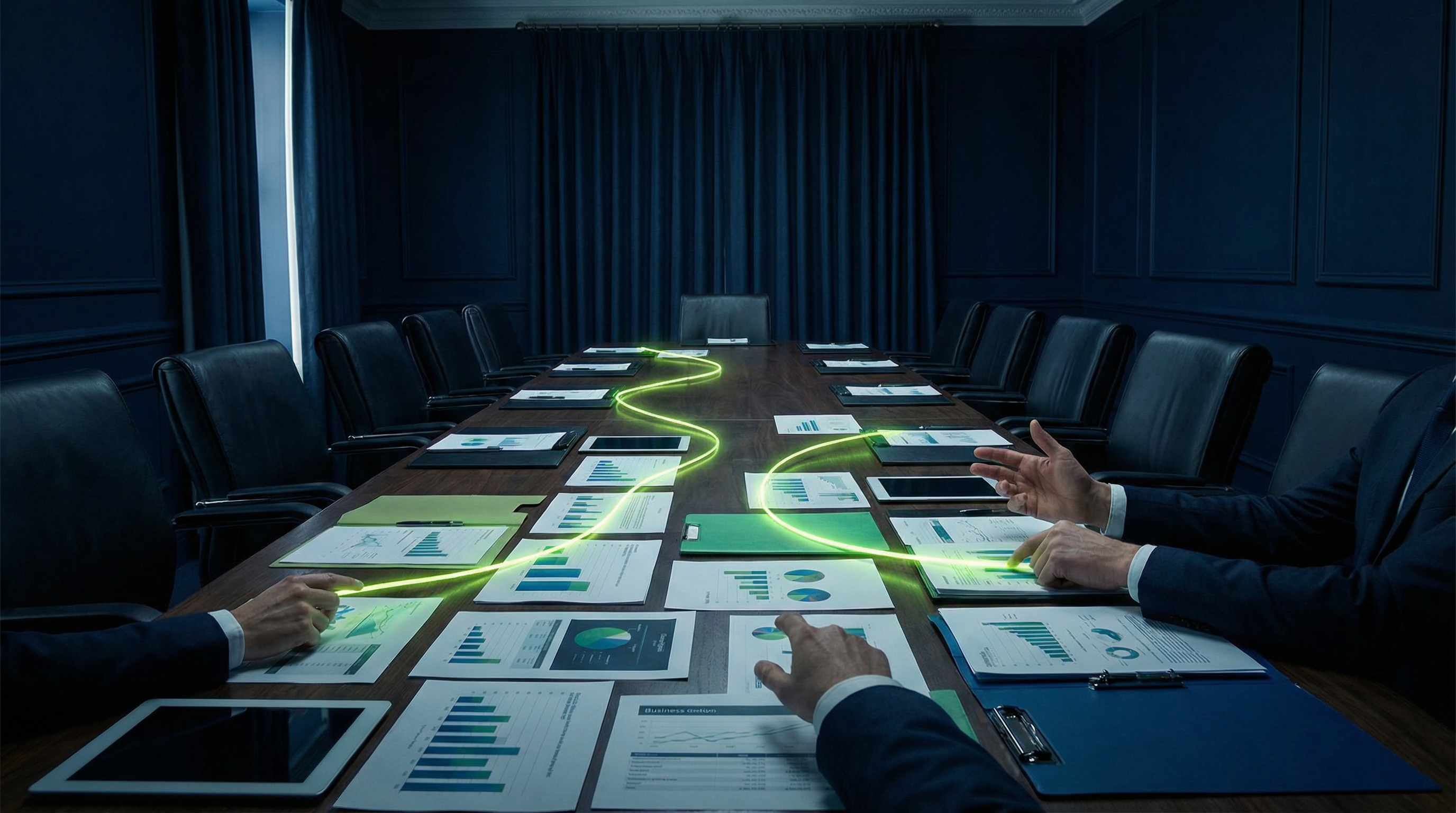
One of the most critical mistakes in B2B sales: focusing on a single contact while ignoring the entire buying committee — everyone involved in the purchasing decision. In large enterprises, that averages 6.8 people (Gartner 2024); in complex IT or infrastructure projects, it can exceed 15.
| Role | Function | Primary Interest | Relevant Content |
|---|---|---|---|
| Initiator | Identifies the need, triggers the process | Solve the problem, build internal urgency | Problem-awareness content, blog posts |
| End User | Uses the product/solution daily | Usability, efficiency, learning curve | Demos, how-to guides, case studies |
| Influencer | Advises internally, evaluates technically | Technical excellence, integration capability | Whitepapers, technical documentation |
| Decision-Maker | Has formal authority to decide | ROI, strategic fit, risk minimization | Business cases, ROI calculators |
| Approver | Signs off on budget/contract | Compliance, costs, overall risk | Security certifications, references |
| Buyer (Procurement) | Negotiates terms, reviews proposals | Price-performance, contract conditions | Proposals, SLA overviews, comparison tables |
| Gatekeeper | Filters information, controls access | Evaluation efficiency | Executive summaries, quick value arguments |
What this means for your B2B customer journey strategy: each role has different questions, different fears, and different decision criteria. A whitepaper on technical integration capability will convince the technical influencer — but not the CFO responsible for the budget. Successful B2B companies build dedicated content paths for each buying committee role.
The 6 Stages of the B2B Customer Journey
The B2B customer journey is not a linear funnel. Decision-makers jump between stages, evaluate multiple vendors in parallel, and abandon the process — only to restart it weeks later. Despite this, six structurally distinct stages can be identified.
Stage 1: Trigger — Problem Awareness Emerges
Every B2B customer journey begins with a trigger. Something shifts inside the organization: a system breaks down, a growth target demands new capacity, a competitor does something better, or an industry trend forces action.
Common triggers in large enterprises:
- Technological obsolescence (legacy systems, compliance gaps)
- Growth pressure (new markets, scalable processes needed)
- Efficiency problems (manual processes, rising costs)
- Regulatory requirements (GDPR, ISO certifications)
- Strategic initiatives (digital transformation, international expansion)
What this means for you: In the trigger stage, your future buyer isn’t looking for vendors yet. They’re looking for validation that their problem is real — and for a framework that helps them articulate it internally. Thought-leadership content that names and contextualizes exactly these problems makes you visible at this critical moment.
Stage 2: Awareness — Active Research Begins
Once the problem is internally acknowledged, active research begins. At this stage of the B2B customer journey, the prospect is searching for solutions — not yet for vendors. Research runs primarily online: Google, LinkedIn, trade publications, industry reports.
What’s critical here: If you’re not found in the awareness stage, you don’t exist for the buyer. SEO, content marketing, and a clear positioning are not nice-to-haves here — they’re table stakes.
Younger B2B decision-makers — under 35 — use an average of four to five digital channels for initial research, according to Forrester. LinkedIn, Google, YouTube, and industry communities are used simultaneously. Cold-call outreach during this phase rarely lands.
Stage 3: Consideration — Vendors Are Being Compared
Now it gets concrete. The prospect has defined their solution space and begins evaluating vendors. They compare offerings, read case studies, check references — and in 80% of cases, they do this without having contacted a single salesperson yet.
What determines outcomes in the consideration stage:
- Credibility: Do you have verifiable results for comparable companies?
- Relevance: Does your content speak to their specific industry, company size, and problem?
- Accessibility: Is your information easy to find, understand, and share internally?
Stage 4: Decision — Commitment and Negotiation
In the decision stage, the vendor list has narrowed to two or three finalists. Sales is now actively engaged — demos, custom proposals, reference calls, technical proof-of-concepts. This stage demands intensive support.
What separates winners from losers now:
- Business case: Can you quantify the ROI in concrete terms?
- Risk mitigation: How do you reduce the perceived risk for decision-makers?
- Buying committee alignment: Have you addressed all relevant stakeholders?
- References: Do you have verifiable success stories from comparable companies?
Stage 5: Onboarding — The Most Dangerous Stage
Closing the deal isn’t the end of the B2B customer journey — it’s the beginning of the real test. The onboarding stage determines whether a new customer becomes a loyal one. In B2B relationships, this is where the foundation for renewals, expansions, and referrals is built.
Stage 6: Retention & Advocacy — The Long-Term Value
In the final stage of the B2B customer journey, the focus shifts to customer retention, upselling, and — ideally — active advocacy. B2B customers who become true advocates are invaluable: they provide reference calls, participate in case studies, and recommend you through their professional networks.
What drives long-term B2B customer loyalty:
- Regular QBRs (Quarterly Business Reviews)
- Proactive optimization suggestions — not just reactive support
- Early involvement in product roadmaps and new development
- Relationships that extend beyond a single point of contact
The Most Important B2B Touchpoints by Journey Stage
The average B2B customer journey involves 59 touchpoints before a deal closes. The distribution is far from equal. Not every touchpoint carries the same weight — and not every channel fits every stage.
| Stage | Key Touchpoints | Primary Channels | Touchpoint Goal |
|---|---|---|---|
| Trigger | Thought-leadership articles, LinkedIn posts, conferences | SEO, LinkedIn, trade press | Sharpen problem awareness |
| Awareness | Blog posts, whitepapers, webinars, industry reports | Google, LinkedIn, email newsletters | Establish as the authoritative source |
| Consideration | Case studies, product pages, demo requests, comparison pages | Website, G2/Capterra, referrals | Demonstrate concrete solution expertise |
| Decision | Sales demos, custom proposals, reference calls, PoC | Direct contact, video calls, events | Overcome objections, enable close |
| Onboarding | Kick-off meeting, documentation, training, helpdesk | Direct, customer portal, email | Secure fast time-to-value |
| Retention | QBRs, newsletters, product updates, community events | Email, customer support, events | Drive expansion and advocacy |
Building a B2B Customer Journey Map: The 5-Step Framework
A B2B customer journey map is the most important strategic tool for systematically understanding your customers’ perspective — and aligning your marketing, sales, and service activities accordingly. Here’s the framework I use in consulting practice.
Step 1: Define Buyer Personas for All Stakeholder Roles
Not one persona — one per buying committee role. The procurement manager has different questions than the CTO — both need their own persona with distinct pain points, information needs, and decision criteria.
What a strong B2B persona includes:
- Role and area of responsibility within the buying committee
- Primary KPIs and success criteria (what is this person measured on?)
- Typical objections and concerns
- Preferred information channels and content formats
- Decision-relevant triggers
Step 2: Inventory All Existing Touchpoints
Before optimizing, you need to understand what already exists. Map every point of contact a potential customer has with your company — from the first Google search to post-sale support. Deliberately distinguish between active touchpoints (which you control) and passive touchpoints (review sites, referrals, press coverage).
Step 3: Collect the Customer Perspective and Pain Points Per Stage
The journey map only becomes valuable when you describe not just what happens — but how your customers experience it. Conduct structured interviews with current customers, lost deals, and active prospects. Ask directly:
- “How did you first find us?”
- “What influenced your decision most?”
- “Where in the process were you most uncertain?”
- “What was the deciding factor in choosing us?”
Step 4: Identify Content Gaps and Friction Points
With the insights from Step 3, you can systematically identify where your journey map has gaps: stages where buyers can’t find information, feel left alone, or can’t move forward internally. These gaps are your biggest growth levers.
Common content gaps in B2B customer journeys:
- Missing trigger-stage content → buyers find you too late
- No role-specific content → the CFO and CTO read the same undifferentiated material
- Disconnect between website and sales → prospects know a lot, sales knows none of it
- Weak onboarding materials → customers experience a value gap after signing
Step 5: Quantify Pipeline Potential and Prioritize
A customer journey map without numbers is a strategic artwork with no execution relevance. Quantify the opportunity: How many deals are currently in your pipeline? What revenue can you expect at your current close rate? Where are you losing the most opportunities?
Calculate your expected pipeline revenue:
The B2B Customer Journey in Digital Sales
The B2B buying process has fundamentally shifted over the past five years. What was once dominated by field sales, trade shows, and personal networks now runs largely online — even at the enterprise level.
| Aspect | Traditional B2B Journey | Digital B2B Journey |
|---|---|---|
| First contact | Cold calling, trade shows, field sales | SEO, LinkedIn, content marketing |
| Research phase | Sales conversations, printed materials | Independent online research, 57–70% without sales |
| Proposal process | Manual, email-based, slow | Automated, self-service configurators |
| Basis for decision | Sales presentations, phone references | Online reviews, case studies, video demos |
| Contract signing | In-person, paper documents | Digitally signed, e-commerce enabled |
| After-sales | Dedicated account manager | Self-service portal, automated support |
| Data foundation | CRM notes, gut feeling | Analytics, lead scoring, journey tracking |
What this means concretely: B2B companies that still rely exclusively on field sales and personal relationships are systematically losing the early stages of the customer journey. The decision-maker who didn’t find you digitally in stages 1 and 2 arrives at stage 4 with a shortlist — and you’re not on it.
Measuring sales ROI: Use our calculator to quantify the return on your sales investment — a critical KPI for evaluating your customer journey strategy:
KPIs: Measuring the Performance of Your B2B Customer Journey
Designing a customer journey is one thing — knowing whether it’s working is another. Here are the KPIs that provide genuine insight, organized by stage.
| Stage | KPI | What It Measures | B2B Benchmark |
|---|---|---|---|
| Trigger / Awareness | Organic visibility (impressions) | Reach in the early stages | YoY growth > 20% |
| Awareness | Content engagement rate | Quality of early touchpoints | > 3 min. average session duration |
| Consideration | MQL rate (Marketing Qualified Leads) | Transition from interest to qualification | 5–15% of all visitors |
| Consideration → Decision | Lead-to-opportunity rate | Qualification efficiency | 20–30% |
| Decision | Close rate (win rate) | Sales efficiency in the decision stage | 15–30% depending on industry |
| Decision | Avg. sales cycle length | Process efficiency | 10–20% reduction YoY |
| Decision | Customer Acquisition Cost (CAC) | Cost efficiency of customer acquisition | Max. 25–33% of first-year revenue |
| Onboarding | Time to first value | Speed of value realization | < 30 days post-close |
| Retention | Net Revenue Retention (NRR) | Growth from existing customers | > 100% = upselling outpaces churn |
| Advocacy | NPS (Net Promoter Score) | Willingness to recommend | B2B average: 25–40 |
Checklist: Is Your B2B Customer Journey Enterprise-Ready?
Use this checklist to assess the current state of your B2B customer journey. The more items you can answer “yes” to, the stronger your market position across the critical buying stages.
Strategy & Foundations
- Buyer personas are documented for all relevant buying committee roles
- The typical length of your sales cycle is known and actively tracked
- A defined content strategy exists for all stages of the customer journey
- Touchpoints are systematically captured and analyzed
- Marketing and sales share a common definition of MQL and SQL
Awareness & Visibility
- Your website ranks for the most important informational B2B keywords in the trigger stage
- You publish regular thought-leadership content (at least twice per month)
- LinkedIn is used as a strategic channel for the awareness stage
- Content exists that addresses your audience’s specific problems — not just your products
- Average session duration on strategic content exceeds 3 minutes
Consideration & Decision
- At least 3 current case studies with concrete, measurable results exist
- Role-specific content is available (e.g., separate materials for CFO vs. CTO)
- ROI calculators or business case templates are available for prospects
- The handoff from marketing to sales is clearly defined (lead scoring system in place)
- Sales reps can see which content a lead has already consumed
Onboarding & Retention
- A documented onboarding process exists with clear milestones
- Time to first value is measured and actively optimized
- Regular customer reviews (QBRs) are scheduled for all enterprise accounts
- Net Revenue Retention (NRR) is tracked monthly
- A structured process exists to turn satisfied customers into active references
Frequently Asked Questions About the B2B Customer Journey
How long does a typical B2B customer journey take?
It depends heavily on product complexity, company size, and deal size. As reference points: simple B2B products (under $10,000) have cycles of 1–3 months. Mid-market solutions ($10,000–$100,000) typically take 3–9 months. Enterprise deals (over $100,000) can run 9–18 months or longer. An average of 59 touchpoints are documented across that period.
How many decision-makers are typically involved?
According to Gartner, B2B purchase decisions involve an average of 6.8 people. In enterprise deals with investments exceeding $500,000, it’s frequently 10–15 people from different departments. Each role has different information needs — which makes the buying committee the single greatest challenge in B2B sales.
What's the difference between the B2B customer journey and the B2B buyer journey?
The terms are often used interchangeably, but they describe slightly different scopes. The buyer journey focuses on the decision-making process up to the point of purchase. The customer journey is broader: it encompasses the entire lifecycle — from first awareness through purchase to retention and advocacy. In a B2B context, I recommend the fuller customer journey approach, because long-term customer value through renewals and expansions frequently exceeds the initial contract.
How do you build a B2B customer journey map?
The five core steps: (1) create buyer personas for all buying committee roles, (2) inventory all existing touchpoints, (3) gather the customer perspective through structured interviews, (4) identify content gaps and friction points, (5) prioritize actions and quantify pipeline potential. Critically, the journey map must not end in a workshop — it needs to be translated into concrete actions for marketing, sales, and customer success.
Why does your sales team miss the most critical part of the customer journey?
The classic mistake: sales enters in stage 3 (consideration) — but the most influential touchpoints for the final decision happen in stages 1 and 2. When a decision-maker has consumed your content in the awareness stage, understands your positioning, and already trusts your perspective, sales has a fundamental advantage in stage 4. Without that groundwork, they’re fighting against pre-formed convictions.
How do you integrate the B2B customer journey into existing CRM systems?
Modern CRMs (Salesforce, HubSpot, Microsoft Dynamics) enable journey tracking across all stages. The key is consolidating website activity, content consumption, and sales interactions in a single system. This way, sales can see in stage 4 which articles a buyer has read, which webinars they’ve attended, and which topics have moved them — enabling highly relevant, personalized conversations instead of generic pitches.
How does the B2B customer journey differ for e-commerce?
In B2B e-commerce, part of the consideration and decision stage shifts into a digital self-service format. Large companies now enable ordering through online stores or portals that previously ran exclusively through field sales. The foundational journey structure remains the same, but the touchpoints shift: product configurators, pricing calculators, self-service portals, and automated quoting processes progressively replace manual sales workflows — creating more efficiency for both sides.
Conclusion: The B2B Customer Journey as a Competitive Advantage
The central insight from this guide: 73% of the B2B purchase decision happens before your sales team is ever involved. That means the decisive competitive advantage isn’t created in the sales conversation — it’s built in the quality of your presence during the early stages of the B2B customer journey.
Companies that understand this invest systematically in:
- Thought-leadership content that’s visible in the trigger stage
- Role-specific materials for every buying committee stakeholder
- Measurable touchpoints across the full journey
- Seamless handoffs between marketing, sales, and customer success
This isn’t a short-term marketing project — it’s a strategic investment in the architecture of your growth. Companies that invest consistently in their B2B customer journey today win the deals of tomorrow — in the stage where competitors haven’t yet appeared on their future customers’ radar.