It’s Thursday evening. Your biggest campaign of the year goes live tomorrow. You’re out of warehouse space. Your best picker just gave two weeks’ notice. And the founder you grabbed coffee with last week mentioned her 3PL ships 800 orders a day — and she hasn’t set foot in a warehouse in two years.
You’re wondering: Is now the right time? And how do I make sure I’m not jumping from the frying pan into the fire?
Those are exactly the right questions. This article answers them — with no conflict of interest. I don’t sell fulfillment services, I don’t get referral fees from 3PLs, and I don’t recommend whatever pays the highest commission. Just operational experience from e-commerce projects and the things no provider will tell you in a first sales call.
What Fulfillment Actually Means — and Why It’s More Than Just “Shipping”
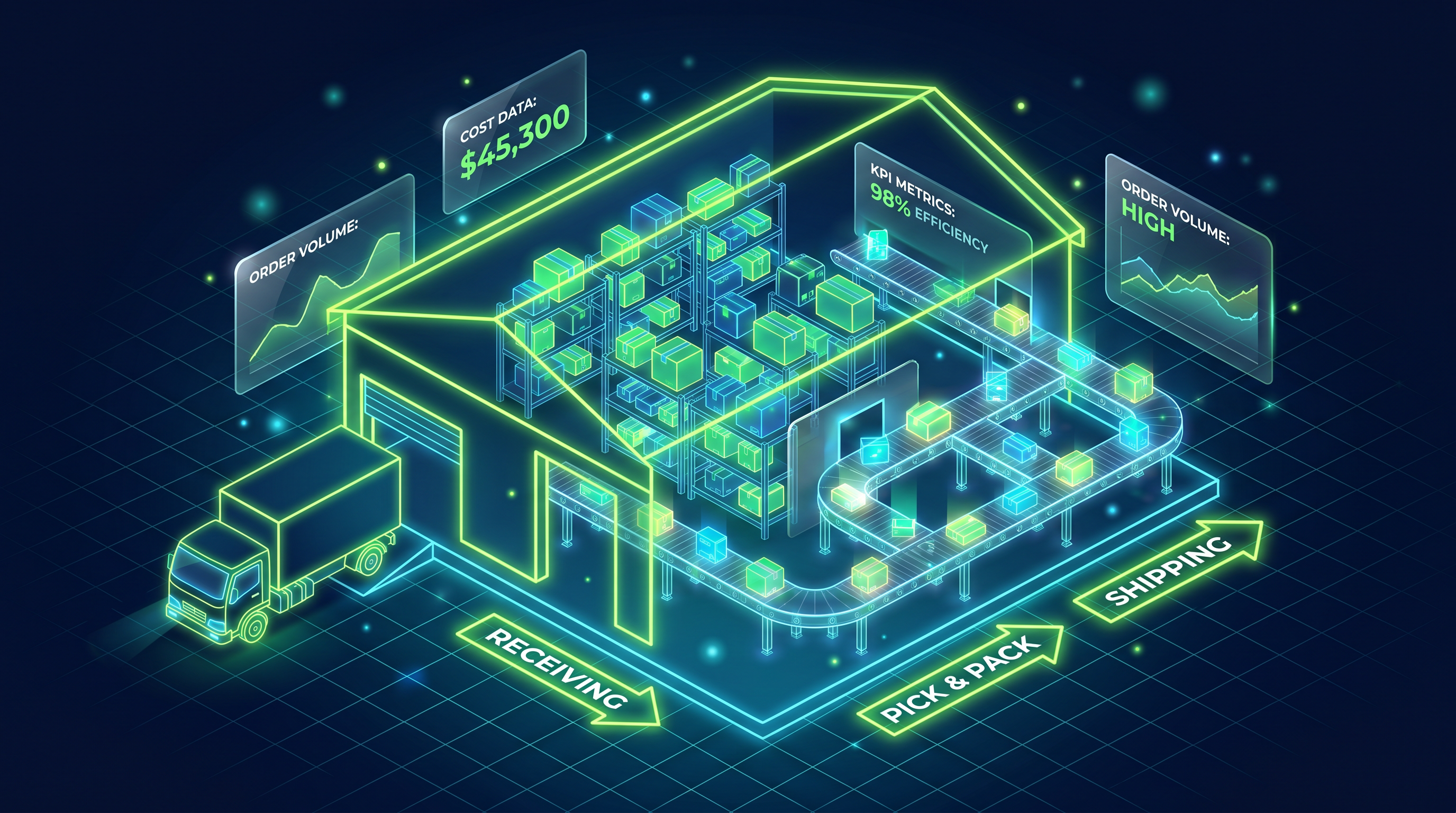
Fulfillment is the entire physical fulfillment process for an order: from receiving inventory, to storage, picking, packing, shipping, and all the way through to returns processing.
When you outsource fulfillment, you hand that entire process to a Third-Party Logistics provider (3PL). The 3PL takes on the warehouse space, staff, carrier contracts, and systems — in exchange for fees that typically combine a base rate, storage costs, and per-transaction charges.
The alternative is in-house fulfillment: your own warehouse, your own people, your own processes.
The 7 Signs Your Fulfillment Is Already Costing You
You don’t have to wait for a breakdown. These signals tell you that in-house fulfillment is already costing you more than a 3PL would:
1. You’re spending more than 20% of your time on logistics instead of growth. As a founder or Head of E-Commerce, your time is your scarcest resource. Every hour you spend on warehouse issues, staffing shifts, or carrier disputes is an hour not spent on strategy, product, or revenue.
2. You’ve delayed at least one campaign in the last three months because of warehouse capacity. When your ad spend is constrained by your square footage, logistics is limiting your marketing.
3. Your return rate is climbing — but you don’t know why. Without direct data access on warehouse quality, packaging errors, and pick accuracy rates, root cause analysis is impossible. 3PL systems surface this data in real time.
4. You have no capacity to handle seasonal spikes without a massive hiring scramble. Black Friday, holiday season, a product launch: every peak requires temporary labor that you recruit, train, and let go once the season ends. 3PLs distribute that capacity across hundreds of clients.
5. Your carrier rates are worse than what you’d get through a 3PL. Retail shipping rates without a volume contract typically run $5–$9 per shipment. 3PL providers shipping thousands of packages a day negotiate rates in the $3–$6 range. At 1,000 orders a month, that delta alone is $1,000–$3,000.
6. “Logistics plus everything else” is in too many job descriptions. When warehouse work bleeds into roles you need for product, marketing, or customer experience, you’re losing talent to the wrong tasks.
7. Your WMS is a spreadsheet. Not a joke — this is reality for many stores under $500k in revenue. Once you scale past a few thousand SKUs or 500+ orders a month, spreadsheet inventory management costs you errors, time, and customer trust every single day.
The Real Cost Breakdown: Three Scenarios
The most common mistake when comparing in-house vs. 3PL: only the visible costs get compared. The full picture looks different.
What In-House Fulfillment Actually Costs
Full in-house costs include:
- Warehouse space: Rent, utilities, insurance. Ballpark: $8–$18/sq ft/year in typical US industrial areas.
- Labor: Warehouse staff including payroll taxes and benefits. One FTE costs $3,200–$4,800/month all-in.
- Carrier rates without a volume contract: $5–$9 per shipment at low volumes.
- WMS and systems: Barcode scanners, label printers, software licenses — amortized monthly.
- Packaging materials: Boxes, fill material, tape, labels.
- Opportunity cost: The hours founders or managers spend on logistics instead of value-creating work. This never shows up in the P&L — but it’s real money.
What 3PL Actually Costs
Full 3PL costs include:
- Base / minimum fee: $0–$500/month depending on provider and volume.
- Storage fees: Flat rate or per cubic foot. Typical for SMB: $400–$900/month.
- Inbound fee: Receiving and putting away inventory. Often charged per pallet or carton.
- Pick & Pack: $1.50–$3.50 per shipment (standard). $3.50–$6.00 for D2C branded packaging with custom inserts.
- Carrier rates with volume contract: 15–30% cheaper than retail rates.
- Returns handling: Inspection, restocking, or disposal depending on the agreement.
Scenario 1: 300 Orders per Month
| Cost Item | In-House | 3PL |
|---|---|---|
| Warehouse space (500 sq ft) | $700 | — |
| Storage at 3PL | — | $400 |
| Labor (0.75 FTE) | $2,800 | — |
| Pick & Pack ($2.50/order) | — | $750 |
| Carrier costs | $1,800 | $1,200 |
| WMS & systems | $150 | incl. |
| Packaging materials | $200 | incl. |
| Returns handling | $150 | $100 |
| Founder time (6 hrs/mo.) | $600 | — |
| Total | ~$6,400 | ~$2,450 |
Bottom line at 300 orders: The 3PL is already significantly cheaper. In-house carries too much fixed overhead for the volume.
Scenario 2: 1,000 Orders per Month
| Cost Item | In-House | 3PL |
|---|---|---|
| Warehouse space (1,500 sq ft) | $1,800 | — |
| Storage at 3PL | — | $700 |
| Labor (1.5 FTE) | $5,400 | — |
| Pick & Pack ($2.50/order) | — | $2,500 |
| Carrier costs | $6,000 | $4,200 |
| WMS & systems | $200 | incl. |
| Packaging materials | $600 | incl. |
| Returns handling | $450 | $300 |
| Founder time (10 hrs/mo.) | $1,000 | — |
| Total | ~$15,450 | ~$7,700 |
Bottom line at 1,000 orders: Monthly savings of ~$7,750 — over $93,000 per year that can go directly into growth, product, or marketing.
Scenario 3: 3,000 Orders per Month
| Cost Item | In-House | 3PL |
|---|---|---|
| Warehouse space (4,000 sq ft) | $5,500 | — |
| Storage at 3PL | — | $1,600 |
| Labor (3.5 FTE) | $14,000 | — |
| Pick & Pack ($2.20/order) | — | $6,600 |
| Carrier costs | $18,000 | $12,600 |
| WMS & systems | $500 | incl. |
| Packaging materials | $1,500 | incl. |
| Returns handling | $1,500 | $1,100 |
| Founder time (20 hrs/mo.) | $2,000 | $500 |
| Total | ~$43,000 | ~$22,400 |
Bottom line at 3,000 orders: The 3PL is still significantly cheaper — but the gap stops growing proportionally. Around 5,000–8,000 stable orders per month with a consistent SKU mix and cheap warehouse access, in-house can start to make sense again.
Your Personal Calculator
First, calculate your full in-house fulfillment costs:
Then calculate your 3PL costs with realistic assumptions:
D2C vs. Traditional Online Retail: Why the Same Decision Looks Different
Almost every article on fulfillment outsourcing writes for “generic e-commerce.” For D2C brands — brands with a direct customer relationship, a distinct brand identity, and CLV-driven thinking — different rules apply.
The Package Is a Brand Touchpoint
For a D2C brand, opening the package is part of the brand experience. Tissue paper, a handwritten note, a custom sticker, branded tape. That’s not a nice-to-have: unboxing content drives organic reach on social and builds direct traffic.
A 3PL that can’t or won’t deliver that experience doesn’t cost you one order — it costs you word-of-mouth, user-generated content, and customer lifetime value.
What you need to lock in: Packaging instructions specified in the contract. Test runs documented with photos. SLA terms for packaging quality.
Data Ownership Is a Business Strategy Issue, Not an IT Issue
Who buys what, how often, in what combinations? That data drives your product development, replenishment, and CRM. With a 3PL, you need to ensure you have real-time access to all inventory data, movement data, and returns data.
What you need to lock in: API access to real-time inventory. Full data portability at contract end. Explicit ownership clauses — your data belongs to you.
Return Rate Is a ROAS Factor
Poor packaging quality at the 3PL increases your return rate. More returns mean worse product reviews. Worse reviews mean higher CPMs in paid channels, lower organic conversion rates — and ultimately, higher customer acquisition cost. The link between 3PL quality and ROAS is real and is almost never made explicit.
D2C vs. Traditional Retailer: Checklist
| Criteria | Traditional Online Retailer | D2C Brand |
|---|---|---|
| Custom packaging | Low priority | Critical |
| Customer data ownership | Medium | Critical |
| Carrier flexibility | Important | Medium |
| Unboxing quality | Unimportant | Very important |
| Real-time API data | Nice to have | Must-have |
| Branded inserts | Rare | Standard |
| Data portability at exit | Standard | Critical |
The Types of 3PLs — and Who They’re Right For
There’s no single “best” fulfillment solution. There’s the solution that fits your specific situation.
Type 1: Platform 3PLs (API-First)
Examples: Flexport, ShipBob, Alaiko, byrd
Profile: Software-driven fulfillment platforms. Shopify integration from day one, real-time dashboards, automated tracking. Higher base fees than traditional 3PLs, but significantly more transparency and control.
Best for: D2C brands, growing Shopify stores, anyone who prioritizes data visibility and is willing to pay for it.
Type 2: Regional 3PLs
Profile: Traditional logistics providers with e-commerce experience. More manual processes, lower base fees, less automation. Personal account reps, but more variable service quality.
Best for: Retailers with stable processes and limited tech budget. Works well for B2B fulfillment, not ideal for dynamic D2C brands.
Type 3: Specialty 3PLs
Profile: Specialists in temperature control, hazmat, oversized freight, or specific product categories.
Best for: Only if your product type requires it — food and beverage, cosmetics with temperature requirements, sporting equipment with oversize dimensions.
Type 4: Enterprise Logistics Providers
Examples: UPS Supply Chain, DHL Supply Chain, FedEx Fulfillment
Profile: Excellent infrastructure and carrier rates, but minimal flexibility for smaller brands. Volume minimums, rigid processes, lengthy contract negotiations.
Best for: Stores with 10,000+ stable orders per month that prioritize scalability over agility.
The 5 Most Expensive Contract Traps in 3PL Agreements
This is the section no provider includes in their sales deck. And the section where an experienced, neutral advisor delivers real value.
Trap 1: Auto-Renewal with a Short Cancellation Window
Many 3PL contracts auto-renew for 12 months unless you cancel 60–90 days before the end of the term. Miss that window — often in Q4 when nobody’s thinking about contract dates — and you’re locked in for another year.
Counter-move: Negotiate a rolling 60-day cancellation clause. Set a calendar reminder 6 months before the end of every term.
Trap 2: Inventory Removal Fees with No Cap
When you leave a 3PL, some providers charge per pallet or per carton to return your own inventory. Without a contractual cap, this can easily run into thousands of dollars on larger stock positions.
Counter-move: Cap inventory removal fees in the contract. Negotiate free removal in the first year.
Trap 3: Price Escalation Clauses Without a Termination Right
Many contracts allow the 3PL to raise prices annually by a set percentage — without giving you the right to exit early. If the carrier market tightens or the 3PL wants to improve its margin, you’re stuck.
Counter-move: Negotiate a termination right triggered by any price increase above 5%. Alternatively, tie escalations to a defined index (e.g., CPI).
Trap 4: Minimum Volume Commitments with Shortfall Fees
If your volume dips below a contracted minimum — after a weak campaign, at the end of a season, due to a supply issue — you pay a shortfall fee for unshipped packages. This clause appears in many contracts and never comes up in the first sales conversation.
Counter-move: Set minimum volume thresholds realistically low. No shortfall fees without a 90-day advance warning period.
Trap 5: IT Integration Billed as a Separate Project
The Shopify integration is “standard,” but connecting your ERP, your CRM, or your returns platform is a “custom project” with a price tag that scales with your systems’ complexity. That’s not in the quote.
Counter-move: Define all required integrations in writing as standard included services before signing. Or: only work with API-first platform 3PLs that include standard integrations at no added cost.
Decision Matrix: Should You Outsource Fulfillment?
Answer these 8 questions and tally your score.
| Question | 0 Points | 1 Point | 2 Points |
|---|---|---|---|
| Order Volume | < 200/month | 200–1,000/month | > 1,000/month |
| Growth Rate | Flat | < 20% per year | > 20% per year |
| Seasonality | Even year-round | Moderate spikes | Heavy spikes (Q4, BFCM) |
| Logistics Time (Founder) | < 5% | 5–20% | > 20% |
| Carrier Rates | Below market | At market | Above market |
| Warehouse Access | Owned / cheap lease | Tight | None / expensive |
| Branding Requirements | Low | Medium | High (D2C) |
| 12-Month Growth Plan | No clear target | Moderate growth | Scaling planned |
Score interpretation:
- 0–5 points: In-house fulfillment is probably the right call. Revisit in 6 months.
- 6–10 points: Explore a hybrid approach or phased outsourcing. Run the cost model now.
- 11–16 points: Outsourcing fulfillment is strategically sound. Build your provider shortlist and kick off the process.
The 12-Week Migration Plan
Starting a 3PL transition in panic mode costs you twice: in mistakes and in money. A structured process takes 8–15 weeks.
Phase 1: Evaluation and Preparation (Weeks 1–4)
Weeks 1–2: Build your requirements profile
- Average and peak order volume
- SKU count and dimensions
- Return rate
- Carrier requirements (overnight, signature required, oversized?)
- Branding requirements
- ERP / store integrations needed
Weeks 2–3: Build your shortlist, request quotes Contact at least 3 providers. Give them identical volume scenarios. Explicitly ask about hidden costs: inbound fees, base fees, IT integration, inventory removal.
Weeks 3–4: Contract negotiation Audit all 5 contract traps above. Bring in a logistics attorney. Anchor SLA terms (pick accuracy, OTIF, order cycle time) in the contract.
Milestone: Contract signed, IT integration scoped, go-live date confirmed.
Phase 2: Parallel Setup and Inventory Migration (Weeks 5–8)
Weeks 5–6: Build systems
- Test Shopify integration end-to-end
- Clarify barcode / labeling requirements
- Map your SKUs into the 3PL’s system
Weeks 6–7: Pilot run Start with a small subset of your catalog. Review package quality. Test tracking. Record error rate.
Weeks 7–8: Inventory transfer Wind down in-house shipping. Transfer stock to 3PL. Avoid parallel operations — double warehouse costs are the most expensive part of this phase (typically 4–8 weeks of overlap).
Red flags in this phase:
- 3PL delivery times suddenly exceed 5 business days without explanation
- Tracking numbers not generating correctly
- Inbound confirmation taking more than 48 hours
Phase 3: Go-Live and Stabilization (Weeks 9–12)
Week 9: Cut-over All orders now route through the 3PL. Keep a small in-house safety buffer for 2 weeks in case of emergencies.
Weeks 10–12: Intensive KPI monitoring Daily: order cycle time, open orders, tracking exceptions. Weekly: pick accuracy, OTIF, returns handling. Escalate immediately when SLAs are breached.
Milestone: Stable KPIs over 4 consecutive weeks = successful migration.
The KPIs You Need to Manage Your 3PL
If you don’t know these metrics and anchor them in your contract, you have no control.
Pick Accuracy
Definition: The percentage of orders shipped with the correct item in the correct quantity.
Minimum SLA: > 99.5%
Top 3PL standard: > 99.95%
Why it matters: One error per 500 orders costs on average $30–$60 (return, reshipment, support). At 0.5% error rate on 1,000 orders = $150–$300 in direct costs every month.
OTIF (On Time In Full)
Definition: The percentage of orders shipped complete and on schedule.
Minimum SLA: > 92%
Why it matters: OTIF below 90% drives up your customer contact rate, strains support, and hurts reviews — especially on Amazon and Google Shopping.
Perfect Order Rate
Definition: The percentage of orders delivered on time, complete, undamaged, and with correct documentation.
Target for D2C: > 95%
Why it matters: For D2C brands this is the gold standard — every deviation is a CLV risk.
Inventory Accuracy
Definition: Reconciliation between physical stock and system stock.
Minimum SLA: > 99.5%
Why it matters: Discrepancies between the 3PL’s WMS and your store system cause oversells, cancellations, and eroded customer trust.
Order Cycle Time (Order to Ship)
Definition: Time from order receipt to carrier handoff.
Standard: ≤ 24 hours (business days)
Premium: ≤ 12 hours
Why it matters: Delivery speed expectations drive conversion rate. “Ships same day if ordered by 2 PM” is a measurable revenue lever.
| KPI | SLA Minimum | Top 3PL Standard | Consequence if Breached |
|---|---|---|---|
| Pick Accuracy | >99.5% | >99.95% | Credit per error — negotiate into contract |
| OTIF Rate | >92% | >96% | Escalation protocol + monthly review |
| Perfect Order Rate (D2C) | >95% | >98% | SLA breach penalty |
| Inventory Accuracy | >99.5% | >99.9% | Monthly audit at 3PL's cost |
| Order Cycle Time (Standard) | ≤ 24 hrs | ≤ 12 hrs | Express reship at 3PL's cost |
| Returns Processing | ≤ 5 business days | ≤ 2 business days | Credit upon completion |
What No Article Covers: Bringing Fulfillment Back In-House
Every guide covers the move toward outsourcing. Nobody writes about the move back. But it’s real — and it makes sense in specific situations.
When does in-house logistics make sense again?
When three conditions are met simultaneously:
- Stable volume of 5,000+ orders per month for at least 12 consecutive months
- Favorable warehouse access — owned property or a long-term lease below market rate
- Consistent SKU mix without heavy seasonality
Under those conditions, owning your capacity can eliminate the 3PL margin and improve process quality because you have full control.
What makes switching back complicated:
- Rebuilding staff and operational expertise takes 3–6 months
- WMS implementation: a project cost that scales with SKU count, integration depth, and warehouse complexity
- Transition overlap costs
- 3PL contract lock-in that hasn’t expired yet
Bottom line: Bringing fulfillment back in-house is a real strategic option — but not a fast one. Anyone planning it needs an 18–24-month horizon.
Frequently Asked Questions About Fulfillment Outsourcing
How many orders per month before outsourcing fulfillment makes sense?
The general benchmark is 200–400 shipments per month. Below that threshold, 3PL fixed fees and minimums weigh too heavily. At that volume, the combination of 3PL carrier rates and eliminated labor costs typically outperforms in-house operations.
What does a fulfillment company charge per order?
Average pick & pack pricing in the US runs $1.50–$3.50 per shipment for standard fulfillment. D2C fulfillment with custom packaging and inserts runs $3.50–$6.00. Add storage ($400–$900/month for SMB), carrier costs ($3–$6/shipment with volume rates), and any base fees.
How long does a 3PL transition take?
A structured transition takes 8–15 weeks across three phases: evaluation and contract negotiation (4 weeks), parallel setup and inventory transfer (4 weeks), go-live and stabilization (4 weeks). Rushing the process costs you through errors and duplicated expenses.
What’s the difference between a 3PL and a 4PL?
A 3PL (Third-Party Logistics) handles physical logistics tasks: storage, picking, shipping. A 4PL (Fourth-Party Logistics) goes further — it coordinates multiple logistics partners and manages your supply chain strategy. For most e-commerce businesses under $50M in revenue, a 3PL is the relevant category.
What contract length makes sense with a 3PL?
For a first engagement, I recommend month-to-month or maximum 12 months with a rolling cancellation clause. Only after 12–18 months of proven partnership quality do longer terms with better pricing make sense to negotiate.
Do I keep my customer data when I leave a 3PL?
That depends entirely on the contract. Make sure it explicitly states: all inventory, movement, and customer data belongs to you. You have the right to a full data export in machine-readable format within 14 days of contract termination. Without that clause, a 3PL can hold your data hostage in a dispute.
Can I do a D2C unboxing experience through a 3PL?
Yes — but not through every 3PL. Platform providers like ShipBob, Alaiko, and byrd offer custom packaging instructions and quality checks for D2C brands. Traditional regional 3PLs often don’t have those processes. Describe your requirements in as much detail as possible during the sales process and ask for references from comparable D2C brands.
The Bottom Line: Fulfillment Outsourcing as a Strategic Decision
Outsourcing fulfillment is not an operational workaround. It’s a strategic decision that frees up capital, time, and headspace to invest in growth, product, and customer experience.
But it’s also a decision that can go wrong — through incomplete cost analysis, weak contracts, the wrong 3PL, or bad timing.
This article gave you what no provider will: the full cost picture, the hidden traps, and the structured process.
If you now know it’s time — or if you still have questions about your specific situation: I offer a vendor-neutral first assessment. No sales pressure, no recommendations driven by referral fees.
The answer I give most often isn’t “outsource now” and it isn’t “keep it in-house.” It’s: run the numbers. Then decide. Most founders never do — because nobody showed them how.
Related Articles
Fulfillment is one piece of your operational stack. Other parts:
- Shopify ERP Guide 2026: Which WMS or ERP fits your fulfillment setup?
- Return Rate in E-Commerce: What poor packaging quality actually costs you
- E-Commerce Metrics: The complete KPI framework for online retailers