
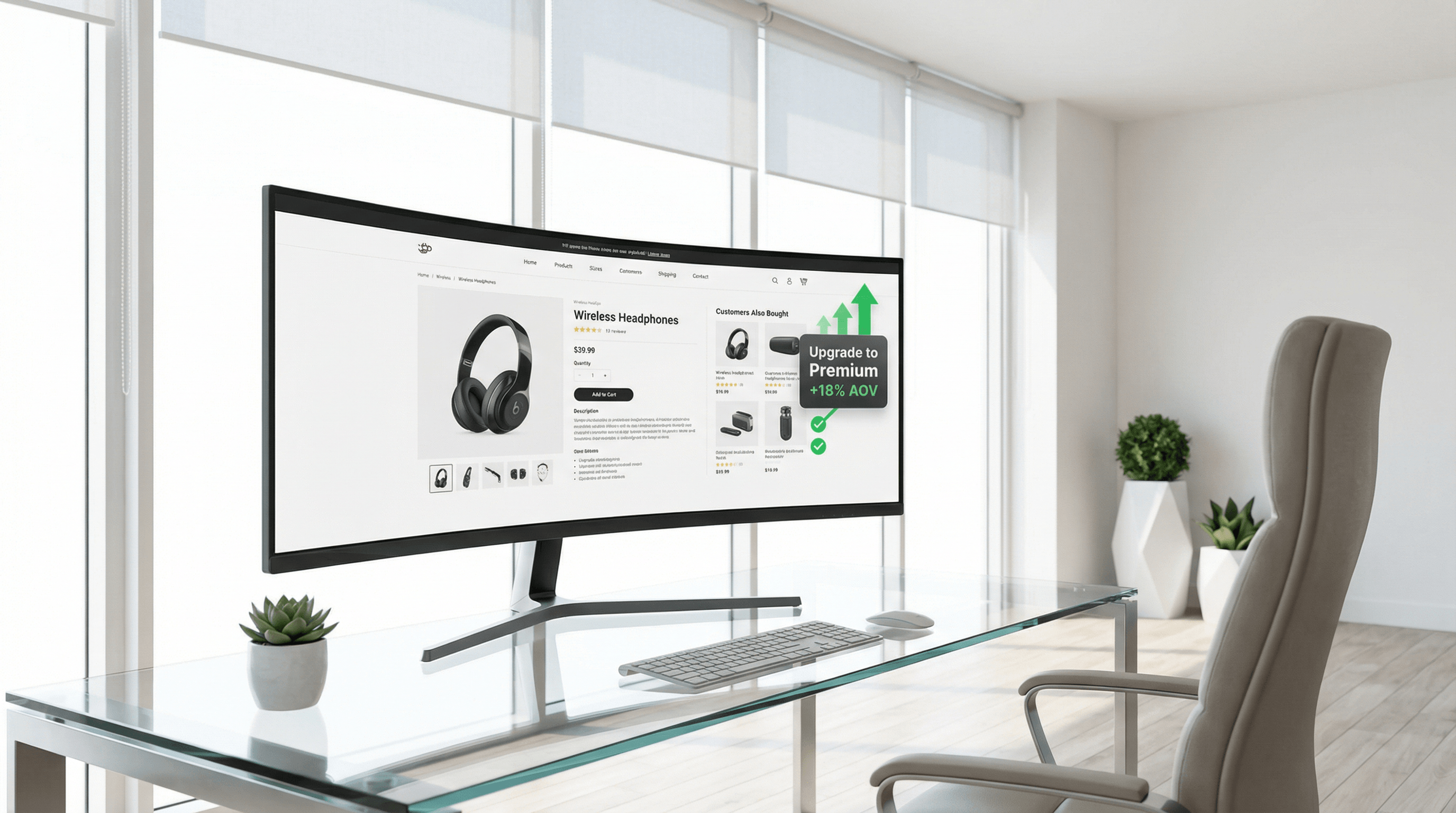
You installed an upselling app. The recommendations went live. Two weeks later you check the numbers — and notice your conversion rate dropped.
So you turn the app off.
That’s the most common mistake in e-commerce. The app wasn’t the problem. Upselling wasn’t the problem. The timing was wrong. A cross-sell widget in the middle of your checkout flow costs you purchases — because it creates friction exactly when a customer was already ready to buy. The same suggestion, one page later, would have converted 4–10% of customers.
Welcome to the Timing Paradox.
Cross-selling and upselling are among the most powerful revenue levers in e-commerce. Amazon generates 35% of its total revenue through product recommendations. Stores that use upselling consistently see AOV increases of 10–30%. But the same strategy, at the wrong moment or with irrelevant offers, lowers overall conversion and frustrates customers.
This article shows you why timing matters more than the offer itself, why 80% of cross-sells fail because of irrelevance — and which app actually makes sense at your current revenue stage.
Cross-Selling vs. Upselling: The Formula Everyone Can Remember
Before diving in: the distinction is simpler than most definitions suggest.
Cross-selling = offer a complementary product. → Sneakers + shoe care. Camera + memory card. Coffee machine + coffee.
Upselling = offer a better version of the same product. → Camera Basic → Camera Pro. 250g pack → 1kg pack. Single license → Team license.
Both strategies share the same goal — increase cart value — and that’s exactly where the confusion creeps in. But the path is different, and so is the optimal placement, the psychology behind it, and the mistakes you can make.
| Cross-Selling | Upselling | |
|---|---|---|
| What it is | Complementary product | Better version |
| Goal | Completing the purchase | Upgrading the same purchase |
| Best timing | Post-purchase, email | Product page, post-purchase |
| Psychology | ”This belongs with it" | "This is worth more” |
| AOV increase | +10–20% | +15–30% |
| Error risk | Irrelevant products | Too large a price jump |
What does AOV optimization actually mean for your store?
Calculate your personal upside:
The Psychology Behind It — Why Customers Say Yes
Upselling isn’t manipulation. It’s psychology — and understanding the mechanisms means using them correctly.
The Commitment Principle: Why Post-Purchase Converts So Well
Robert Cialdini describes in Influence the principle of consistency: people who’ve said yes once find it easier to say yes again. Someone who’s already completed a purchase is psychologically in a “yes mode.”
A post-purchase upsell works precisely because of this: the purchase risk is gone. The credit card is already in the system. The decision has been made. Saying yes again costs far less mental energy than the first yes — which is why post-purchase upsells convert at 4–10%, significantly above cart upsells (1–4%).
That’s not a coincidence. That’s Cialdini.
The Anchor Effect: The Good-Better-Best Strategy
Show a customer two options — Basic at €29 and Pro at €59 — and they’ll perceive the more expensive one as overpriced. Show them three options — Basic at €29, Standard at €49, and Pro at €89 — and Standard suddenly looks like a bargain.
The anchor (the most expensive option) makes the middle option attractive. Amazon uses this consistently. Apple has perfected it. For upselling, this means: always offer at least three variants, not two.
Social Proof: “Frequently Bought Together”
Customers trust other customers more than product descriptions. “Customers also bought” is one of the most common cross-selling phrasings — but it has a problem: it’s generic.
Customers also bought → neutral, weak 87% of buyers combine this with… → specific, convincing Perfect for this outfit → situational, emotional
The phrasing makes the difference. Social proof works — but only when it’s specific and credible.
The Timing Paradox: When the Moment Matters More Than the Offer
This is the most underestimated principle in cross-selling — and the main reason many stores have a bad experience and give up on the strategy entirely.
The core thesis: A perfect product at the wrong moment converts worse than a mediocre product at the right moment.
Product Page and Cart: Pre-Purchase Upselling
Conversion rate: 1–4%
Pre-purchase upsells on the product page or in the cart work — but only under specific conditions:
- The cross-sell product is directly functionally linked (camera → memory card)
- The upsell is clearly superior and the price premium is less than 25%
- There are at most 1–2 recommendations at any time
The risk: every additional decision before checkout increases cognitive load. Cognitive load increases the likelihood of abandonment. Five upsell widgets in your checkout means optimizing for the wrong goal.
Post-Purchase: The Gold Mine After Checkout
Conversion rate: 4–10% (up to 15% with one-click)
Post-purchase upsells appear after the order confirmation — after the primary conversion is already secured. That’s the key.
The customer has already paid. Credit card details are in the system. A one-click upsell requires no re-entry — and that’s what makes the difference. The only click needed is “Add to cart” or “Upgrade now.”
One-click post-purchase conversion rate: up to 15%. Classic cart upsell: 1–4%.
That’s not a marginal difference. That’s the factor that determines whether your upselling strategy is profitable.
Cross-Selling via Email: The Underrated Channel
Email is the most underrated cross-selling channel. Why? Because there’s no time pressure.
Post-purchase emails have an average open rate of 40.95% — nearly double a standard newsletter. Click-to-conversion is 21.12%. This explains why well-configured post-purchase email sequences can generate 20–30% of a store’s revenue.
The sweet spot: 2–7 days after order confirmation or delivery. Earlier feels pushy; later and the impulse is gone.
5-stage post-purchase email sequence:
| Day | Content | Goal | |
|---|---|---|---|
| +0 | Order confirmation | Confirmation + first cross-sell hint | Delight, plant the first impulse |
| +2 | Shipping confirmation | Accessory recommendation (functional) | Cross-sell at peak attention |
| +5 | ”On its way to you” | Tutorial / use case + upgrade hint | Upsell before product experience |
| +10 | Post-delivery | Review request + “Others also loved” | Social proof + cross-sell |
| +30 | Win-back / reorder | ”Running low?” | Repeat purchase or upsell |
The Relevance Rule: Why 80% of Cross-Sells Fail
Here’s the uncomfortable truth: most cross-sell widgets underperform not because upselling doesn’t work — but because the recommendations are irrelevant.
79% of consumers are more likely to buy when recommendations are relevant. 74% get frustrated when they receive no personalized suggestions. These aren’t just nice stats — they’re the foundation of your entire upselling strategy.
Generic “customers also bought” widgets show what’s statistically purchased together. That’s not the same as what’s right for this customer, in this moment.
The 3 Relevance Levels
Level 1 — Categorical relevance: Same product segment. → Sneakers → other sneakers. Weak. Someone buying sneakers doesn’t want more sneakers.
Level 2 — Functional relevance: Complements the function of the main product. → Sneakers → shoe care. Camera → memory card. Laptop → laptop bag. This is the standard — and it works.
Level 3 — Situational relevance: Same usage situation. → Running shoes → compression socks + water bottle + training plan. Coffee machine → coffee + descaler + cups. This is where conversion rates are 2–3× above standard.
Most stores optimize at Level 2. The stores that make upselling genuinely profitable think at Level 3: what situation is this customer buying for? What else do they need in that moment?
Cross-Selling by Category — Concrete Shopify Examples
Fashion & Apparel
The challenge in fashion: someone buying trousers doesn’t want more trousers. They want the complete outfit.
Cross-sell: “Goes with these trousers” — shirt, shoes, belt — presented as a complete outfit, not a list. Upsell: Quality tier (organic cotton → premium merino). Single item → outfit bundle. Email timing: 5–7 days after delivery — when the customer is wearing the first piece and thinking about the outfit.
Beauty & Skincare
Beauty thrives on routines. No customer needs just one product.
Cross-sell: The complete skincare routine — cleanser, serum, moisturizer, SPF. Upsell: Travel size → full size. Single product → discovery set or subscription. Note: Subscription upsells work especially well in beauty — customers don’t want to run out. OLLY increased subscription revenue by 63% using Rebuy.
Food & Supplements
Cross-sell: Recipe bundles (all ingredients together), combo packs (protein + creatine + shaker). Upsell: Small pack → monthly supply → annual supply (anchor effect maximally usable). Email: Post-purchase “Running low?” after 25–30 days depending on product size.
Tech & Electronics
Tech is the only category where pre-purchase upsells (on the product page) work strongly — because tech buyers research and compare before buying.
Cross-sell: Essential accessories (charging cable, case, screen protector, extended warranty). Upsell: Next product generation, more storage, longer warranty. Timing: Product page (pre-purchase) + post-purchase for accessories. Never in checkout.
When Upselling Kills Conversion — 7 Mistakes to Avoid
Mistake 1: Upselling before checkout Cart upsells and pop-ups that interrupt the checkout flow increase abandonment. The rule: secure the primary conversion first — then expand.
Mistake 2: Irrelevant recommendations “Customers also bought: vacuum cleaner” on a running shoes product page isn’t cross-selling — it’s noise. Irrelevant recommendations damage trust.
Mistake 3: More than 2 options simultaneously The paradox of choice: beyond 2–3 simultaneous recommendations, decision-making ability drops. Show at most 1–2 precise recommendations — no widget galleries.
Mistake 4: Price jump over 25% The 25% rule: an upsell offer should cost at most 25% more than the original product. Upselling a €30 case for a €50 item loses the upsell — and sometimes the whole purchase.
Mistake 5: Too many pop-ups Pop-ups that interrupt the purchase flow feel pushy. Exit-intent pop-up with a single targeted upsell: fine. Full-screen pop-up in checkout: conversion killer.
Mistake 6: Same recommendation for all customers Segmentation isn’t optional. Showing every customer the same thing optimizes for the average — and misses everyone individually. At minimum: segment by product category, AOV tier, and new vs. returning customer.
Mistake 7: Cross-selling without context “Customers also bought” doesn’t explain why. “Perfect for caring for your new product” does. The context sentence makes the difference between a recommendation and a sale.
The GMV-Stage Model: Which Shopify App at Which Revenue
The most important insight from Shopify practice: the best upselling app doesn’t exist. There’s only the right app for your current revenue stage.
Rebuy at €30K GMV is wasted capital — its AI personalization algorithm needs data volume you don’t have yet. No app at €500K GMV is wasted revenue.
| GMV Stage | Recommendation | Price | Why this stage |
|---|---|---|---|
| €0–50K / year | Selleasy (Upsell & Cross Sell) | Free to €8.99/mo | Too little data for AI personalization. Simple logic, zero overhead. |
| €50K–300K / year | Frequently Bought Together CBB | €19.99/mo (flat) | AI algorithm works once you have enough order history. Flat pricing scales cleanly. |
| €300K–1M / year | ReConvert + Aftersell | from €29/mo | Post-purchase funnels become ROI-positive. A/B testing matters here. |
| €1M+ / year | Rebuy Personalization Engine | from €99/mo | Full-stack personalization, Smart Cart, subscription upsells. Pays off from ~3,000 orders/month. |
Rebuy: When does it pay off?
Rebuy starts at €99/month. The break-even point is roughly +0.5–1% additional conversion or €1–2 higher AOV at sufficient order volume.
Rebuy case studies show: +18–27% AOV lift depending on category (Alex and Ani +18%, Copper Cow Coffee +23%, MOSH +19%). That means: from around 1,000 orders/month at €50 AOV, Rebuy pays for itself within the first week at a conservative 15% AOV lift.
Below 500 orders/month, Frequently Bought Together CBB is almost always the better choice.
Setting up a post-purchase upsell (quick guide)
- Install app: ReConvert or Aftersell (both in Shopify App Store)
- Choose product: Max. 1 product, direct functional connection to main product
- Check price: Max. 25% above purchase price
- Enable one-click: No re-entry of payment details
- Start A/B test: At least 500 post-purchase impressions per variant
Measuring and Optimizing AOV
AOV (Average Order Value) is the metric behind every upselling decision — and arguably the most ignored one in Shopify dashboards.
AOV = Total Revenue / Number of OrdersAOV benchmarks in e-commerce:
| Category | Benchmark AOV | Realistic upselling potential |
|---|---|---|
| Fashion & Accessories | €65–85 | +12–20% through outfit cross-sells |
| Beauty & Skincare | €45–75 | +15–25% through routine bundles |
| Supplements | €55–90 | +20–35% through size upgrades |
| Electronics | €120–350 | +10–15% through accessory cross-sells |
| Home & Living | €80–150 | +10–18% through combo sets |
| Pet | €40–65 | +15–25% through routine bundles |
A/B Testing: How to Find the Best Placement
Before every test:
- What are you testing? Placement (product page vs. post-purchase), offer (product A vs. B), phrasing, price
- How much traffic? At least 1,000 post-purchase impressions per variant for statistically relevant results
- What’s the success metric? AOV increase, not just click rate
Real-world example: Dr. Squatch tested quantity defaulting (instead of a single pack, the 3-pack was pre-selected). Result: +54% revenue. No new app. No new product. Just a different default selection.
FAQ: Cross-Selling & Upselling in E-Commerce
What is the difference between cross-selling and upselling?
Cross-selling offers customers complementary products that complete their original purchase (sneakers → shoe care). Upselling suggests a better version of the same product (Camera Basic → Camera Pro). Both strategies increase AOV but through different paths: cross-selling expands the cart, upselling upgrades it.
When does upselling actually annoy customers?
Upselling gets annoying when: (1) it interrupts the checkout and derails an already-made purchase decision, (2) the offer is more than 25% above the purchase price, (3) more than two recommendations show up at once, (4) the recommendation has no obvious connection to what was just bought. The most common frustration? Irrelevant recommendations that feel like spam.
What is the average conversion rate for upselling?
Conversion rates vary significantly by placement. Product page and cart: 1–4%. Post-purchase page (after checkout): 4–10%, with one-click up to 15%. Post-purchase emails: 40.95% open rate, 21.12% click-to-conversion. The biggest lever is therefore timing — not the offer itself.
Which Shopify app is best for cross-selling and upselling?
There’s no universally best app — it depends on your GMV. €0–50K: Selleasy (free). €50K–300K: Frequently Bought Together CBB (€19.99/mo). €300K–1M: ReConvert or Aftersell for post-purchase funnels. Above €1M: Rebuy Personalization Engine (from €99/mo). Rebuy only earns its keep from around 1,000 orders/month — below that, its AI personalization algorithm doesn’t have enough data to shine.
When should a cross-selling email be sent after purchase?
The sweet spot for post-purchase cross-sell emails is 2–7 days after order confirmation or delivery. Earlier feels pushy (the customer hasn’t used the product yet); later and the emotional impulse of the purchase has faded. The highest conversion comes from emails that connect to the specific usage situation (“Your new product has arrived — here’s what other customers pair it with”).
What is the 25% price rule in upselling?
The 25% rule is straightforward: your upsell should cost no more than 25% above what the customer already chose. For a €60 item, upgrading to €75 is realistic. Jumping to €120 is too far outside their mental price frame. Cross that line and the customer doesn’t just skip the upsell — they start feeling manipulated.
How do you calculate AOV and what's a good value?
AOV = Total Revenue ÷ Number of Orders (in the same period). A “good” AOV is industry-dependent: fashion €65–85, beauty €45–75, supplements €55–90, electronics €120–350. More important than the absolute value is the trend: if your AOV stagnates with growing traffic, you don’t have a traffic problem — you have a cross-selling problem.
Can upselling lower a store's overall conversion rate?
Yes — if used at the wrong moment. Cart upsells and pop-ups before checkout increase cognitive load and therefore the likelihood of abandonment. Every additional decision element in the checkout flow can reduce conversion. The solution: use cross-selling and upselling primarily post-purchase. Secure the primary conversion first — then expand.
The Only Mistake You Must Avoid
Cross-selling and upselling aren’t tricks. They’re service — when done correctly.
A customer who buys a camera without knowing they need a memory card isn’t a satisfied customer. They’re a customer who’ll discover in two days that the camera doesn’t work. The right cross-sell at the right time isn’t an imposition — it’s help.
The Timing Paradox explains it: post-purchase doesn’t convert better because customers are more “compliant” after checkout. It converts better because the primary risk — “am I making the right call?” — is already off the table. The customer is relaxed. Open. Done with the hard part.
Use that moment. Show the right thing. Say why it fits. And don’t reach for a price premium that would strain the trust of a customer you just earned.
The one mistake you really can’t afford: writing off upselling because a badly-timed attempt didn’t work.
Want to audit your cross-selling and upselling setup? Let’s talk.