
Three agencies, three opinions. One says headless commerce is the only future-proof architecture for your store. The second thinks nothing of it and pushes you back toward an off-the-shelf Shopify theme. The third has a case-study deck ready with big brand logos and not a single cost figure in it.
Here’s the problem with almost every headless commerce article I’ve read in the last few months: it explains the architecture but not the bill. It shows logos but no numbers. And it rarely says when headless commerce would simply be the wrong call for your store.
I’m a Shopify partner. digitalsprung specializes in Shopify and Shopify Plus, that’s no secret. Precisely because of that, this isn’t a sales pitch for headless commerce. I’ve been on projects where headless was the right call, and just as many where a solid monolithic setup with a good theme delivered the same result for a fraction of the effort.
What is headless commerce? Definition and distinction
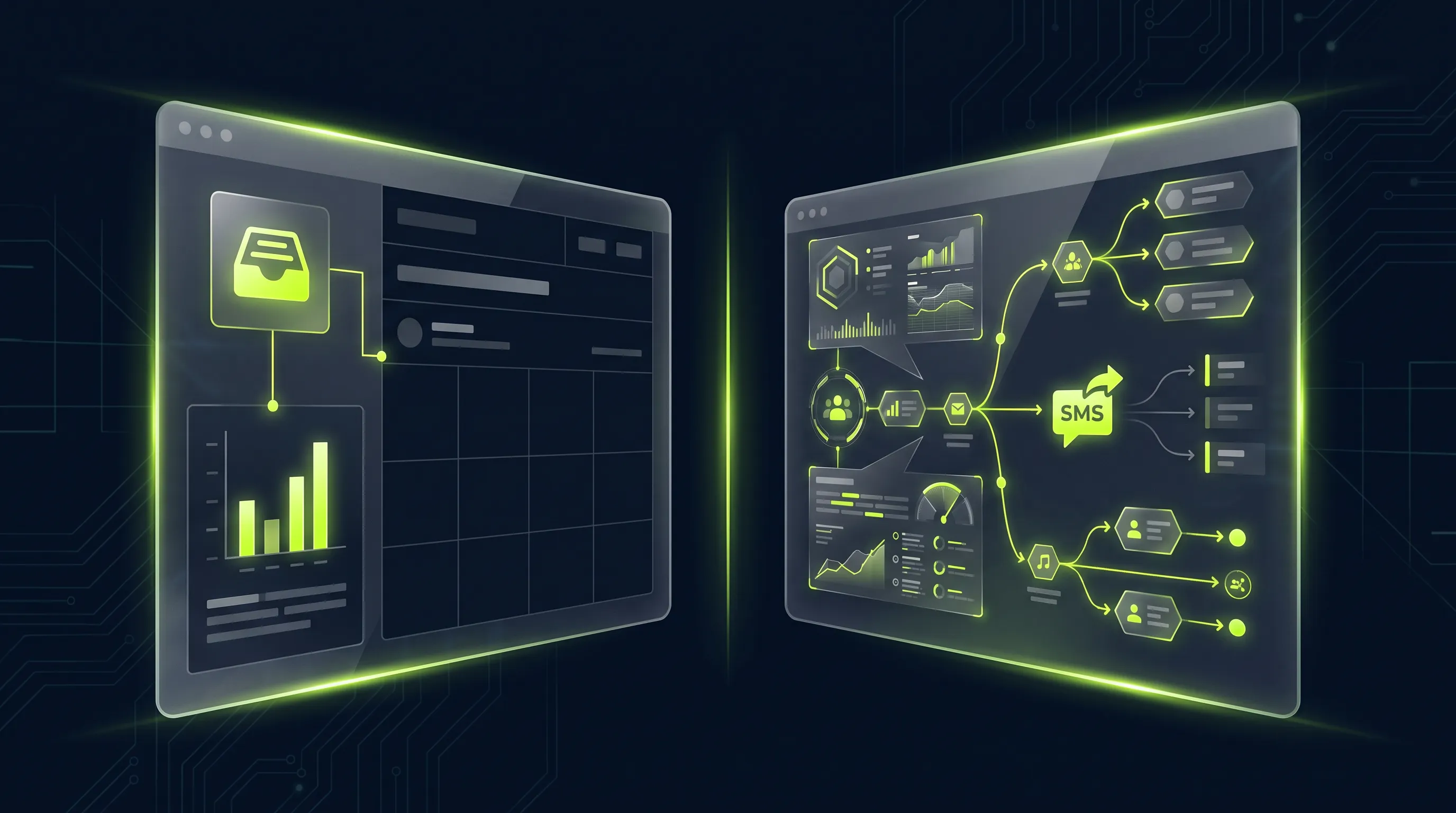
Headless commerce is an e-commerce architecture where the frontend (the presentation layer customers see) and the backend (product data, cart, checkout logic) are fully decoupled and communicate only through APIs. The backend is “headless”, it no longer has a fixed frontend attached. Instead, any number of frontends, a website, an app, a voice interface, can talk to the same backend logic through standardized interfaces.
The difference from a traditional shop system: in a monolith like a standard Shopify theme or a classic Shopware installation, frontend and backend live in the same system. You change the template, and the change shows up directly for customers. In headless commerce, the frontend is its own project, usually built on React, Next.js, or Remix, that fetches backend data via API and renders it independently.
Headless commerce, headless e-commerce, and headless storefront: what’s the difference?
These three terms get used almost interchangeably, but they don’t mean quite the same thing:
- Headless commerce is the umbrella architecture term: decoupling frontend and backend as a principle, independent of industry.
- Headless e-commerce is the same architecture applied specifically to online retail: product catalogs, cart, checkout, order fulfillment.
- Headless storefront refers specifically to the decoupled frontend itself, the actual shop interface built on top of the backend APIs. When someone says “our headless storefront,” they mean the React or Next.js project that actually renders the shop.
In practice, the distinction rarely matters for the buying decision. The next distinction matters more.
Headless commerce vs. MACH architecture vs. composable commerce
These three terms get blended together in marketing, but they’re different concepts:
- Headless commerce is just the decoupling of frontend and backend. A monolithic backend can still be run headless.
- MACH architecture (Microservices, API-first, Cloud-native, Headless) is a broader architectural principle: the entire backend is built from independent microservices instead of a single system.
- Composable commerce is the business strategy behind it: you assemble your tech stack from swappable, best-of-breed solutions instead of using an all-in-one platform.
So headless is the technical prerequisite, MACH is the architectural philosophy, and composable commerce is the resulting purchasing strategy. A shop can be headless without being fully MACH or composable, for example if only the frontend was decoupled while the backend remains a single system.
If you’re not yet sure which shop system should even sit behind the frontend, it’s worth starting with the full e-commerce platform comparison covering Shopify, Shopware, WooCommerce, and Magento before treating headless commerce as a frontend-only question.
Headless commerce vs. monolith: the real cost comparison
Headless commerce typically costs about 2 to 3 times more upfront than a professionally built monolith, but it often pays back over three to four years through lower platform dependency and better performance. That’s the honest number most comparison articles leave out.
Concretely: a solid monolithic setup, say a customized Shopify theme with clean app integration, typically runs €25,000 to €40,000 for a mid-complexity store. A comparable headless project with its own frontend, storefront API integration, and content layer runs closer to €70,000 to €150,000, depending on scope and integration depth.
3-year TCO: headless commerce vs. monolith
| Cost item | Monolith (e.g. Shopify theme) | Headless commerce | Trend |
|---|---|---|---|
| Initial development | €25,000 – 40,000 | €70,000 – 150,000 | Headless significantly more expensive to build |
| Ongoing maintenance/month | €500 – 2,000 | €3,000 – 13,000 | Headless requires a permanent dev team |
| Hosting & infrastructure | Included in platform fee | Separate: CDN, frontend hosting, API gateway | Monolith more predictable |
| Theme replatforming after 3-4 years | €15,000 – 30,000 (usually required) | Usually avoided (frontend independent of backend) | Headless more stable long-term |
| Flexibility across multi-channel/omnichannel | Limited by platform logic | High, one backend for any number of frontends | Clear headless advantage |
| Time-to-market for new features | Weeks (app ecosystem) | Weeks to months (custom development) | Monolith faster for standard needs |
What this shows: in the first one to two years, a monolith is almost always cheaper. Headless commerce’s TCO advantage only appears once the monolith needs an expensive theme replatform after three to four years, while a well-built headless frontend keeps running independent of the backend.
Payback calculator: when does headless commerce actually pay off?
Instead of a blanket statement, here’s a calculation with your own numbers. The formula sets migration cost against the monthly revenue gain from conversion uplift, minus the additional operating cost:
Documented Shopify case studies show a conversion uplift from headless commerce ranging from 4 to 20 percent, depending on the starting point. Use a conservative estimate here, 5 to 8 percent is a more reliable planning basis for most shops than extreme values from individual case studies.
What happens to your existing theme investment?
This is the question almost no headless commerce article asks, even though it’s the decisive one for many mid-market retailers: you’ve likely already invested €20,000, €40,000, or €60,000 into your current Shopify theme. Custom sections, custom app integrations, a checkout tailored exactly to your process. In a headless migration, none of that is typically reused.
The frontend gets rebuilt from scratch. Not adapted, rebuilt. Your existing template logic, your Liquid sections, your theme apps: all of it gets replaced by React or Next.js components that reimplement the same functionality from the ground up. If you made that investment recently, it should factor explicitly into your business case, not get written off as a sunk cost.
Practical takeaway: before committing to headless, check whether your actual problem is frontend architecture at all, or whether targeted checkout optimization and performance work in your existing system would solve it. The article on checkout optimization with concrete implementation steps shows how much conversion potential often already sits in your existing monolithic setup, long before a full re-architecture is even on the table.
Shopify Hydrogen: headless commerce for Shopify merchants
Shopify Hydrogen is Shopify’s own framework for headless storefronts, built on React and Remix, with Oxygen as the matching hosting infrastructure. For Shopify merchants considering headless commerce, Hydrogen is usually the natural starting point in 2026, because the Storefront API connects directly to your existing Shopify backend without migrating products, customers, or orders.
An important, fair objection independent critics raise: Hydrogen is tied to Shopify as the backend. If you’re after true platform independence, a backend you could swap out tomorrow, Hydrogen doesn’t give you that. For most Shopify merchants that’s not a practical problem, since switching backend systems is rarely the actual motivation for going headless. But if vendor independence is specifically why you’re considering headless, clarify this point upfront.
What Hydrogen actually delivers: server-side rendering out of the box, direct access to Shopify Functions for checkout customization, and a storefront that fully breaks free of Liquid theme limitations. For B2B configurators, highly custom landing pages, or storefronts with UX far outside standard Shopify themes, that’s a genuine functional gain.
Hydrogen project costs typically range from €30,000 to €150,000 for the initial build, plus ongoing maintenance of €2,000 to €8,000 a month for a small to mid-size dev team. If you’re already running a B2B model with complex requirements, the Shopify B2B guide covering the limits of standard functionality helps you figure out when custom frontend development like Hydrogen actually becomes necessary, rather than pushing standard Shopify B2B features further than they go.
When headless commerce is NOT the right choice
Most headless commerce articles end with a list of benefits. This list matters just as much:
| Your profile | Recommendation | Reasoning |
|---|---|---|
| Annual revenue under €500k, no in-house dev team | Monolith (e.g. Shopify theme) | Headless's operating cost exceeds the benefit at this volume |
| €500k to €5M, standard requirements | Monolith with targeted customization | 70-80% of these shops don't need full decoupling |
| Over €5M, multiple frontends (web, app, POS) | Headless commerce | One backend for multiple touchpoints pays off |
| Highly custom UX, well beyond theme limits | Headless commerce (e.g. Hydrogen) | Liquid limits are the constraint, not the budget |
| Content-heavy brand with editorial ambitions | Headless with content layer (e.g. Contentful) | Decoupling lets content teams publish independently |
| No in-house team, no planned agency relationship | Monolith | Headless without ongoing technical support becomes a cost trap |
| Planned backend switch in 2-3 years | Headless commerce | Frontend survives a backend swap, saving replatforming cost |
If you’re unsure where your business fits in this matrix, the first useful step is rarely an architecture decision, it’s a clean criteria analysis. The 8 criteria for choosing an e-commerce platform help you answer the prior question, which backend and which operating size is realistic for you, before you even choose between headless and monolith.
Headless commerce and SEO: opportunity and risk at once
Headless commerce can either improve or damage SEO, depending on how the frontend is rendered. That’s the nuanced answer most comparisons skip.
The risk factor: if the frontend is rendered purely client-side (CSR), the initial HTML response search engine crawlers and AI bots receive often looks nearly empty. Content only appears after JavaScript loads in the browser. Many AI crawlers, like GPTBot or certain Googlebot variants, don’t execute JavaScript, meaning purely client-side rendered headless storefronts can be effectively invisible to search engines and AI systems.
The upside factor: with proper server-side rendering (SSR) or static site generation, which Shopify Hydrogen supports by default, the server delivers fully rendered HTML content. Combined with the typically much faster load times of headless frontends (no bloated theme framework, precisely loaded assets), this can meaningfully improve Core Web Vitals and, with it, rankings.
The practical takeaway: a headless migration without verified SSR is one of the most underestimated SEO risks in e-commerce. Done with a technically clean setup, the risk is low and the performance-ranking upside is often real.
How central technical cleanliness and topical depth have become for visibility in classic search and AI search systems in 2026 is covered in depth in the guide to topical authority in e-commerce SEO, including the AI-citability checklist that applies to headless storefronts too.
Agentic commerce: why headless commerce matters more in 2026
One trend still barely covered in most headless commerce articles: agentic commerce, AI agents acting as autonomous buyers on behalf of customers or businesses, interacting directly with APIs instead of visual interfaces.
For this use case, a headless, API-first architecture isn’t optional, it’s the prerequisite. An AI agent can’t “browse” a product page the way a human does, it needs a structured, machine-readable API to query product data, fill carts, and place orders. Shops with a clean headless architecture are structurally better positioned for this shift than shops whose entire business logic is baked into a monolithic theme template.
This isn’t a purchase-driving argument for most mid-market retailers yet in 2026, I mention it anyway because it’s the most honest forward look: investing in headless commerce today buys you a more flexible storefront, but also a better starting position for machine buyers, which will grow in importance over the next few years. How AI is reshaping online retail more broadly in 2026 is covered in more depth in the article on AI in e-commerce 2026.
Migrating to headless commerce: process and timeline
A professional headless migration runs through these phases:
- Requirements analysis and architecture decision (2 to 4 weeks): which backend stays, which frontend framework, which APIs are needed
- Content and product data modeling (2 to 6 weeks): how product data, content, and metadata are structured so they can be delivered cleanly via API
- Frontend development (8 to 20 weeks): the actual storefront build, including checkout integration, search, cart logic
- Testing and performance optimization (2 to 4 weeks): SSR verification, Core Web Vitals check, crawlability for search and AI bots
- Launch and SEO safeguarding (1 to 2 weeks): URL mapping, 301 redirects, schema markup implementation
Overall, a headless commerce migration for a mid-complexity shop takes 15 to 30 weeks in practice. That’s significantly longer than a pure theme redesign, which is often completed in 4 to 8 weeks.
What’s commonly underestimated in this timeline:
- The need to manually rebuild every existing theme feature (filters, variant selection, bundle logic) in the new frontend
- Coordination with your PIM system if product data comes from multiple sources, see the guide on PIM for Shopify and when metafields stop being enough
- SEO migration with a complete URL map, similar to the risks described in platform switches like the Shopify Plus vs. Shopware comparison
Real examples of headless commerce
Instead of anonymized case studies, here are publicly documented examples with concrete numbers:
- Sennheiser migrated its D2C shop to a Shopify-based headless architecture and reported a documented conversion increase of 4.5 percent.
- Creality (3D printer manufacturer) saw roughly a 20 percent conversion increase and around 30 percent more organic traffic after its headless migration.
- Patta x Tommy Hilfiger used Shopify Hydrogen to launch a limited-collection storefront within 14 days, an example of how quickly a new frontend can go live on an existing backend.
These are real, publicly documented results, not a guarantee for your outcome. Your actual conversion improvement depends on your starting point, current performance, and execution quality.
Who actually benefits from headless commerce?
Headless commerce pays off when at least one of these applies: you run multiple frontends (web, native app, in-store kiosk) off the same product data. Your desired UX structurally breaks the limits of the Liquid theme system, not just cosmetically. You have a content team that wants to publish independently from your dev team. Or you’re planning a backend switch down the line and want the frontend to survive it.
Headless commerce mostly doesn’t pay off if your annual revenue is under €5 million, you don’t have a permanent dev team or a reliable agency relationship, and your actual problem is closer to conversion optimization, checkout friction, or product page quality than architecture. For these cases, targeted work on your existing system, like product page optimization, usually delivers a far better cost-to-benefit ratio than a full re-architecture.
If you’re already on a growth trajectory and thinking about how to scale structurally from six to seven figures, independent of frontend architecture, the 5D framework for Shopify scaling offers a structured approach in which headless commerce is a possible, but not mandatory, building block.
FAQ: Headless Commerce
What is headless commerce in simple terms?
Headless commerce means the frontend (what customers see) and the backend (product data, cart, orders) are technically separated and communicate only via APIs. This lets one backend connect to any number of independent frontends, for example a website, an app, and a kiosk system at the same time.
What does a headless commerce migration cost?
Initial development for a headless commerce project typically runs €70,000 to €150,000, depending on scope and integration depth. On top of that come ongoing operating costs of €3,000 to €13,000 a month for hosting, API maintenance, and dev team. A comparable monolithic project often costs only €25,000 to €40,000 upfront, but usually needs an expensive theme replatform after three to four years.
Is headless commerce worth it for a mid-size shop?
For the majority of shops in the €500k to €5M revenue range, headless commerce isn’t worth it based on practical experience. 70 to 80 percent of these shops are better served by a well-executed monolithic system. Headless commerce pays off mainly once you have multiple frontends, highly custom UX, or a planned backend switch.
Is Shopify Hydrogen the same as headless commerce?
Shopify Hydrogen is one specific implementation of headless commerce for Shopify merchants, built on React and Remix with Oxygen as hosting. It’s headless in the technical sense, but still tied to Shopify as the backend. If you want true backend independence, Hydrogen doesn’t automatically give you that.
Does headless commerce hurt SEO?
Headless commerce can either improve or hurt SEO. Purely client-side rendered storefronts often deliver empty HTML content to search engines and AI crawlers, costing visibility. With proper server-side rendering, which Shopify Hydrogen supports by default, rankings often benefit from the faster load times headless frontends typically deliver.
What’s the difference between headless commerce, MACH architecture, and composable commerce?
Headless commerce only describes the decoupling of frontend and backend. MACH architecture (Microservices, API-first, Cloud-native, Headless) describes a broader principle where the entire backend consists of independent microservices. Composable commerce is the business strategy of assembling your tech stack from swappable, best-of-breed solutions instead of an all-in-one platform.
How long does a headless commerce migration take?
A headless commerce migration for a mid-complexity shop typically takes 15 to 30 weeks, from requirements analysis through content modeling and frontend development to testing and SEO safeguarding. That’s significantly longer than a pure theme redesign at 4 to 8 weeks.
Do I need my own development team for headless commerce?
Yes, permanently. Headless commerce isn’t a one-time investment, it requires ongoing technical support for API maintenance, frontend updates, and hosting management. Without an in-house team or a reliable agency relationship, the initial investment often becomes a cost trap instead of a competitive advantage.
What happens to my existing Shopify theme in a headless migration?
Typically, your existing theme investment isn’t reused. The frontend is rebuilt from scratch as a React or Next.js project that reimplements the same functionality from the ground up. This investment should factor explicitly into your business case rather than being treated as an already-lost cost.
Are there real examples of successful headless commerce implementations?
Yes. Sennheiser reported a 4.5 percent conversion increase after a Shopify-based headless migration. Creality saw roughly 20 percent more conversions and 30 percent more organic traffic. Patta x Tommy Hilfiger launched a collection storefront on Shopify Hydrogen within 14 days.
Conclusion: headless commerce is an operational question, not a trend question
Headless commerce isn’t an automatic improvement, and it isn’t an automatic mistake. It’s an architecture decision that pays off when your business model needs multiple frontends, your UX requirements structurally outgrow a theme system, or you want backend independence down the line. It doesn’t pay off for most shops between €500k and €5M in annual revenue, because the operating overhead outweighs the benefit.
What this decision doesn’t need is another buzzword deck. It needs an honest calculation, based on your actual numbers, not on case studies from companies with a different starting point.
If you’re facing this decision and want an independent read, with numbers instead of buzzwords: I have these conversations. Book a free consultation →