Wednesday evening, just before a new collection launch. 340 products going live: on Shopify, Amazon, a B2B wholesale catalog, and an OTTO listing. Your marketing team has spent two weeks on product descriptions. Your purchasing department has maintained all attributes in a spreadsheet. The agency is waiting for the final data.
Then comes the question you cannot answer: which product description is actually current? The one from last week’s spreadsheet, the version in Shopify, or the one someone manually updated in Amazon Seller Central?
This is not an isolated case. It happens systematically in every store that manages product information without a central system. The question is not whether this will cause problems, but when.
Whether a PIM system for Shopify is the right answer depends on your specific setup. Some stores never need a PIM. For others, it is the most important infrastructure decision of the year. I will walk through this decision with you in a vendor-neutral way, without any commission for system recommendations, without partnerships with Akeneo, Plytix, or any other provider.
What Is a PIM System and Why Would a Shopify Merchant Need One?
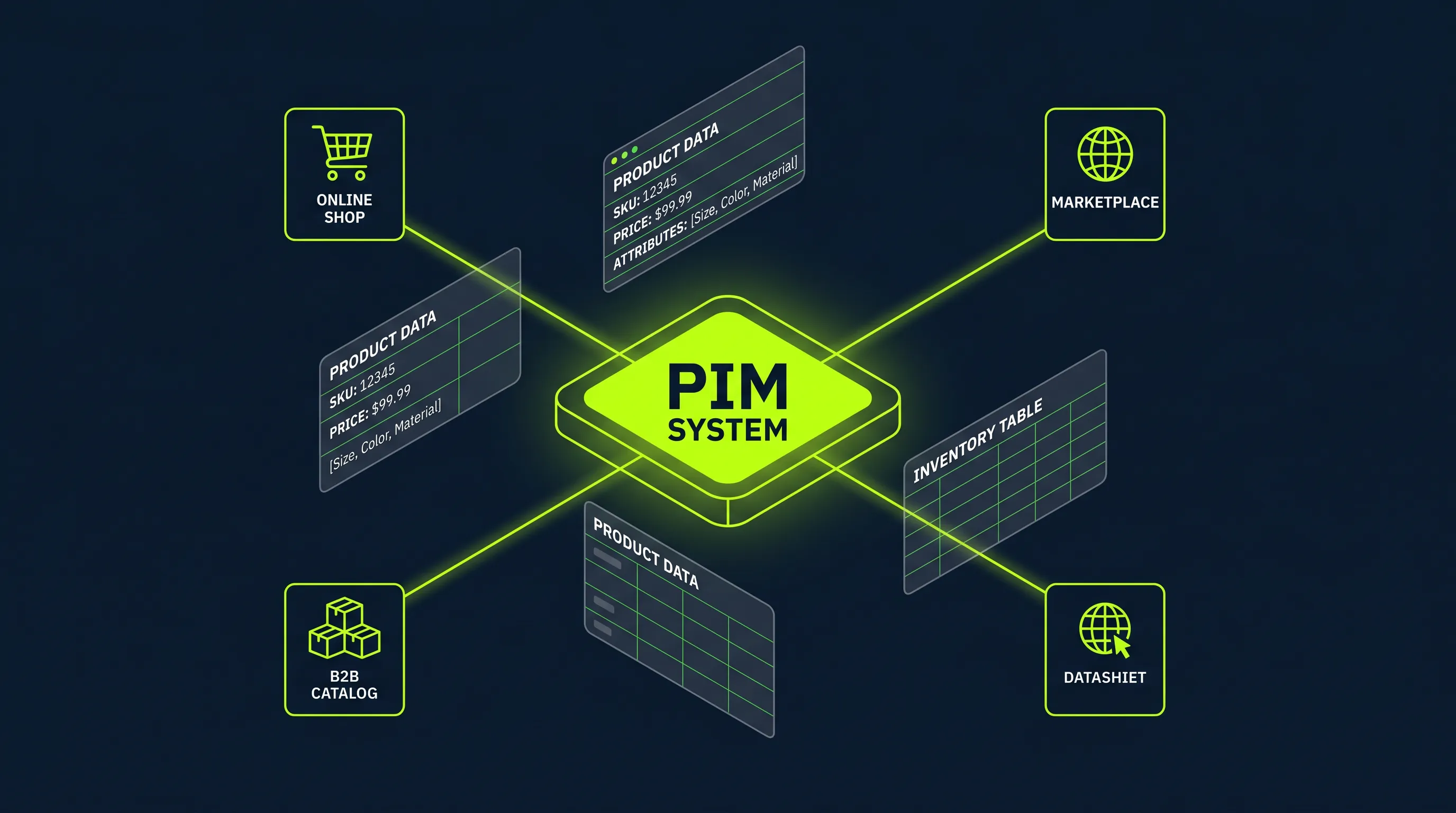
A Product Information Management system (PIM) is a central data repository for all product-related information: texts, technical attributes, images, videos, translations, channel-specific descriptions, certificates, safety data sheets, dimensions, weights, EAN codes, and everything else that describes a product.
The core promise of a PIM for Shopify: you maintain a product once in a central place, and the system distributes the right information automatically to the right channels, in the right language, in the right format.
Without a PIM, the opposite happens. Product data emerges in silos. A spreadsheet for attributes, Shopify for the online store, Amazon Seller Central for the marketplace, a separate document for the wholesale catalog. Every update needs to happen in four places. Someone always forgets one. At some point, the product description on Amazon no longer matches the one on Shopify, and nobody knows which is correct.
The difference from an ERP system: a Shopify ERP or inventory management system manages your stock levels, orders, suppliers, and accounting. It answers: what is where, what does it cost, how do we book it? A PIM answers: how do we describe this product, on which channel, in which language, with which attributes? Both systems work together in a complete setup, they do not compete.
Shopify Natively: What Metafields and MetaObjects Can Actually Do
Before considering an external PIM for Shopify, it is worth taking an honest inventory of Shopify’s native capabilities. Shopify has invested significantly in its data architecture over the past few years. Two features are particularly relevant: Metafields and MetaObjects.
Shopify Metafields Explained
Metafields allow you to add additional structured data fields to Shopify objects (products, variants, collections, customers). A furniture retailer can use them to store dimensions, materials, care instructions, and assembly time as dedicated fields that are displayed directly in the theme. Metafields have become significantly more powerful since 2021, supporting types like text, numbers, dates, booleans, JSON, colors, file references, and lists.
Shopify MetaObjects Explained
MetaObjects (introduced in 2022) go a step further. They allow you to define custom structured data objects that are reusable. A classic example: you define a MetaObject called “Material” with fields for name, origin, certification, and care instruction, then link that object to any number of products. Change the certification of the material in one place, and the information updates automatically across all linked products.
Where Shopify Metafields and MetaObjects Are Sufficient
For many Shopify merchants, Metafields and MetaObjects genuinely suffice. Specifically:
You sell exclusively through Shopify with no Amazon, no additional marketplace, no B2B catalog. Your product attributes are manageable and change infrequently. You have a single-language catalog or use Shopify Markets for translations. Your product count is under 500 SKUs, and a small team maintains data directly in the Shopify admin.
In this case, a PIM system for Shopify is unnecessary complexity that costs more than it saves.
The Technical Limits of Shopify as a PIM Substitute
Once your setup becomes more complex, Shopify Metafields and MetaObjects hit structural limits that no app or workaround can permanently close.
The 100-variant limit: Shopify allows a maximum of 100 variants per product (3 options with up to 100 combinations). For fashion retailers with many sizes, colors, and fits, this is a hard technical wall. MetaObjects cannot solve this; they do not change the Shopify product structure.
No quality assurance for product data: Shopify has no native completeness score or quality gate for product information. You cannot systemically ensure that all required fields are filled before a product goes live. A product without dimensions or care instructions still publishes.
No channel-specific field sets: Shopify has no channel assignment for attributes. You cannot define that Amazon should use a different product description than the Shopify store without maintaining the data twice. An external PIM for Shopify treats this distinction as a core requirement.
No bulk validation for Metafields: If you have 1,200 products and want to check which ones are missing the “Material” Metafield, you need to find this out manually or via CSV export. A PIM shows you this immediately as a filterable dashboard.
No native workflow for translations: Multilingual product data (German, English, French, Dutch) requires either Shopify Markets with its own limitations or external translation apps. A PIM manages translations as a first-class citizen, with approval workflows, review status, and automated translation service integration.
The 7 Signals: When a PIM for Shopify Is Genuinely Worth It
This is the section no PIM vendor writes honestly, because it also covers when a PIM is not worth it. Evaluate your current setup against these seven signals.
Signal 1: Multichannel Product Data Without a Central Source
You sell through more than one channel: Shopify plus at least one marketplace (Amazon, a B2B catalog, or another storefront). Every channel has its own requirements for attributes, text lengths, image formats, and categorizations. When the same product data is maintained manually in three or more places, you lose control over data quality beyond around 200 SKUs.
Signal 2: SKU Count Is Not the Key Criterion, But a Hint
The common advice of “you need a PIM at 1,000 SKUs” is oversimplified. A fashion retailer with 300 products but 50 attributes per product (material, fit, washing instructions, certifications, size guides, sustainability statements) has more data maintenance burden than a retailer with 2,000 simple standard items. The decisive criterion is the attribute complexity per product, not the raw SKU count.
Signal 3: High Return Rate from Poor Product Data
Product data quality and returns are directly linked. Studies consistently show that incomplete or inconsistent product information accounts for 20 to 40 percent of all e-commerce returns. If your return rate is persistently above the industry average, and your product descriptions are incomplete, inconsistent, or wrong by channel, a PIM is a direct investment in lower return costs.
Signal 4: Data Maintenance Effort Is Consuming Operational Resources
How many hours per week does your team spend manually maintaining product data across multiple systems? 5 hours per week at a cost of 35 euros per hour is 7,280 euros per year in pure data maintenance overhead, without creating a single euro of value. From around 10 hours of weekly manual multi-system data maintenance, a PIM for Shopify pays off in most setups.
Signal 5: Growth into New Product Categories with Different Attribute Structures
You are expanding into new product categories with fundamentally different attribute requirements. A fashion retailer adding electronics faces a completely different data schema: EAN codes, technical specifications, warranty conditions, CE marking. Shopify Metafields can represent this, but without central schema management, the structure becomes unmanageable quickly.
Signal 6: Internationalization with Multilingual Product Texts
You sell in multiple markets and need professionally translated, localized product texts, not just machine-translated ones. A PIM for Shopify with an integrated translation workflow enables you to use the same process for all languages, with approval by native speakers, complete version history, and automatic synchronization with Shopify Markets.
Signal 7: External Product Data Suppliers or Manufacturer Data Sheets
You source product data from manufacturers or suppliers in various formats (spreadsheets, BMEcat catalogs, CSV exports, images in various resolutions) and need to normalize, enrich, and import this data into Shopify. This import-enrichment-export process is the core function of a PIM system. Without a central PIM for Shopify, every new supplier becomes its own migration project.
The Self-Assessment: When Does a PIM for Shopify Pay Off?
| Criterion | Yes (2) | Partially (1) | No (0) |
|---|---|---|---|
| Product data is maintained manually in 3+ systems | ✓ | ||
| Attribute complexity > 20 fields per product | ✓ | ||
| Return rate above industry average (data-driven cause) | ✓ | ||
| Data maintenance consumes > 10 hours/week | ✓ | ||
| Selling through 2+ external channels (Amazon, B2B) | ✓ | ||
| Multilingual operation with localized product texts | ✓ | ||
| External supplier data in various formats | ✓ |
When a PIM for Shopify Is Explicitly Not Worth It
This is the section you will not find on any PIM vendor’s website. The honest answer: for a significant portion of Shopify merchants in the DACH market, a PIM does not make sense, at least not yet.
Revenue under one million euros with a simple catalog: If you have fewer than 300 SKUs, sell exclusively through Shopify, and your products have fewer than 10 relevant attributes, a PIM system is too much infrastructure. Implementation costs exceed the achievable benefit for years.
Early growth phase with an uncertain catalog: Setting up a PIM means defining your attribute structure and data schema. If your catalog is still evolving and could change fundamentally, a PIM implementation consumes more resources than it frees up. In this phase, consistently maintained Shopify Metafields are the better choice.
Single channel with stable product data: If you sell exclusively through Shopify, your product descriptions rarely change, and a small team has direct Shopify admin access, the overhead of a PIM is not justified. Structure your Metafields cleanly, and you have a good starting point for a future PIM introduction.
When the problem is actually a process problem: Sometimes the root cause is not a missing system structure but unclear ownership for data maintenance. A PIM does not solve an organizational problem. If nobody is clearly responsible for product data quality, the best PIM system will not help.
Shopify Metafields vs. PIM: The Complete Decision Matrix
| Criterion | Shopify Metafields | Shopify MetaObjects | External PIM |
|---|---|---|---|
| Setup effort | Low | Medium | High |
| Cost | Free (in Shopify) | Free (in Shopify) | 300–2,500 EUR/month |
| Channel-specific attributes | Not native | Not native | Core feature |
| Multilingual data management | Via Markets (limited) | Via Markets (limited) | Full workflow support |
| Quality assurance / completeness | Not available | Not available | Dashboards + scoring |
| External data format import | Manual/CSV | Manual/CSV | Automated (BMEcat, ETIM) |
| Multichannel export | Via Shopify Channels | Via Shopify Channels | Channel-optimized exports |
| Variants beyond 100/product | Not possible | Not possible | Possible |
| Product data versioning | Not native | Not native | Full history |
| Approval workflows | Not available | Not available | Configurable |
| Third-party tool integration | App-dependent | App-dependent | Native connectors |
| Scaling to 10,000+ SKUs | Limited | Limited | Built for it |
| Best for | < 500 SKU, single channel | < 1,000 SKU, structured attributes | Multichannel, complex, growing |
PIM Costs in the DACH Market: What You Actually Pay
One of the biggest frustrations in the PIM topic is that nobody publishes concrete numbers. Here they are.
Plytix: Free plan for up to 100 products and 2 users. Paid plans from approximately 300 euros per month. Plytix is designed specifically for small and mid-sized e-commerce teams and has one of the lowest barriers to entry in the market.
Akeneo: Community Edition (CE) is open source and free, but requires your own hosting and development resources. The cloud-based Growth tier starts at around 25,000 euros per year, with Enterprise significantly above that. Akeneo is the standard choice for mid-market companies with complex requirements and multiple channels.
Hublify: Cloud PIM with a focus on Shopify and multichannel. Entry from approximately 200 euros per month. Hublify is actively building AI-powered data maintenance as a differentiator and is technically designed for the DACH market.
Sales Layer: Starting from approximately 600 euros per month. Sales Layer positions itself as a user-friendly SaaS solution with strong onboarding support and native connectors for Shopify, Amazon, and other channels.
Pimcore: Enterprise open source with a free community core. Full enterprise implementations require a substantial project budget and a specialized agency, scaling with catalog complexity and integration depth. Pimcore is powerful but not practical without a specialized agency.
Implementation Effort in the DACH Market
| Setup Type | SKU Count | Channels | Implementation Effort | Timeline |
|---|---|---|---|---|
| Entry setup (Plytix/Hublify, self-managed) | up to 500 | 1–2 | Low, mostly self-service | 4–8 weeks |
| Mid-market with agency (Akeneo/Sales Layer) | 500–5,000 | 2–4 | Medium to high, agency-supported | 3–6 months |
| Complex enterprise setup (Pimcore/Akeneo EE) | 5,000+ | 5+ | High, specialized agency required | 6–18 months |
| Re-implementation/migration (existing → PIM) | any | any | Additional premium on top of new implementation | +4–8 weeks |
ROI Calculation: When Does a PIM for Shopify Actually Pay Off?
Consider a concrete case: a Shopify merchant in the DACH market with 1,500 SKUs, three channels (Shopify, Amazon, OTTO), and a team currently spending 12 hours per week on manual data maintenance.
Current costs without a PIM: 12 hours/week times 40 weeks (realistic annual average, as peak periods are higher) times 35 euros/hour equals 16,800 euros per year in pure data maintenance overhead.
Add returns caused by poor product data. If the return rate is 18 percent and 20 percent of that is attributable to poor product data, with annual revenue of 2 million euros, data-quality-related returns cause approximately 72,000 euros of annual damage in direct return costs, before accounting for opportunity costs. More on the real costs of e-commerce return rates.
Costs with a PIM (Plytix Growth plan): License: 4,200 euros per year. Implementation: a one-time project cost that scales with SKU count, source data quality, and channel complexity. Time savings: minus 8 hours per week (estimated 35% reduction in manual effort) equals 11,200 euros per year saved. Return improvement: minus 30% of data-related returns equals approximately 21,600 euros per year saved.
Result: In this scenario, the PIM investment with Plytix Growth typically pays back within the first year, the exact payback period depends on your implementation cost, which a free audit can quantify for your catalog. From the second year onward, there is an annual net benefit of 24,000 to 28,000 euros, without accounting for growth effects from better product data quality and higher conversion rates from more complete product pages.
The Key PIM Systems for Shopify Compared
| System | Type | Starting Price | Shopify Integration | DACH Fit | Self-Setup | Best For |
|---|---|---|---|---|---|---|
| Plytix | Cloud SaaS | Free / ~300 EUR/mo. | ★★★★☆ | ★★★★☆ | Yes | SME, B2C, simple multichannel |
| Akeneo CE | Open Source | Free (hosting separate) | ★★★★☆ | ★★★★☆ | Conditional (developer) | Tech teams, mid-market |
| Akeneo Cloud | Cloud SaaS | From ~2,000 EUR/mo. | ★★★★★ | ★★★★★ | No (agency) | Enterprise, complex multichannel |
| Hublify | Cloud SaaS | From ~200 EUR/mo. | ★★★★★ | ★★★★★ | Yes | Shopify-first, DACH, AI-PIM |
| Sales Layer | Cloud SaaS | From ~600 EUR/mo. | ★★★★★ | ★★★☆☆ | Yes (with support) | Mid-market, simple workflows |
| Pimcore | Open Source Enterprise | Free (implementation project cost varies) | ★★★★☆ | ★★★★★ | No (specialist) | Enterprise, platform projects |
| AtroPIM | Open Source | Free (hosting separate) | ★★★☆☆ | ★★★☆☆ | Conditional (developer) | Technical teams, cost-focused |
PIM, ERP, and Shopify: The Right System Architecture
Many Shopify merchants ask: ERP first, then PIM, or the other way around? The answer depends on which problem is more urgent.
As a rule of thumb: a Shopify ERP addresses operational problems (inventory, order processing, accounting). A PIM addresses data quality problems (product information, channel consistency, translations). If your biggest problem is overselling and inventory chaos, solve that first with an ERP. If your biggest problem is inconsistent product data and high return rates, the PIM is the first priority.
In a complete multichannel setup for Shopify, the architecture typically looks like this: the PIM is the central product data source (master). It supplies Shopify with product attributes, texts, and translations. The ERP manages inventory, orders, and accounting. Shopify is the commerce platform that brings both data sources together in the store.
This setup does not need to happen simultaneously. Many Shopify merchants introduce ERP and PIM in different growth phases, often one to three years apart. What matters is that you consider PIM compatibility when choosing an ERP, and ERP compatibility when choosing a PIM.
AI-Powered PIM Systems for Shopify in 2026
Artificial intelligence is changing what product data maintenance costs and what it can achieve. This is particularly relevant for the question of whether a PIM for Shopify is worth it, because AI features can significantly improve the ROI.
Concrete AI features that modern PIM systems offer in 2026:
Automatic attribute extraction: The PIM analyzes product images or manufacturer documents and automatically extracts attributes like color, dimensions, material, and category tags. What a team member used to enter manually happens in seconds.
AI-generated product descriptions: Based on structured attributes, the PIM generates initial text drafts in multiple languages. Editors review, refine, and approve. The productivity of the content team increases without reducing quality. More on how AI is transforming e-commerce processes in the article on AI in e-commerce.
Completeness scoring with AI: The system automatically evaluates how complete a product entry is relative to the requirements of the target channel, and makes prioritized recommendations for which attributes to add next.
Data consistency checks: AI detects inconsistencies in product data, for example if the same product is described as “100% cotton” on Amazon but “cotton blend” in Shopify, and flags these for manual resolution.
The practical effect: AI reduces manual data maintenance effort by a further 30 to 50 percent compared to a PIM without AI. This changes the ROI calculation significantly in favor of an earlier PIM investment.
Implementation: With or Without an Agency?
The honest answer: it depends on the system and your internal competence.
Self-setup possible (without agency): Plytix, Hublify, and Sales Layer are explicitly designed for self-setup. A technically competent marketing or e-commerce team can productively set up these systems in four to eight weeks, provided the source data is reasonably structured. The biggest time consumer is not system configuration but data cleansing.
Agency recommended: Akeneo Cloud, Sales Layer in complex multichannel setups, and all Pimcore projects should be implemented with a specialized agency. The reason is not poor user experience but the complexity of attribute schema design, data migration, and Shopify integration. Errors at this stage are expensive because they sit deep in the data structure and are difficult to correct.
When you definitely need outside help: During data migration from legacy systems, when integrating BMEcat or ETIM supplier data, and when introducing approval workflows in larger teams with clear compliance requirements.
One important note: choose a system architecture for your Shopify scaling that grows with you. A PIM you need to migrate again in two years because it cannot represent your new complexity level costs more than a higher-quality system from the start.
Frequently Asked Questions About PIM for Shopify
When do I need a PIM for Shopify?
A PIM for Shopify makes sense when at least two of the following apply: you sell through more than one channel (Shopify plus Amazon, a B2B catalog, or additional storefronts), your product attribute maintenance consumes more than 8 to 10 hours per week, you have more than 500 SKUs with high attribute complexity, you operate a multilingual store with localized texts, or you source product data from suppliers in different formats. For single-channel merchants with a simple catalog under 500 SKUs, Shopify Metafields and MetaObjects are sufficient in most cases.
Do Shopify Metafields work as a PIM substitute?
For single-channel setups with fewer than 500 SKUs and up to 20 attributes per product: yes, Shopify Metafields suffice. For multichannel operations, multilingual product data, supplier data imports, or attribute complexity beyond 20 fields per product: no. Shopify Metafields have no quality assurance, no approval workflow, and no channel-specific output mechanism. These are structural limits, not configurable gaps.
What does a PIM for Shopify cost in the DACH market?
The range is wide: Plytix Free for up to 100 products at no cost, Plytix Paid from around 300 euros per month, Hublify from around 200 euros per month, Sales Layer from around 600 euros per month, Akeneo Cloud from around 2,000 euros per month, Pimcore as an enterprise project from 50,000 euros total budget. Add implementation costs ranging from 2,000 euros (self-setup) to 150,000 euros (enterprise project) depending on complexity.
PIM or ERP first for Shopify?
It depends on which problem is more urgent. If your biggest problem is inventory chaos, overselling, and missing accounting integration, solve that first with an ERP. If your biggest problem is inconsistent product data, high return rates from poor product descriptions, and manual multichannel data maintenance effort, the PIM is the first priority. Both systems solve different problems and are not competitors.
Is Shopify itself a PIM system?
No. Shopify is a commerce system that stores and outputs product data for the online store. Shopify does not have PIM-typical features like product data quality assurance, channel-specific attribute sets, structured approval workflows, supplier import normalization, or a central single-source-of-truth architecture for multiple output channels. Shopify Metafields and MetaObjects are a powerful data structure layer, but not a complete PIM.
Which PIM for Shopify is best for DACH merchants?
There is no blanket recommendation because requirements vary too much. As orientation: for entry-level and SMEs with limited budgets, Plytix is the most accessible starting point. For Shopify-focused merchants with AI interest, Hublify is particularly interesting. For complex requirements with agency support, Akeneo is the European standard. For enterprise setups with high customization requirements, Pimcore is the most powerful option. Book a vendor-neutral consultation before booking a demo with any vendor.
Can I set up a PIM for Shopify without an agency?
Yes, with the right systems. Plytix, Hublify, and Sales Layer are designed for self-setup and are manageable for technically capable e-commerce teams without programming skills. Akeneo Community Edition requires development resources for installation and configuration. Pimcore and enterprise Akeneo implementations always require specialized agency support.
Conclusion: The Honest Recommendation
Do you need a PIM for Shopify? The answer is differentiated.
If you operate a single channel with a simple catalog, under 500 SKUs, and clear processes for data maintenance: no. Invest the time in cleanly structured Shopify Metafields and MetaObjects. That is your preparation for a future PIM introduction without over-investing today.
If you operate multichannel, have attribute complexity beyond 20 fields, data maintenance consumes more than 8 to 10 hours per week, or you have a return rate attributable to product data weaknesses: yes. A PIM for Shopify in this scenario is not a nice-to-have infrastructure investment, it is a measurably positive return on investment.
What no vendor will tell you: not every Shopify merchant needs a PIM. Those who grow into the systems proactively and make the decision ahead of the pain pay significantly less in implementation than those who wait until the situation becomes critical.
If you are not sure where your setup stands relative to these criteria, that is exactly the question a vendor-neutral consultation is for.