Most guides on taking an online store international are written for a different reader. They come from the US and recommend Canada, the UK and Australia as first markets, or they cover tax in a single sentence: “Ask your tax advisor.” A retailer based in Germany faces very different questions. Austria or Switzerland first? What changes once cross-border sales pass €10,000? Why do Swiss customers suddenly pay fees on delivery? And how much of this can Shopify Markets handle?
This guide answers exactly these questions for online stores and D2C brands in the DACH region with €500,000 to €50 million in revenue. It brings together three topics that are usually covered separately: the order of markets, the tax and legal obligations, and the implementation in Shopify.
The short answer: in which order should you expand?
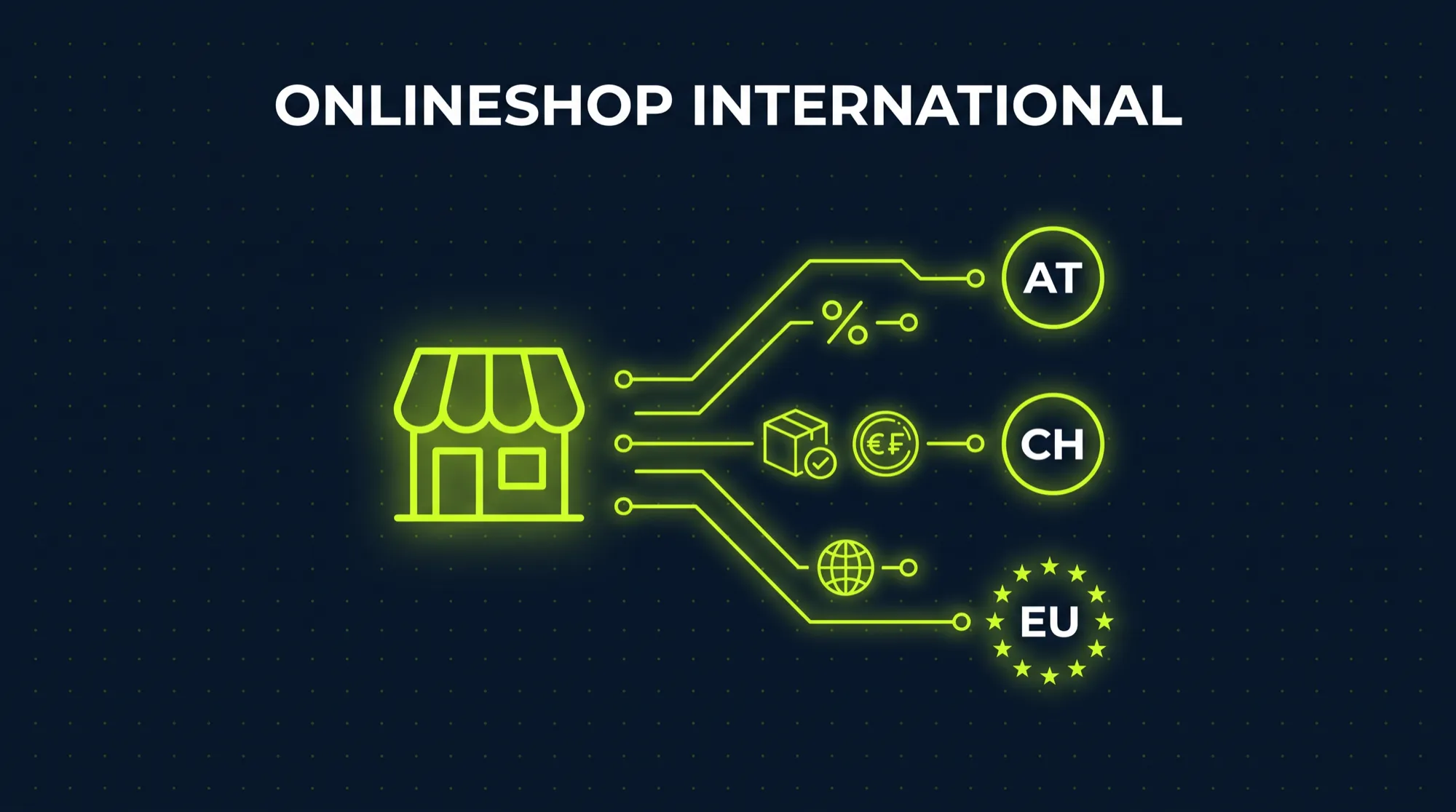
For most German online stores, Austria is the most sensible first foreign market, followed by Switzerland, then the Netherlands and Belgium. Austria shares the language, is part of the EU single market and has no customs. Switzerland also shares the language and has high purchasing power, but requires customs clearance and, above a revenue threshold, its own VAT registration. Only after that do markets make sense that require real translation, different payment methods and their own producer obligations.
This order is a rule of thumb, not a law. It changes, for example, if your data shows clearly stronger demand from Switzerland, if you sell food (still subject to customs duty in Switzerland), or if competition in Austria runs mainly through Amazon. The grid below shows how to assess this for your store.
Are you ready to go abroad? The readiness check
Internationalisation amplifies what already exists in your home market. A store that does not earn a stable contribution margin in Germany will not become more profitable abroad, where shipping, returns, fees and fixed costs per market are added. Check four points before taking the first step:
- Profitability: Do you know your contribution margin per order after shipping, returns and payment fees? If the domestic margin is tight, an extra 3 to 8 percentage points of cross-border costs become a problem.
- Demand signals: Do you see sessions and orders from the target country in Shopify Analytics? Does Google Search Console show impressions from Austria or Switzerland? Existing, unplanned demand is the most reliable starting point.
- Processes: Can logistics, customer service and accounting handle a second market without everything running manually? Bookkeeping in particular becomes more complex with OSS and foreign currencies.
- Product range: Do you sell products with special rules (food, cosmetics, electrical equipment, batteries, textiles with labelling requirements)? These often determine which market is easy more than language does.
Which market first? The assessment grid for DACH retailers
The following table assesses the typical candidates for a German store. The ratings are a qualitative assessment based on the framework conditions described in this article. They do not replace an analysis of your own numbers, but they make visible where the effort really lies.
| Market | Language | Tax and customs | Legal and producer obligations | Payment methods | Logistics and returns | Typical position |
|---|---|---|---|---|---|---|
| Austria | German, minor adjustments | EU single market, OSS, no customs | Authorised representatives for packaging, electrical equipment, batteries; own consumer protection laws | eps, Klarna, invoice, PayPal | Like domestic, no customs | 1 |
| Switzerland | German, optionally French and Italian | Third country: customs declaration, Swiss VAT, own registration above threshold | No statutory right of withdrawal, own data protection act, CHF prices | TWINT, credit card, invoice, PostFinance | Customs clearance required, returns need re-import clearance | 2 |
| Netherlands and Belgium | Dutch, plus French in Belgium | OSS | Producer obligations per country, local language for product safety | iDEAL | Wero, Bancontact | Short distances, high expectations for fast delivery | 3 |
| France | French mandatory for consumer information | OSS | Own registration for producer responsibility, Triman labelling | Carte Bancaire, PayPal | Larger market, deeper localisation needed | 4+ |
| Italy and Spain | Italian or Spanish | OSS | Producer registrations per country | Local wallets, credit card, PayPal | Longer transit times, higher shipping costs | 4+ |
| Nordics and Poland | Local language | OSS, Poland with 23 % standard rate | Producer obligations per country | Local bank and wallet methods, in Poland e.g. BLIK and P24 | Varies by carrier | 4+ |
How to use the grid for your store:
- Add demand: Note for each market how many sessions and orders you already receive today without localisation.
- Check your range: Remove markets where your products trigger special rules you cannot yet handle.
- Offset fixed costs: Every market brings fixed costs (see the cost section). A market only pays off when the expected contribution margin clearly exceeds them.
- One market at a time: Launch one market, stabilise processes and numbers, then move to the next. Parallel launches in several countries hide which market is actually profitable.
Austria: same language, but its own obligations
Austria looks like an extension of the German market. Language, payment habits and logistics are similar, and there are no customs. That is exactly why the differences are often overlooked.
VAT: OSS instead of German VAT
Since July 2021, the EU has applied a common distance-selling threshold of €10,000 net per year for all B2C sales to other EU countries combined. Below this threshold, you may charge German VAT. Above it, the VAT of the destination country applies, in Austria usually 20 %, with reduced rates of 13 % or 10 %. Since July 2026, there is also a 4.9 % rate for certain basic foodstuffs.
Reporting is handled through the One-Stop-Shop scheme (OSS) at the German Federal Central Tax Office. You do not need to register in Austria as long as you ship from a German warehouse. For stores of the size covered in this article, the threshold is usually reached with the first foreign market, so plan OSS from the start.
Authorised representatives for packaging, electrical equipment and batteries
This obligation is missing from almost every internationalisation guide: since 1 January 2023, distance sellers without a registered office in Austria that deliver to Austrian end customers must appoint an authorised representative. This applies to packaging and, depending on the range, also to electrical and electronic equipment and batteries. Packaging must additionally be licensed through an Austrian collection and recovery system. Many providers bundle licensing and representation in one package.
Legal texts and consumer protection
If you specifically target Austrian customers, their mandatory consumer protection rules apply. Your German terms and conditions and withdrawal notices therefore do not automatically fit. Specialised legal-text providers offer dedicated packages for Austria. In addition, the Austrian Accessibility Act (BaFG) applies to online stores that are not micro-enterprises, just like the German BFSG.
Market and competition
According to a study by the Austrian Economic Chamber, Austrian online retail reached around €11.5 billion gross in 2025, just over 10 % of retail. Amazon holds almost 30 % of that. In categories with strong Amazon presence, you need a clear reason why customers should buy directly from your store. For payment, alongside PayPal, credit cards and Klarna, buying on invoice and the Austrian online banking method eps play an important role.
Switzerland: VAT, not customs duty
Switzerland is attractive for German stores: the same language in German-speaking Switzerland, high purchasing power and a population that buys a lot online. According to Handelsverband.swiss, Swiss consumers spent around CHF 15.8 billion online in 2025, of which CHF 2.8 billion went directly to foreign retailers. At the same time, Switzerland is a third country with its own rules, and many guides still describe them as they were several years ago.
The key point: industrial tariffs were abolished in 2024
Since 1 January 2024, Switzerland no longer levies customs duties on industrial products. This covers tariff chapters 25 to 97, including clothing, footwear, electronics, furniture and cosmetics. Agricultural products and food remain subject to duty. A customs declaration is still required.
For most online stores, the cost issue is therefore no longer customs duty but three other things: Swiss VAT (standard rate 8.1 %, reduced 2.6 %), the clearance fees charged by the post or parcel service, and the question of who bears these costs.
The small-consignment threshold: up to what value is an order tax-free?
Switzerland does not levy import VAT if the tax amount is no more than CHF 5. The value threshold can be derived from this. The tax base is the value of the goods including shipping costs:
| VAT rate | Applies to | Tax-free value incl. shipping up to approx. |
|---|---|---|
| 8.1 % | Most goods | CHF 61.73 |
| 2.6 % | Food, books, medicines and others | CHF 192.31 |
Older sources still cite CHF 62 or 65 and CHF 200. Those figures are based on the tax rates before 2024. The threshold is not a discount but a simplification: if your average basket is above it, almost every order incurs import VAT.
From CHF 100,000: registration in Switzerland
Since 2019, the so-called mail-order rule has applied: if you generate at least CHF 100,000 in revenue per year from such tax-free small consignments to Switzerland, you become liable for VAT in Switzerland from the following month. From then on, all your deliveries to Switzerland count as domestic supplies, including larger shipments. The consequences:
- You register with the Swiss Federal Tax Administration (ESTV).
- You need a tax representative based in Switzerland.
- Your invoices and parcels carry your Swiss VAT number.
- As a rule, you act as the importer yourself, i.e. you clear customs on behalf of the customer.
Voluntary registration is also possible below the threshold. Whether it pays off depends on how much revenue you expect in Switzerland and which delivery concept you choose. The ESTV adjusted its practice on details such as a possible security deposit in 2025. Clarify this with your tax advisor for your individual case.
DAP or DDP: who pays on delivery?
There are two basic models for deliveries to Switzerland:
- DAP (Delivered at Place): The customer pays import VAT and the parcel service’s clearance fees on delivery. For small orders, these fees can amount to a noticeable share of the order value. Current rates are published on the Swiss Post website.
- DDP (Delivered Duty Paid): You or your service provider handle customs clearance and import VAT. The customer pays exactly the price shown at checkout.
Swiss customers now expect DDP. Unexpected fees at the door lead to refused deliveries, returns and poor reviews. Several logistics providers, including Swiss Post, offer complete solutions: they collect the goods at a hub in Germany, handle export and import clearance and process returns locally in Switzerland. How VAT is handled in each model, and whether you need to be registered yourself, varies by provider. Ask for a written explanation before signing.
Don’t forget the export from Germany
On the German side, delivery to Switzerland is a VAT-exempt export supply, but only with proof of export. The standard is the electronic exit confirmation from the ATLAS customs system. Without this proof, the tax office can reclaim German VAT. If you use consolidated customs clearance through a service provider, clarify how you obtain proof for every shipment. This is a typical checkpoint in tax audits.
Returns, law and payment
- Returns: Switzerland is considered a country with above-average return rates. Without a local returns address, customers have to send parcels abroad, and the goods must be cleared again when they re-enter the EU. Plan your return costs from the start.
- No statutory right of withdrawal: Unlike in the EU, there is no statutory right of withdrawal for online purchases in Switzerland. Most retailers offer a voluntary return policy, in which case the conditions must be clearly stated in the terms and conditions.
- Prices and data protection: Swiss customers expect prices in francs including VAT. Data protection is governed by the revised Swiss Data Protection Act, which your privacy policy should take into account.
- Geo-blocking: Since 2022, Swiss unfair competition law has prohibited discriminating against Swiss customers without objective reason, for example in access to the store. There is no obligation to deliver to Switzerland.
- Payment: According to the 2025 online retailer survey by Handelsverband.swiss, TWINT is, together with credit cards, the most widely used online payment method in Switzerland. A Swiss offering without TWINT leaves conversion on the table. Invoice and PostFinance are also relevant.
Marketplaces as an alternative
Since 2025, online platforms such as Galaxus or Amazon are, under certain conditions, treated as the supplier for Swiss VAT purposes. For some retailers, a marketplace is therefore an easier test run than their own Swiss offering, at the cost of margin and the customer relationship. For your own store, the mail-order rule continues to apply.
EU markets: what applies beyond OSS
For markets such as the Netherlands, Belgium, France or Italy, VAT is handled through the same OSS scheme as for Austria. The effort lies elsewhere: in language, payment methods and above all in producer obligations that apply separately in each country.
VAT rates at a glance
| Country | Standard rate | Reduced rates |
|---|---|---|
| Germany | 19 % | 7 % |
| Austria | 20 % | 13 % / 10 % / 4.9 % |
| Netherlands | 21 % | 9 % |
| Belgium | 21 % | 12 % / 6 % |
| France | 20 % | 10 % / 5.5 % / 2.1 % |
| Italy | 22 % | 10 % / 5 % / 4 % |
| Spain | 21 % | 10 % / 4 % |
| Poland | 23 % | 8 % / 5 % |
| Denmark | 25 % | none |
| Sweden | 25 % | 12 % / 6 % |
Producer responsibility: packaging, electrical equipment, batteries
Packaging, electrical equipment and batteries are subject to extended producer responsibility in the EU. If you deliver to end customers in another country, you generally have to register in each destination country, license there and often appoint an authorised representative:
- Packaging: Since 12 August 2026, the EU Packaging and Packaging Waste Regulation (PPWR) applies directly in all member states, accompanied in Germany by a new implementing act. The PPWR requires distance sellers to appoint an authorised representative per destination country. Relief, for example for micro-enterprises, is still being negotiated at EU level. Check the current status before launch.
- Batteries: Since August 2025, retailers selling batteries or products with built-in batteries to other EU countries need an authorised representative per destination country.
- Electrical and electronic equipment: Registration and an authorised representative per destination country.
- Country-specific systems: France requires its own registration number and the Triman label, Spain an entry in its producer register.
Other obligations in EU distance selling
- Product safety (GPSR): Since December 2024, product pages must include manufacturer details, product identification and safety information, with safety information in the language of the destination country.
- Accessibility: The European Accessibility Act has applied since June 2025 to online stores of companies that are not micro-enterprises. Each country has its own implementing law.
- Withdrawal button: Since 19 June 2026, online stores in the EU must offer an easily accessible withdrawal function.
- Language: In France, consumer information must be provided in French. Belgium is multilingual.
- Geo-blocking: You may not block customers from other EU countries or redirect them without consent. However, there is no obligation to deliver to every country.
What a new market really costs
No guide can seriously tell you what a market costs in euros. That depends on product range, volume and service providers. What can be said clearly is which cost blocks arise and whether they are fixed or variable. This distinction determines the revenue level at which a market becomes viable.
| Cost block | Type | Austria | Switzerland | Other EU markets |
|---|---|---|---|---|
| Legal texts (T&Cs, withdrawal, privacy) | Fixed, recurring | Yes | Yes | Yes, in local language |
| Translation and content maintenance | One-off plus recurring | Low | Low, optionally FR/IT | High |
| VAT reporting | Recurring | OSS, quarterly | Above threshold: registration and tax representative | OSS, quarterly |
| Producer responsibility (packaging, electrical, batteries) | Fixed per country and year | Yes, with authorised representative | No (no EU rules) | Yes, per country |
| Customs clearance and DDP handling | Variable per shipment | No | Yes | No |
| Payment fees and currency conversion | Variable per order | As domestic | Higher (foreign currency, international cards) | Depends on payment method |
| Shipping and returns | Variable per shipment | Slightly higher than domestic | Significantly higher, returns with re-import clearance | Depends on country |
| Marketing for market entry | One-off plus recurring | Low to medium | Medium | Medium to high |
The rule of thumb: A market pays off when the additional contribution margin after variable costs covers the market’s fixed costs within a reasonable period. Run this calculation with your own numbers before starting translation and campaigns.
Setting up Shopify Markets correctly from a DACH perspective
Shopify Markets is the built-in feature that lets you serve multiple countries from a single store, with separate domains or subfolders, languages, currencies, prices and product ranges per market. Shopify rebuilt Markets fundamentally in 2025, and many guides online still describe the old version.
What Markets can do and from which plan
The core features are included in all Shopify plans: creating country markets, local currencies (with Shopify Payments), translations, separate domains and the calculation of duties and taxes at checkout. According to Shopify, some features are tied to higher plans:
- From Advanced: Theme, checkout and customer account page customisations per market.
- Shopify Plus only: Checkout extensions per market and multiple legal entities in one store, for example a German GmbH and a Swiss AG with separate payment accounts.
One important limitation applies regardless of plan: there is only one published theme for all markets. In addition, inventory is shared across all markets. You manage separate stock per country via locations and shipping settings.
Domains, subfolders and hreflang
For each market, you can use its own domain (e.g. .at, .ch), a subdomain or a subfolder (e.g. /de-ch/). For most stores of this size, subfolders on the main domain are the best choice: all domain authority stays bundled and maintenance effort is lowest. Separate country domains are mainly worthwhile when a market needs to appear legally or brand-wise separate.
Shopify sets the hreflang tags that tell Google about language and country versions automatically. Since July 2026, this can be switched off in the admin if your theme or an app outputs its own tags. Keep two points in mind:
- Don’t simply deactivate subfolder markets: According to the Shopify Help Center, redirects are set when markets with their own domain are deactivated, but not automatically for subfolders. Without your own redirects, 404 errors occur.
- No forced redirects based on IP address: Google crawls predominantly from US IP addresses. A hard redirect can prevent country versions from being indexed. A notice with a country selector is the safer solution.
Prices: the dynamic tax-inclusive pricing trap
This is where the most expensive mistakes happen. For markets with gross prices, Shopify offers a feature called dynamic tax-inclusive pricing. It removes German VAT from your price and adds the destination country’s tax. The result:
- A product priced at €100 including 19 % German VAT costs around €100.84 in Austria (20 %) and around €105.04 in Denmark (25 %).
- Your margin stays the same, but your final prices are no longer uniform, and round price points are lost.
If you want the same final price in all euro countries, you must deactivate the feature or set fixed prices per market. With uniform final prices, your margin decreases in countries with higher tax rates. This is a conscious decision you should make with your numbers, not a default setting to overlook.
For foreign currencies such as the Swiss franc, two further points apply:
- Rounding: Shopify rounds converted prices according to fixed rules per currency. Custom price endings such as “.90” cannot be freely defined this way. For key products, fixed prices in francs are usually the better solution.
- Conversion fee: If a customer pays in a currency other than your store currency, Shopify Payments charges a 2 % conversion fee for merchants outside the US, according to the Shopify Help Center. It is built into the converted price and is not refunded on returns.
Duties and import taxes at checkout
Shopify can calculate duties and import taxes at checkout and charge them to the customer directly. This is the technical prerequisite for DDP deliveries to Switzerland. Your products need HS codes and country of origin, and for Switzerland also weight information. You also need a carrier that can handle DDP.
Shopify charges an additional fee for orders with duty calculation. According to the Shopify Help Center, the regular rate is 0.85 % with Shopify Payments and 1.5 % with other payment providers. It has been temporarily reduced since February 2025. It does not apply to deliveries within the EU.
An example: fees per Swiss order
A simplified example shows how fees add up. Assumptions: Shopify Advanced plan, order worth €100, payment with a non-European credit card in francs, duty calculation active at checkout. The rates come from Shopify’s German pricing page and the Shopify Help Center as of October 2026.
| Item | Rate according to Shopify | Amount on a €100 order |
|---|---|---|
| Card fee, international card | 2.7 % + €0.30 | €3.00 |
| Currency conversion fee | 2 % | €2.00 |
| Duty calculation fee (regular rate) | 0.85 % | €0.85 |
| Total before shipping, DDP provider and taxes | approx. €5.85 |
That is almost 6 % of the order value before shipping, clearance by the service provider and any Swiss tax registration. Depending on card type, payment method and plan, the actual figure will be higher or lower. The key point: these costs do not arise on orders from Germany and belong in every calculation for Switzerland.
Shopify Managed Markets: not an option for German merchants
Many guides recommend Shopify Managed Markets (formerly Markets Pro), where partner Global-e acts as the official seller and handles tax, duties and fraud protection. What is almost never mentioned: according to the Shopify Help Center, Managed Markets is only available to merchants based in the US and to selected stores in Canada and the UK. It is currently not available to merchants based in Germany, Austria or Switzerland.
Anyone looking for a similar all-in-one solution must work directly with such a merchant-of-record provider, which means a separate contract with its own fees and dependencies. For most DACH retailers, the route via Shopify Markets, OSS and a DDP-capable logistics partner for Switzerland is easier to manage.
Translation
Shopify’s free Translate & Adapt app translates automatically into up to two languages, according to Shopify, and allows manual translations without a language limit. For Austria and German-speaking Switzerland, a per-market adaptation is usually enough, for example for terms and spelling; Switzerland does not use the “ß”. For further languages, many stores use specialised translation apps. Make sure the app works with Shopify’s own translation API so that hreflang tags and sitemaps stay correct. Translate URL handles as well, not just content.
Local payment methods
Through Shopify Payments, German merchants can offer credit cards, Klarna, iDEAL | Wero, Bancontact, eps, Apple Pay and Google Pay, among others. For Switzerland, check in your payment setup whether TWINT is offered directly. Otherwise, integrate TWINT through a payment provider with a Shopify connection. Payment providers outside Shopify Payments incur an additional transaction fee that varies by plan. For more on the role of payment methods, see the guide to checkout optimisation.
One store or several?
For pure internationalisation, one store with Shopify Markets is sufficient in most cases. Multiple stores only make sense when separate legal entities, strongly differing ranges or separate teams per country require it. You will find a detailed decision guide in our article on Shopify multiple stores.
Timeline: what changes from 2026 to 2028
| Date | Change | Relevance for German stores |
|---|---|---|
| 19.06.2026 | Withdrawal button in the EU | Easily accessible withdrawal function in all EU markets |
| 01.07.2026 | EU abolishes €150 duty exemption, flat €3 per tariff line | Parcels from third countries become more expensive; relevant if you ship from a warehouse outside the EU |
| 01.07.2026 | Austria: new reduced rate of 4.9 % for certain basic foodstuffs | Check tax rates in store and OSS returns |
| 12.08.2026 | EU Packaging Regulation (PPWR) applies | New labelling and registration obligations, authorised representatives per destination country |
| 29.11.2026 | Swiss referendum on higher VAT | If approved, standard rate of 8.5 % instead of 8.1 % from 2028 |
| 01.07.2028 | EU VAT in the Digital Age package: single VAT registration | OSS extended, including certain stock transfers; relief for retailers with foreign warehouses |
The most common internationalisation mistakes
- Opening several markets at once. Fixed costs arise in all countries, but you cannot see which market is profitable.
- Launching Switzerland with DAP. Customers pay fees at the door, refuse delivery, and the return costs you twice.
- Planning for customs instead of VAT. Since 2024, it is not customs duty but Swiss VAT and the CHF 100,000 threshold that determine your effort for industrial products.
- Treating Austria as domestic. OSS, authorised representatives and dedicated legal texts are then missing at launch.
- Overlooking dynamic tax-inclusive pricing. Final prices in the store differ by country without anyone having consciously decided this.
- Not factoring in fees. Card fees, conversion and duty calculation quickly add up to several percent of the order value on Swiss orders.
- Counting on an all-in-one solution that does not exist in Germany. Managed Markets is currently not available to DACH merchants.
- Shipping without proof of export. Without it, the tax office can reclaim German VAT on Swiss orders.
Checklist: ready for the next market?
FAQ
Which country should a German online store enter first?
For most German online stores, Austria is the easiest first market: same language, EU single market, no customs. Switzerland usually follows, then the Netherlands and Belgium. The order can change if your data shows stronger demand from another country or your range triggers special rules there.
When do I have to use the OSS scheme?
As soon as your distance sales to consumers in other EU countries together exceed €10,000 net per year. From then on, the VAT of each destination country applies, which you report centrally via OSS at the German Federal Central Tax Office. You can also opt in voluntarily earlier.
Do I need a Swiss company to sell to Switzerland?
No. You can sell to Switzerland from Germany. From CHF 100,000 in annual revenue from small consignments, however, you become liable for VAT in Switzerland and need a tax representative based there. A separate company is not required.
Do I have to pay customs duty on deliveries to Switzerland?
Not for industrial products any more: Switzerland abolished industrial tariffs on 1 January 2024. Food and agricultural products remain subject to duty. The customs declaration, Swiss VAT and the parcel services’ clearance fees still apply.
Up to what value is a delivery to Switzerland tax-free?
Switzerland does not levy import VAT if the tax amount is no more than CHF 5. At the standard rate of 8.1 %, this corresponds mathematically to a value including shipping of around CHF 61.73; at the reduced rate of 2.6 %, around CHF 192.31.
Can I use Shopify Managed Markets as a German merchant?
Not at present. According to the Shopify Help Center, Managed Markets is only available to merchants based in the US and to selected stores in Canada and the UK. German merchants use Shopify Markets in combination with OSS and a DDP-capable logistics partner.
How much does Shopify Markets cost?
The core features of Shopify Markets are included in all Shopify plans. Additional costs arise from per-order fees, for example for currency conversion, international cards and duty calculation at checkout. Some features, such as per-market theme or checkout customisations, require higher plans.
Is there a right of withdrawal for online purchases in Switzerland?
There is no statutory right of withdrawal for online purchases in Switzerland as there is in the EU. Most retailers offer a voluntary return policy, in which case the conditions should be clearly set out in the terms and conditions.
Do I need separate legal texts for Austria?
If you specifically target Austrian customers, their mandatory consumer protection rules apply, so German legal texts do not automatically fit. In addition, distance sellers without a registered office in Austria have needed an authorised representative for packaging, and depending on the range for electrical equipment and batteries, since 2023.
Conclusion: internationalisation is a sequence, not a leap
Taking an online store international does not mean translating the store and launching campaigns. It means checking market by market whether tax, producer obligations, logistics and fees can be carried by your margin. For most German stores, the path is clear: Austria first with OSS and the required authorised representatives, then Switzerland with a DDP concept, then the next EU markets with genuine localisation. Shopify Markets supports this path well technically, as long as you consciously plan for pricing logic, fees and the platform’s limits.
Which order and which setup fit your range, your numbers and your organisation can usually be clarified faster in a conversation than in any guide.
References
- ESTV: VAT mail-order and platform taxation
- FOCBS: VAT rules for mail order and platform taxation
- SECO: Abolition of industrial tariffs
- Swiss Parliament: VAT increase for the 13th AHV pension (19.06.2026)
- Handelsverband.swiss: Swiss online consumption 2025
- Handelsverband.swiss: Online retailer survey 2025
- Swiss Post: Import customs clearance
- IHK Freiburg: Exporting to Switzerland
- IHK Chemnitz: One-Stop-Shop
- Austrian Business Service Portal: New reduced VAT rate
- IHK Braunschweig: Austria, authorised representative rules for packaging
- WKO: E-commerce study Austria
- German Federal Ministry of Finance: End of the €150 duty exemption
- European Consumer Centre Germany: Withdrawal button
- European Commission: Taxes in Europe Database (TEDB)
- Shopify Help Center: Markets requirements and considerations
- Shopify Help Center: Dynamic tax-inclusive pricing
- Shopify Help Center: Charging duties and import taxes
- Shopify Help Center: Currency conversion fees
- Shopify Help Center: Managed Markets
- Shopify Changelog: Turn automatic hreflang tags on or off
- Shopify: Pricing Germany