Most D2C projects I hear about fail not because of technology. They fail because someone built a D2C strategy without answering one central question first: Why, exactly?
“D2C is a trend” is not a strategy. “We want to improve margins” sounds like a strategy but is really a hope without foundation, until the unit economics are actually calculated. “We want more customer data” is a goal, but without a plan for GDPR-compliant first-party data infrastructure, it remains intention.
This guide focuses on what most articles about direct to consumer miss: the business economics perspective, the reality of the DACH market, and an honest assessment of who D2C actually works for, and who it doesn’t.
What a D2C Strategy Is, and How It Differs from Just Having a Webshop
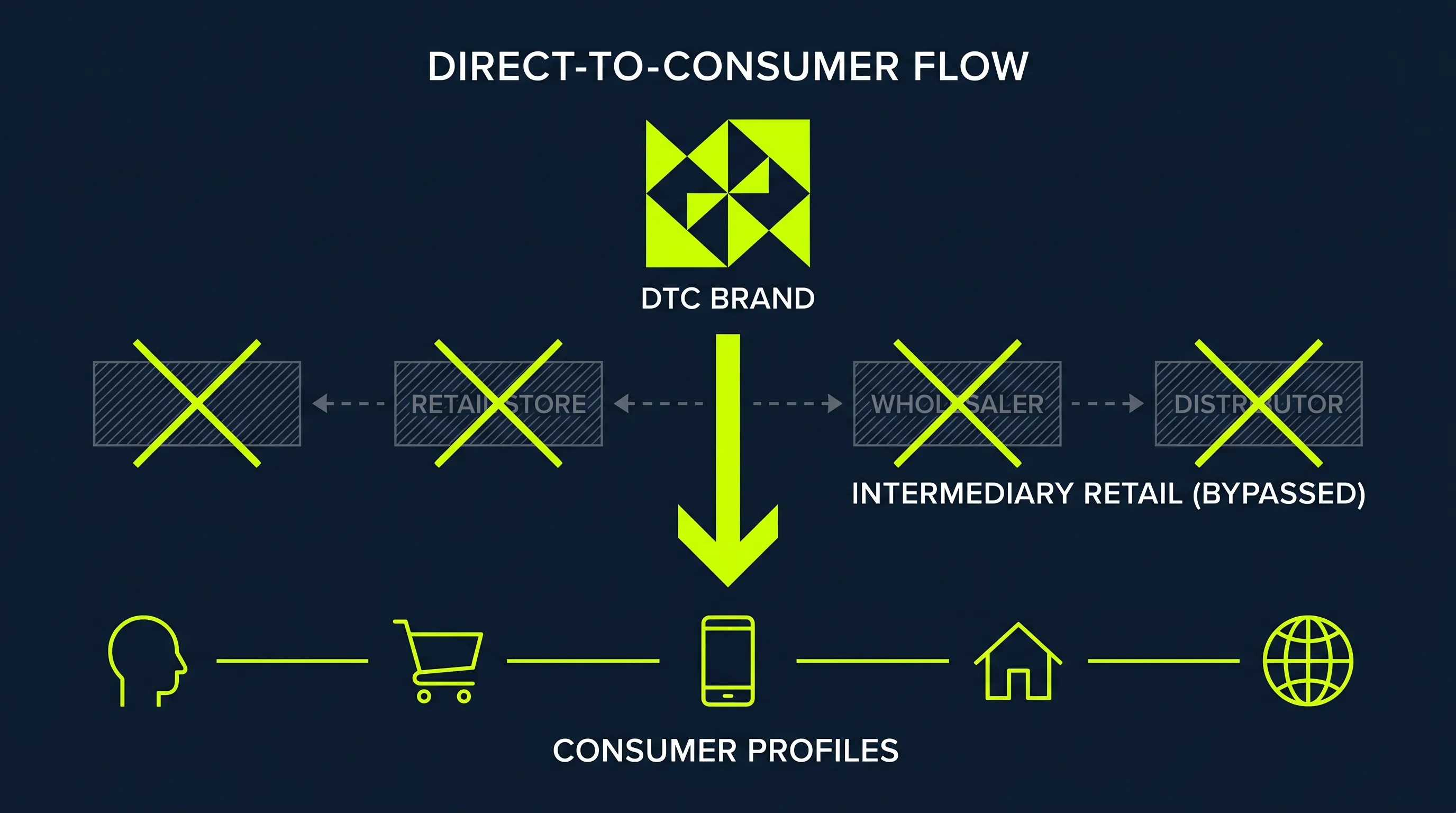
Direct to consumer means selling products directly to end customers without intermediaries. No wholesaler, no retailer, no marketplace as a required channel. That sounds simple. It isn’t.
A webshop alone is not a D2C strategy. The difference lies in intent and consequence: D2C as a strategy means your brand owns the entire customer relationship, controls the customer data, shapes the shopping experience, and sets prices without deference to retailer pricing policies. That requires strategic decisions in at least six areas, which I’ll get to shortly.
The D2C model sits on a spectrum:
- Pure D2C: All revenue exclusively through owned channels. Extremely rare in established businesses, because single-channel dependency is fragile.
- D2C as primary channel with selective retail: Own shop is the main channel, selected retailers supplement reach. The model of Snocks or EMMA.
- D2C hybrid model: D2C and wholesale run in parallel. This is the reality for most DACH manufacturers entering D2C.
- D2C as a test channel: D2C runs as a small experiment alongside dominant wholesale business. This approach rarely produces strategic insights, because the investment commitment isn’t there.
| Criterion | D2C (own shop) | Retail / Wholesale | Marketplace (Amazon/OTTO) |
|---|---|---|---|
| Gross margin | 60–80% possible | 20–50% after retail margin | 25–50% after fees |
| Customer data | Complete (first-party) | None or minimal | None |
| Brand control | Full | Limited | Very limited |
| Entry effort | High (tech + marketing) | Low (listing) | Medium (optimization) |
| Scalability | High, but CAC-dependent | Via dealer network | Algorithmically limited |
| Channel conflict | High with parallel retail | Not relevant | Rarely direct |
| Returns risk (DACH) | Entirely with manufacturer | With retailer | Complex (FBA vs. FBM) |
| Speed to market | Fast | Slow (listing cycles) | Medium |
Who Benefits from a D2C Strategy, and Who Doesn’t
This is the question no vendor will answer for you. Shopware wants to sell you Shopware. Every other article about “how to build a D2C strategy” is pushing you toward something someone profits from.
My answer is less comfortable: D2C only makes sense under specific business conditions. Without those conditions, you build an expensive channel that doesn’t improve your overall business.
The Gross Margin Threshold
D2C improves margins when your retail margin exceeds your D2C costs. That sounds obvious, but it’s systematically underestimated. Your retail margin (what the retailer takes as a markup) is your theoretical D2C advantage. From that, subtract your actual D2C costs:
- Customer acquisition cost (CAC), depending on channel mix
- Fulfillment cost per order (pick, pack, shipping, returns)
- Payment processing (2–3% of order value in DACH due to invoice payment/Klarna preferences)
- Platform costs (Shopify Plus, Shopware, middleware)
- Content and customer service costs
As a rule of thumb: D2C as direct-to-consumer works structurally at product gross margins above 50%, in certain categories below that too. For food, medical supplies, or standardized industrial goods with margins below 30%, the model is generally not viable unless subscription share is high enough to significantly lift lifetime value.
D2C for Manufacturers: A Different Starting Point
A manufacturer introducing D2C faces a different situation than a digital pure-play brand. The manufacturer has existing customers, ongoing dealer relationships, and often years of supply contracts with price-binding or exclusivity clauses. D2C for them is not a channel experiment but a strategic decision with direct consequences for the dealer network.
For manufacturers, the critical first question is not “which platform?” but “how do we protect our trade partners while building D2C?” Anyone who doesn’t clarify that risks lost listings, price erosion, and active sabotage by dealers who own customer relationships and know how to use them.
D2C for Existing Online Shops: When You Already Have a Store
Many online shops with third-party brands are considering building a private label and selling it D2C. That’s a legitimate path, but it’s not D2C strategy in the classic sense — it’s private label development plus a D2C channel. The decision depends on whether you can improve margins sufficiently through private label while handling the additional complexity (product development, sourcing, quality control).
Building a D2C Strategy: The 6 Strategic Decisions
When the prerequisites are in place, the actual D2C strategy begins. It consists of six decisions that build on each other.
1. Define the Strategic Goal
D2C has different drivers, and the chosen driver determines what the strategy looks like. The four most common legitimate goals:
- Data ownership: First-party customer data for product development, targeting, and personalization. This goal makes D2C worthwhile even when the channel is marginally profitable in the short to medium term.
- Margin improvement: Capturing the retail markup as your own margin. Only viable if D2C costs stay below the retail markup.
- Brand control: Managing the shopping experience, pricing presentation, and communication without retailer constraints. Especially relevant for premium brands under pressure in retail.
- Speed of innovation: Testing new products directly with real customer data, without waiting for listing cycles with trade partners. Snocks has explicitly stated this goal.
Anyone who doesn’t define a clear primary goal builds a D2C channel that genuinely fulfills none of them.
2. Channel Architecture: Pure D2C or Hybrid
For most DACH companies, a true hybrid D2C model is a more realistic strategy than pure D2C. That means D2C as its own growing channel, parallel to existing wholesale or marketplace business, with a clear channel logic.
The channel logic decides: which products exclusively through D2C? Which through retail? Which through both channels? A clear answer to this question is the prerequisite for managing channel conflict — which gets its own section next.
3. Platform Decision: Shopify or Shopware
The platform question is secondary to the strategy question, but it matters. For D2C shops up to 50,000 SKUs without complex ERP requirements, Shopify (Plus) is the faster decision: lower setup effort, better app ecosystem, easier to scale internationally.
For manufacturers with existing ERP systems, complex pricing models, or B2B-D2C components, Shopware 6 is often the better choice due to flexibility for backend integration. A detailed comparison of both platforms for the DACH market is in the article Shopify Plus vs. Shopware 6 — though many of the principles apply beyond DACH. For most new D2C brands without legacy system requirements, the practical guidance is in the e-commerce platform comparison.
4. Pricing and Assortment Strategy Against Channel Conflict
This is the decision that determines success or failure of D2C at established companies. More on this in the next section.
5. First-Party Data Infrastructure Under GDPR
D2C customer data is your most valuable asset — but only if you can capture and use it legally and in a structured way. The core requirements:
- Explicit consent for marketing emails (double opt-in is standard, but consent management is more complex)
- Server-side tagging for analytics, since browser-side tracking is massively constrained by iOS changes and browser extensions
- CDP or at minimum a CRM with segmentation capability from the first purchase
- GDPR-compliant personalization without third-party cookies
This looks like IT overhead but is the actual competitive advantage of D2C over marketplace channels: you build a data asset that Amazon and OTTO will never have.
6. Go-to-Market and CAC Assumptions
Without a marketing budget, there is no D2C. The most common underestimation in D2C business plans: customer acquisition costs. In the DACH market, CPCs on Meta and Google for e-commerce categories have been significantly above the levels most business plans are still built on since 2022.
Realistic CAC planning for DACH:
- Fashion/lifestyle: €25–60 CAC in performance channels
- Skincare/cosmetics: €30–80 CAC
- Food/supplements: €20–50 CAC on first order
- Home/interior: €40–100 CAC
These numbers only make D2C profitable when customer lifetime value is correspondingly high. How to calculate CLV for your D2C channel and what a healthy CLV:CAC ratio means is explained in the article on Customer Lifetime Value for Shopify shops.
Channel Conflict: The Underestimated D2C Challenge
No other aspect of D2C strategy for manufacturers is left out more often or proves more expensive when ignored. Channel conflict arises when a manufacturer introduces D2C and thereby directly competes with their trade partners.
The typical dealer reaction:
- Reducing listing depth (fewer product variants on the shelf)
- Switching to competing products with better terms
- Actively downrating or poor positioning of the manufacturer’s products
- In extreme cases: canceling supply contracts
This is not a theoretical risk. There are DACH manufacturers who have abandoned D2C projects because the trade partner reaction more than offset the entire D2C margin gain.
Four Strategies for Resolving Channel Conflict
1. Exclusive assortment for D2C
The most effective tool: products available exclusively in your own store create no direct price comparison with dealer listings. Variants, bundles, sizes, or collections not available in retail protect trade prices and create a genuine D2C advantage. EMMA Mattress has implemented this strategy consistently from the start.
2. Price floors through dealer agreements
When D2C and retail have the same RRP and the manufacturer guarantees trade partners contractual minimum prices (so-called price standards), direct price conflict is minimized. This works in practice but requires legally compliant execution, since resale price maintenance has narrow limits under German competition law.
3. Differentiation through channel performance
D2C offers things retail cannot: personalization, subscription, community access, exclusive content, direct post-purchase communication. If your D2C customers receive a substantially better experience than retail customers, that justifies the parallel existence of both channels.
4. Geographic or segment separation
D2C internationally, retail domestically. Or: D2C for B2C customers, retail for B2B buyers. This separation reduces overlap but is often only viable in the medium term.
D2C Unit Economics: The Only Calculation That Matters
D2C projects are often sold with margin promises. Actual profitability only shows up when all costs sit on a single order. The formula is simple:
D2C contribution margin per order = Revenue – Product costs – Fulfillment – Payment – Marketing share – Return costs
What that means in practice:
| Line item | Amount | Share of AOV | Note |
|---|---|---|---|
| Average order value (AOV) | €89 | 100% | Baseline |
| Cost of goods sold (COGS, purchasing + production) | –€22 | 25% | Gross margin 75% |
| Fulfillment (pick + pack + shipping) | –€8 | 9% | DACH, standard shipping |
| Returns (40% rate, cost allocated) | –€7 | 8% | Fashion DACH: 35–50% return rate |
| Payment costs (Klarna, credit card) | –€3 | 3% | DACH: invoice payment dominant |
| Platform and tech costs (allocated per order) | –€2 | 2% | Shopify Plus + apps |
| Contribution margin before marketing | €47 | 53% | Available for CAC and overhead |
| Customer acquisition cost (CAC) | –€35 | 39% | New customer via performance channels |
| Contribution margin after marketing (new customer) | €12 | 13% | Margin for retention optimization |
| Contribution margin after marketing (returning customer, €0 CAC) | €47 | 53% | Email/owned-media purchase |
This calculation shows the core principle of profitable D2C: for new customers, the first order is often marginal or slightly loss-making. Profitability emerges only over repeat orders, because CAC no longer applies. That means: D2C without a functioning CRM and retention strategy is structurally not profitable.
The return rate is a particularly critical factor in the DACH market. In the fashion segment, return rates range from 35% to 60%, significantly lower in other categories. How to strategically reduce return rates and what the true costs of a return are is explained in the article on calculating and reducing return rates.
When D2C Becomes Profitable
A realistic timeline for D2C profitability in the DACH market:
- Phase 1 (months 1–6): Build-out, negative contribution margins on new customers, high CAC from brand awareness building
- Phase 2 (months 7–18): First loyal customers, retention starts working, CAC falls through owned-media share
- Phase 3 (from month 18–24): Positive overall unit economics, when CLV:CAC ratio is above 3:1
- Break-even at overall channel level: Typically between months 18 and 36, depending on category and initial investment
Anyone expecting D2C profitability after 12 months will be disappointed. Anyone who plans 18–24 months as a build phase from the start and establishes the right e-commerce metrics infrastructure can make the path structured and controllable.
German D2C Brands: What We Learn from Snocks, EMMA, and HelloFresh
Most articles on D2C brand examples show Allbirds, Casper, and Glossier. All American. All built in a different market context. I prefer looking at DACH brands, because the framework conditions — GDPR, return culture, invoice payment expectations, and brand building without Silicon Valley venture capital — are considerably different.
Snocks: Community-first, then D2C
Snocks was founded in 2016 as an Amazon brand, explicitly as a test in the marketplace channel. Only after product validation and brand awareness were built through Amazon did D2C get scaled up. The result by 2025: over €100 million in revenue, significant own-shop component, community with genuine engagement.
The model for other brands: use marketplace as a validation channel, scale D2C as a loyalty channel once product-market fit is proven. Not the other way around.
EMMA Mattress: Category disruption through D2C-first positioning
EMMA was founded in 2015 with the explicit hypothesis that mattresses can be sold online directly — if the buying experience (100-night trial, free returns) overcomes purchase hesitation. By 2024, revenues were over €600 million.
The decisive advantage: EMMA has no trade partner relationships to protect. They were built as a D2C brand and have never faced channel conflict as a problem. That’s the structural difference from a manufacturer introducing D2C after the fact.
MyMuesli: The hybrid pivot as a DACH learning case
MyMuesli launched in 2007 as one of the first German D2C e-commerce pioneers and at times also operated physical stores. The company has shifted multiple times between D2C focus and multichannel models. The lesson: the decision between pure D2C and hybrid is not a one-time choice — it must be re-evaluated continuously as the brand grows.
D2C in the DACH Market: 4 Differences US Playbooks Ignore
D2C guides from the US don’t translate 1:1 to the DACH market. The differences are structural.
1. Return culture
Return rates in German e-commerce are among the highest in Europe. In the fashion segment, many customers order multiple sizes and return the ones that don’t fit. This is not a fringe phenomenon but an embedded customer expectation. A D2C strategy that doesn’t account for returns in the unit economics calculation systematically underestimates actual costs.
2. Payment behavior
German customers strongly prefer invoice payment and BNPL (Klarna, PayPal installments) compared to US or UK customers. Two consequences: higher payment costs (Klarna charges 2.5–3.5% per transaction) and elevated payment default risk. Both must appear in the D2C cost calculation.
3. GDPR and first-party data
What initially looks like a constraint is medium- to long-term a competitive advantage for D2C brands: anyone building GDPR-compliant first-party data owns something retailers and marketplaces don’t have. The technical infrastructure is more effort than in other markets but pays off.
Practically: server-side tagging for Google Analytics 4 and Meta Conversions API instead of browser-side pixels, double opt-in for all email communication, transparent privacy policy with clear consent management. Anyone wanting to scale D2C marketing through AI-powered campaigns, as described in the article on AI in e-commerce, needs this data quality as the foundation.
4. Purchase hesitation with unknown brands
German consumers are more skeptical of unknown brands than US consumers. Trust-building that happens quickly in the US through social proof and influencer content requires more time in Germany, and often different formats: test reports, warranty promises, real customer reviews on Trusted Shops or Google. This raises initial CAC and extends the break-even timeline.
Scaling D2C: What Happens After the First Million Euros
Many D2C brands reach the first million euros in revenue through performance channels: Meta Ads, Google Shopping, TikTok. What comes after is the real strategic challenge.
The first million is usually bought with a high paid-media share. When ROAS drops — which happens regularly once a certain scale is reached — margins drop too. D2C brands stagnating at this level don’t have a D2C problem, they have a CAC problem. How to calculate and correctly interpret ROAS is an important foundation, but the actual lever is diversification away from paid media.
The scaling strategy for D2C brands growing beyond the first million:
- Build owned media: Email list, newsletter with real open rates, community format (Discord, Telegram, closed Facebook group). Every purchase through owned media has zero CAC.
- Optimize retention: The second order is the most important signal for D2C profitability. A customer who buys twice has a significantly higher LTV. Loyalty programs, subscription models, and smart re-order reminders lower effective CAC across the order history.
- Increase cross-selling and basket value: A higher AOV reduces the relative share of all fixed costs per order. How to systematically build cross-selling and upselling in your own shop is explained in the article on cross-selling and upselling in e-commerce.
- Make paid media more efficient: Better creative quality rather than higher budget. With paid, owned, and earned media as an integrated approach, rather than pure performance-channel thinking.
- Scale fulfillment: At a certain volume, a professional fulfillment provider makes sense. When that’s worthwhile and what to watch out for is explained in the article on outsourcing fulfillment.
Frequently Asked Questions About D2C Strategy
What is a D2C strategy?
A D2C strategy (direct to consumer strategy) describes the plan by which a company sells its products directly to end customers without intermediaries. It includes decisions on channel architecture, platform, pricing strategy, data infrastructure, and marketing mix. D2C is not a channel switch — it’s a business model switch.
What gross margin do you need for a profitable D2C strategy?
As a rule of thumb: product gross margins above 50% allow a viable D2C cost structure in the DACH market. At margins below 40%, fulfillment, CAC, and returns in most categories exceed the theoretical margin advantage over wholesale. Exceptions exist with very high basket values (over €200 AOV) or very high repurchase rates.
How do I avoid channel conflict when entering D2C?
The most effective measures: exclusive product lines only for your own shop, contractually secured minimum prices for dealers, transparent communication of D2C strategy to trade partners before launch, and a channel architecture that deliberately allocates different product categories to different channels.
When is D2C more profitable than wholesale?
D2C is more profitable than wholesale when D2C costs (CAC + fulfillment + returns + platform + payment costs) are below the retail margin given up in the wholesale model. This is typically only the case after 18–24 months of build-out, because the initially high CAC drops through retention and repeat customer business.
Which KPIs are critical for a D2C strategy?
The most important D2C metrics in priority order: CLV:CAC ratio (target: at least 3:1), payback period (how many months until CAC is recouped), repurchase rate (share of customers with a second order within 12 months), ROAS by channel, return rate (DACH: plan for high baseline), email open rate as a retention signal.
How long does it take for D2C to become profitable?
Realistically 18 to 36 months to profitability at the overall channel level. The range depends on starting investment, product category, and marketing efficiency. Anyone expecting profitability after 12 months will be disappointed. Anyone who realistically plans 24 months can build D2C in a structured way.
What’s the difference between D2C strategy for manufacturers versus startups?
Manufacturers face channel conflict as the primary challenge: they risk existing trade partner relationships. Startups don’t have this problem but must build brand awareness from zero. D2C entry for manufacturers requires a channel management plan that startups simply don’t need.
Does D2C work without a large marketing budget?
Yes, but more slowly. Without paid media budget, D2C needs a different growth path: SEO and content marketing as the main channel, influencer partnerships with performance-based compensation rather than fixed fees, community building as a long-term CAC reducer. That’s a 3–5 year horizon, not 12 months.
How does first-party data work under GDPR?
GDPR restricts third-party tracking but enables full first-party data management, as long as informed consent is obtained. Practically: double opt-in for email marketing, consent management platform for analytics consent, server-side tagging for conversion tracking without browser constraints, and CRM-side data storage on EU servers.
D2C or hybrid model: when is a mixed model better?
A hybrid model (D2C plus selective retail) is almost always better for established DACH companies than pure D2C. Retail covers reach and market entry barriers; D2C delivers margins, data, and brand control. The question is not whether to go hybrid, but how the channel architecture should look.
Conclusion: D2C as a Business Decision
D2C is neither a trend nor a cure-all. It’s a distribution model with specific prerequisites, opportunities, and risks that calculate differently for every business.
My observation from projects: anyone who introduces D2C from a clear primary goal, who knows the unit economics before launch, who anticipates channel conflict, and who plans with a 24-month horizon has a real chance of building a D2C business that strengthens the company. Anyone who introduces D2C because everyone else is doing it will have run an expensive experiment.
If you want to build your D2C strategy on a solid foundation, I’m happy to work through it with you. No pitch, no platform recommendation — just an honest assessment of your specific situation. Book a call directly here.